


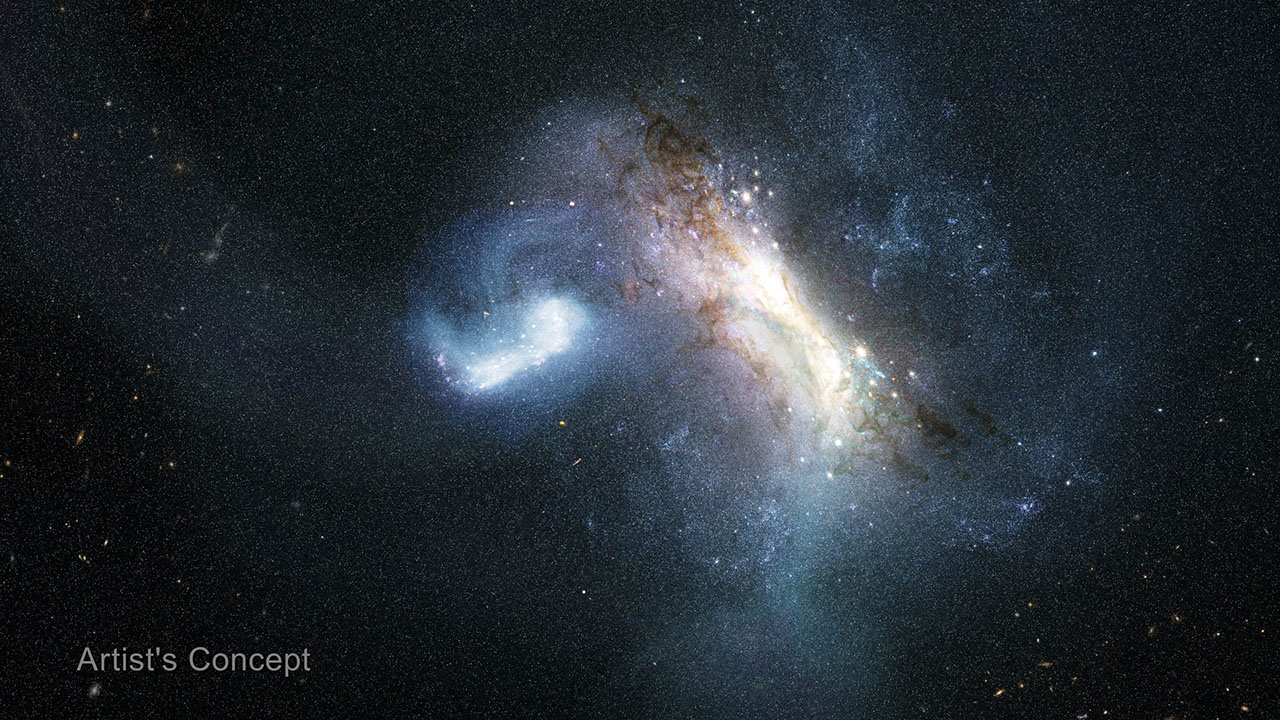
About 12 billion years ago, a dwarf galaxy known as LKH collided and merged with the young Milky Way. This artist’s concept illustrates the ancient galactic merger identified through observations of globular star clusters by NASA’s Hubble Space Telescope.
Illustration: NASA, ESA, Joseph Olmstead (STScI)
Hubble Finds Evidence of an Ancient Galaxy Merger That Helped Build the Milky Way
The Milky Way grew over billions of years by forming new stars and absorbing smaller galaxies. New observations from NASA’s Hubble Space Telescope provide compelling evidence that a dwarf galaxy merged with the young Milky Way approximately 11.8 billion years ago, just 2 billion years after the Big Bang.
The discovery extends the known history of our galaxy by about 1.8 billion years and offers new insight into how the Milky Way became the enormous spiral galaxy it is today.
The study was published Monday in the journal Nature Astronomy.
How the Milky Way grew through ancient galaxy mergers
Today, the Milky Way is a massive spiral galaxy containing hundreds of billions of stars. However, it began as a much smaller system. Over time, it expanded by creating stars from clouds of gas and by collecting stars, gas, and dark matter from neighboring galaxies through gravitational mergers.
One of the Milky Way’s most recent major mergers involves the Sagittarius dwarf galaxy. That interaction began more than 6 billion years ago and is still continuing. Earlier, approximately 10 billion years ago, the Milky Way absorbed a dwarf galaxy known as Gaia-Sausage-Enceladus. Scientists believe that merger significantly influenced the structure of the Milky Way’s stellar disk.
Observations and computer simulations have suggested that an even earlier major merger took place, although the details have remained debated. Hubble’s latest findings provide strong evidence for that previously unknown event, which occurred roughly 11.8 billion years ago.
“Our home is the Milky Way, but we don’t know how our home was built,” said lead author Davide Massari of the Observatory of Astrophysics and Space Sciences in Bologna, Italy. “In this paper, we discover where the first significant brick came from: a dwarf galaxy called LKH.”
Globular clusters reveal the Milky Way’s cosmic history
Reconstructing the early history of the Milky Way is challenging. The galaxy was smaller and more chaotic in its youth, and billions of years of stellar activity can erase many visible signs of ancient collisions. Massive astronomical surveys and precise measurements from spacecraft such as the European Space Agency’s Gaia mission have helped researchers trace those events.
To investigate the distant past, astronomers turned to globular clusters. These dense, nearly spherical groups contain tens of thousands to millions of stars. Because many globular clusters are among the oldest stars in the Milky Way, they act as cosmic archaeological records that can preserve evidence of galaxies absorbed long ago.
“Thanks to the high resolution and depth of the Hubble images, we were able to measure the age and metal content of these clusters with unprecedented precision,” said study co-author Chiara Zerbinati of the University of Bologna in Italy. “Combined with measurements from Gaia, we are now able to distinguish a population of globular clusters that are distinct from other globular clusters. These are star clusters that were born in LKH, which tells us when it was swallowed by our galaxy and how massive it was.”
Hubble identifies a third population of ancient star clusters
The research team examined Hubble observations of 39 globular clusters located within approximately 20,000 light-years of the Milky Way’s center, where evidence of the galaxy’s earliest mergers is most likely to survive.
Scientists expected the sample to include clusters formed inside the young Milky Way as well as clusters captured during the Gaia-Sausage-Enceladus merger around 10 billion years ago. By measuring the precise ages and metallicities—the abundance of elements heavier than helium—of the clusters, researchers identified a third population.
These globular clusters are older than those associated with Gaia-Sausage-Enceladus but younger than clusters formed within the original Milky Way. Their distinct properties indicate that they came from an even earlier merger with a dwarf galaxy.
The researchers named this galaxy the Low-Energy Kraken-Hercules, or LKH, in recognition of three early studies that proposed a major merger during the formative stages of the Milky Way. LKH is estimated to have contained approximately 500 million times the mass of the Sun—a substantial portion of the Milky Way’s mass at that time.
What the LKH merger means for the Milky Way
The discovery shows that the early evolution of the Milky Way was shaped not only by stars born within the galaxy but also by stars formed in other galaxies and later incorporated into it.
“Some past studies have argued that the early stages of our galaxy’s evolution were defined by stars born only within our galaxy,” Massari said. “Here, we showed that we also need to consider stars born in outer galaxies.”
The research team plans to continue studying the Milky Way’s globular clusters to identify and characterize the major mergers that shaped the galaxy throughout cosmic history.
“Hubble has observed a globular cluster that has never been studied before, and this will help characterize merger events that date back far into the history of the Milky Way,” said co-author Fernando Aguado Aguirre of the University of Vigo and the University of La Laguna in Spain.
The Hubble Space Telescope has operated for more than 30 years and continues to make groundbreaking discoveries that advance our understanding of the universe. Hubble is an international collaboration between NASA and ESA. NASA’s Goddard Space Flight Center in Greenbelt, Maryland, manages telescope and mission operations. Lockheed Martin Space supports mission operations at Goddard. The Space Telescope Science Institute in Baltimore, operated by the Association of Universities for Research in Astronomy, conducts Hubble science operations for NASA.
Source: science.nasa.gov