


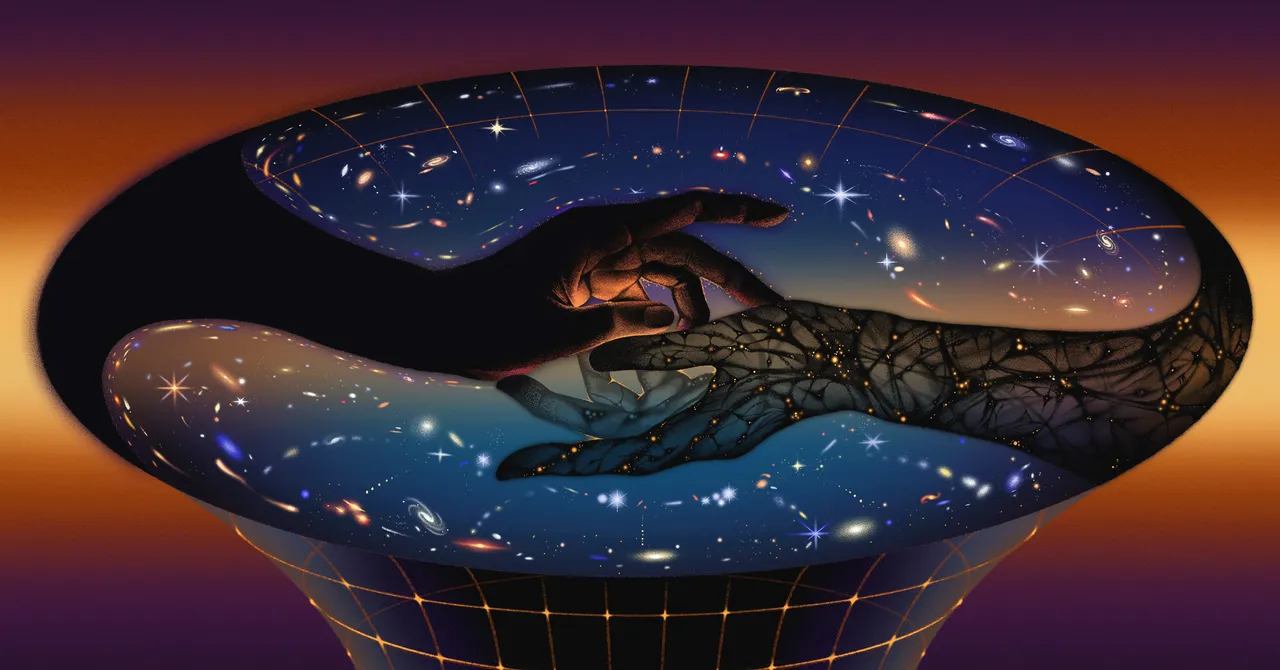
According to the standard model of cosmology, the universe’s expansion rate should be consistent regardless of how it is measured. However, scientists have identified a roughly 9 percent difference between the expansion rate of the early universe and that of the universe today. This discrepancy is known as the Hubble tension.
The conflict “has sparked a heated debate in the cosmology community about whether this difference is due to systematic error or signals new physics,” Teixeira and co-authors write. Their model suggests that if dark energy and dark matter interact, the apparent crisis surrounding the universe’s expansion rate may be an expected feature rather than a measurement error.
The Dark Dimension and the Connection Between Dark Matter and Dark Energy
If dark energy and dark matter interact, they may have a common origin, Corey said.
Ongoing research in string theory—the idea that the universe is composed of tiny, vibrating strings at the most fundamental level—offers possible ways to connect these two mysterious components of the cosmos. In 2019, physicist Cumrun Vafa and two collaborators proposed that dark energy could change naturally. They later concluded that the mass of dark matter particles could also change over time. This work led to the 2022 proposal that dark matter and dark energy may be connected through a so-called dark dimension.
String theory proposes the existence of six or seven additional dimensions beyond the three dimensions of space and one dimension of time familiar to us. These extra dimensions are generally thought to be extremely small—near the Planck scale, or approximately 10-35 meters. However, researchers have proposed that the dark dimension could be substantially larger, potentially reaching the micrometer scale, or around 10-6 meters.
Gravitons—theoretical particles associated with gravity—could leak into this expanded dark dimension. If they did, they would gain mass and become what are known as dark gravitons. These massive particles would exist primarily in the dark dimension, while their gravitational influence would extend into the other dimensions. In this way, dark gravitons could produce the effects normally attributed to dark matter.
In this scenario, “there is a very natural coupling between dark energy and dark matter,” said Georges Oviedo, a physicist at the University of Chicago. Changes in the size of the dark dimension would influence both dark energy and dark matter.
In a paper published in July 2025, Oviedo and Vafa, together with Princeton University’s Alec Bedroya and Harvard University’s David Wu, found that the 2019 scenario is consistent with data from the Dark Energy Spectroscopic Instrument, or DESI. Their model predicts that dark energy’s intensity and the mass of dark matter particles gradually decrease over time. It also predicts that the rate at which dark energy changes is proportional to its energy density. Astrophysical observations show that dark energy has an extremely low energy density, meaning it “doesn’t change rapidly,” Vafa said.
The change is so gradual that “it’s no wonder we didn’t notice it until now,” he said. “We had to wait the entire age of the universe to detect something this small.”
Source: www.wired.com