


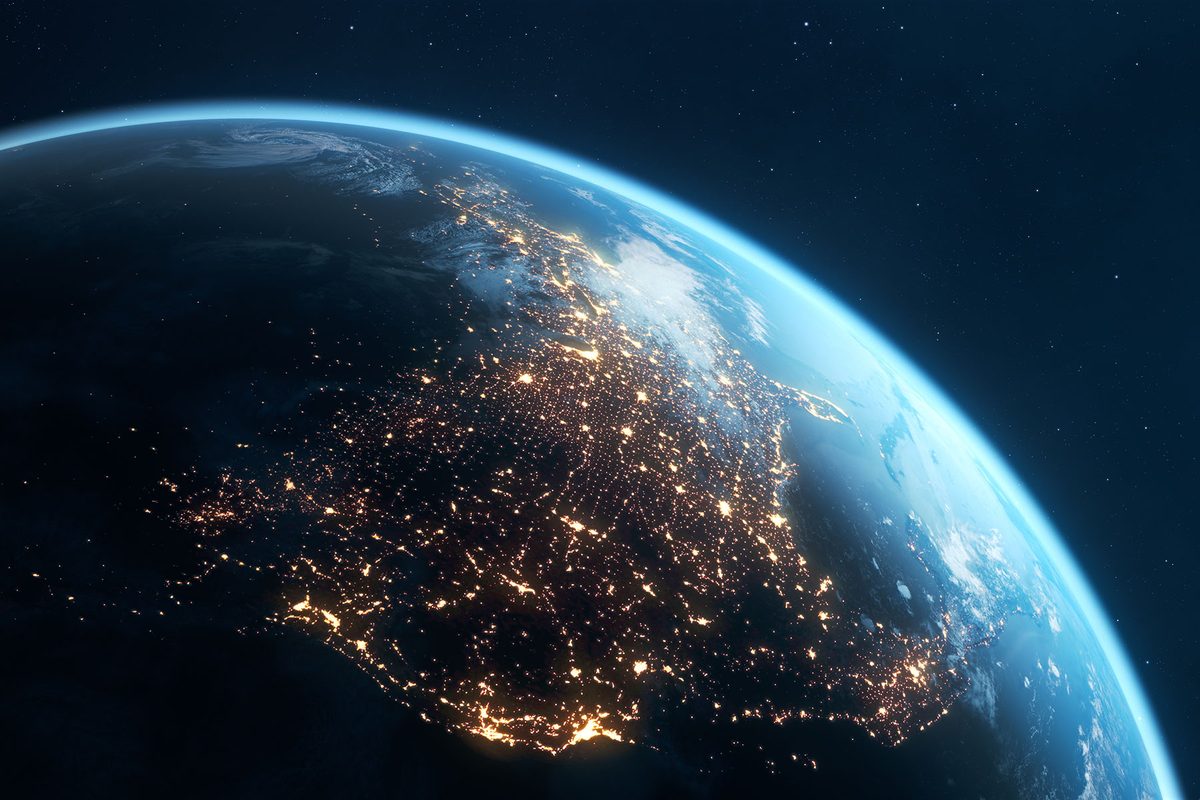
Every day, without you even realizing it, the Earth’s rotation takes a bit longer to complete. Although this change is measured in fractions of a millisecond, the force required to cause it is almost incomprehensibly large.
According to recent research, the rate at which our days are lengthening is currently unprecedented in 3.6 million years of geological history.
The findings indicate that as polar ice sheets and glaciers melt due to climate change, water that was once trapped in high latitudes flows into the ocean, spreading towards the equator.
This mass movement away from the Earth’s poles decelerates its rotation, similar to how a figure skater slows down when extending their arms mid-spin.
Previous studies have shown that climate change already affects Earth’s rotation. A team from the University of Vienna and ETH Zurich examined geological records to determine if the current rates of change have occurred before.
The answer is clearly no.
Investigating Ancient Seashells
The length of a day is not fixed. It is influenced by various factors, including the moon’s gravitational pull, geological processes, and atmospheric changes.
These forces pull and push in different directions, resulting in variations in day length over geological time. Researchers are now proving that climate change is emerging as a dominant force, overshadowing these natural influences.
To trace back millions of years, the researchers focused on fossilized remains of single-celled marine organisms, known as benthic foraminifera, that lived on the ocean floor.
The chemistry of their shells reflects ancient sea level changes. By analyzing these shifts, scientists can calculate alterations in the Earth’s rotation.
Using specially designed machine learning algorithms adept at handling ancient data, researchers have drawn robust conclusions from material dating back to the late Pliocene epoch, approximately 3.6 million years ago.
Throughout this timeline, one data point stands out: today.
The current rate of day lengthening due to climate change (1.33 milliseconds per century) may seem trivial, but the required mass redistribution is immense when considering the forces at play.
“Such a change in day length requires an incredible redistribution of mass, moving around 1,000 gigatons from polar regions to the oceans,” says Professor Benedict Soja from ETH Zurich, co-author of the study. “To visualize this, imagine a solid cube of ice standing 10 km high, higher than Mount Everest, placed on top of New York City.”
Regarding the energy needed for this transformation, Dr. Mostafa Kiani Shahvandi, the study’s lead author and Ph.D. from the University of Vienna, explains it in simpler terms: “The change in Earth’s rotational energy is equivalent to a magnitude 9.0 earthquake,” denoting planetary power rather than destruction.
Surpassing the Moon by 2100
Researchers identified a geological moment from about 2 million years ago when change rates were similar to those observed today. However, this was an exceptional situation.
“A ‘perfect storm’ of fragile ice sheets combined with a natural surge in carbon dioxide led to massive melting of polar ice sheets,” Soja stated. “This rare event has not been naturally replicated since, but human activities have matched that force in just over a century.”
Where do we go from here? In a future heavily reliant on fossil fuels with high emissions, climate change is projected to become the leading driver of day length changes by the century’s end, potentially exceeding even the moon’s gravitational pull.
Though milliseconds might seem insignificant, this change carries substantial implications for ultra-high precision timing vital for GPS navigation on Earth and spacecraft navigation throughout our solar system, according to Soja.

Moreover, the planetary alterations we induce are reflective of our extensive impacts on Earth’s ecosystems. Significant mass redistribution will likely coincide with more extreme weather events and rising sea levels, profoundly affecting where people can live safely in the future.
“The crucial aspect is that humans have significantly influenced the Earth system to the extent that even its rotation is changing,” noted Soja.
As for future research directions, the team is investigating other ways human activities are altering mass distribution on the planet, particularly due to groundwater depletion and climate change. Early estimates suggest these impacts are smaller than those from melting ice and glaciers, but a fuller understanding is essential to grasp precisely how and how quickly Earth’s rotation is changing.
Read more:
Source: www.sciencefocus.com