


Editor’s note: This article reveals the answer to September’s puzzle.
Vasquez Rocks: The Otherworldly Geology Behind a Famous Star Trek Filming Location
Rising dramatically from the arid landscape of Southern California’s Soledad Basin, Vasquez Rocks Natural Area is known for its sharply tilted sandstone formations and spectacular desert scenery. The sedimentary rock layers in this region are tilted to an average angle of approximately 50 degrees, creating ridges and rocky fins that appear to point toward the sky.
The unusual landscape has also made Vasquez Rocks one of the most recognizable filming locations in science fiction. The formations became a favorite backdrop for Star Trek after Captain James T. Kirk battled the Gorn among the jagged rocks during the series’ first season. That symbolic battle helped establish Vasquez Rocks as an iconic alien landscape for generations of viewers.
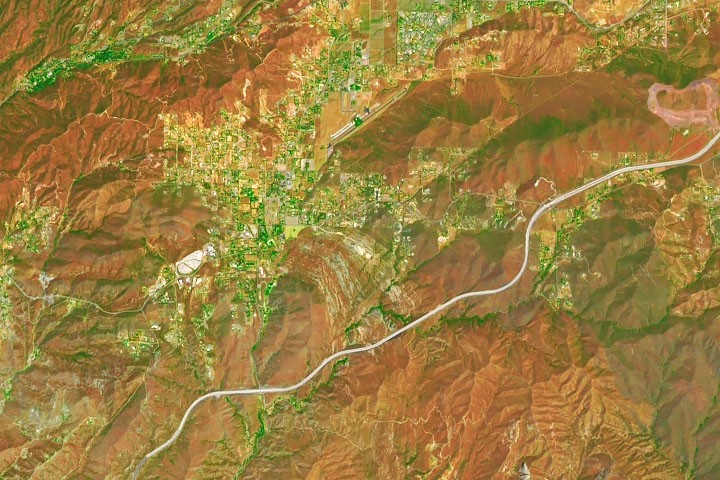
Although the rocks are less dramatic when viewed from orbit, they are clearly visible as a gray band between surrounding mountain ranges in these false-color and natural-color images captured by Landsat 9’s Operational Land Imager (OLI). The false-color Band 6-5-4 composite combines shortwave-infrared and near-infrared observations to emphasize differences in vegetation and moisture. By comparison, the natural-color image more closely resembles what the landscape looks like to the human eye.
Vasquez Rocks did not always stand at such a steep angle. The formations began developing about 25 million years ago, when sediment accumulated across an alluvial fan—a cone-shaped deposit that forms when a fast-flowing stream leaves a mountainous area and spreads onto a flatter plain. Much of the sediment was likely eroded from nearby highlands and transported only a short distance.
Over time, the deposits were buried, compressed, and cemented into thick layers of sandstone and conglomerate. These sedimentary rocks preserved the ancient history of the Soledad Basin, while later tectonic forces transformed their original horizontal arrangement.
The region lies near the San Andreas Fault, where the Pacific and North American plates move past one another along a strike-slip fault boundary. The Pacific Plate is moving northwest relative to the North American Plate, producing powerful tectonic forces throughout Southern California.
Over millions of years, this tectonic activity uplifted and deformed the Soledad Basin. The sedimentary layers were tilted, folded, and rotated. Once exposed at the surface, the rocks were sculpted by weathering and erosion. Softer material wore away more quickly, leaving behind the durable sandstone and conglomerate ridges that make Vasquez Rocks so distinctive today.
The dramatic formations have represented distant planets and moons in numerous productions. In addition to the original Star Trek series, Vasquez Rocks appeared in later episodes and films, including scenes depicting Vulcan, Spock’s home planet. The location has also been featured in dozens of other television shows and movies, including Westworld, For All Mankind, and Battlestar Galactica.
NASA Earth Observatory images by Michala Garrison, using Landsat data from the U.S. Geological Survey. Story by Adam Voiland.
July 28, 2026: False-Color Landsat Image
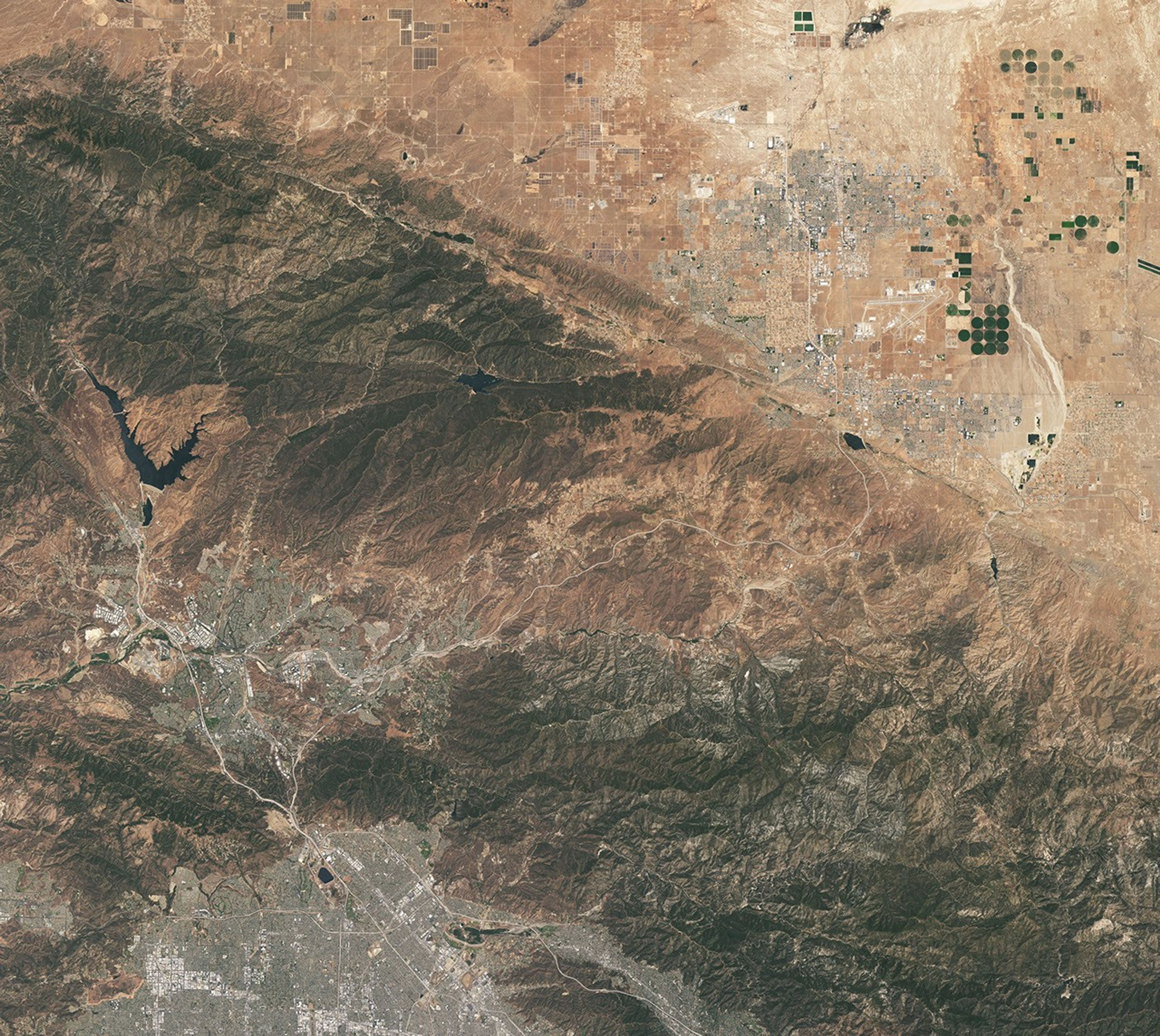
July 28, 2026: Natural-Color Landsat Image
Sources
- Los Angeles County Department of Parks and Recreation. Vasquez Rocks Natural Area. Accessed September 4, 2026.
- Directors Guild of America. Vasquez Rocks. November 2003. Accessed September 4, 2026.
- Hendricks, E., and Ingersoll, R. (1987). Tectonics and alluvial deposition of the Upper Oligocene/Lower Miocene Vasquez Formation, Soledad Basin, Southern California. Geological Society of America Bulletin, 98(6), 647–663.
- Los Angeles Times. How Vasquez Rocks, LA’s former outlaw hideout, became “Star Trek’s” favorite alien landscape. September 8, 2016. Accessed September 4, 2026.
- NASA. 55 years ago: Star Trek debuts and begins a lasting relationship with NASA. September 8, 2021. Accessed September 4, 2026.
- Painter, D. (2023). Didn’t you see these rocks in the movies? Yes, of course—it’s Vasquez Rocks. Accessed September 4, 2026.
- Santa Clarita Valley Historical Society. Vasquez Rocks, California | Natural History. February 23, 2026. Accessed September 4, 2026.
- ScreenRant. All 10 episodes of Star Trek were filmed at Vasquez Rocks in California. May 26, 2024. Accessed September 4, 2026.
- SCVHistory. Land of Sunny Slopes: A History of Vasquez Rocks. Accessed September 4, 2026.
- Space.com. Trekkies celebrate the 60th anniversary of Star Trek. September 4, 2026. Accessed September 4, 2026.
Source: science.nasa.gov