


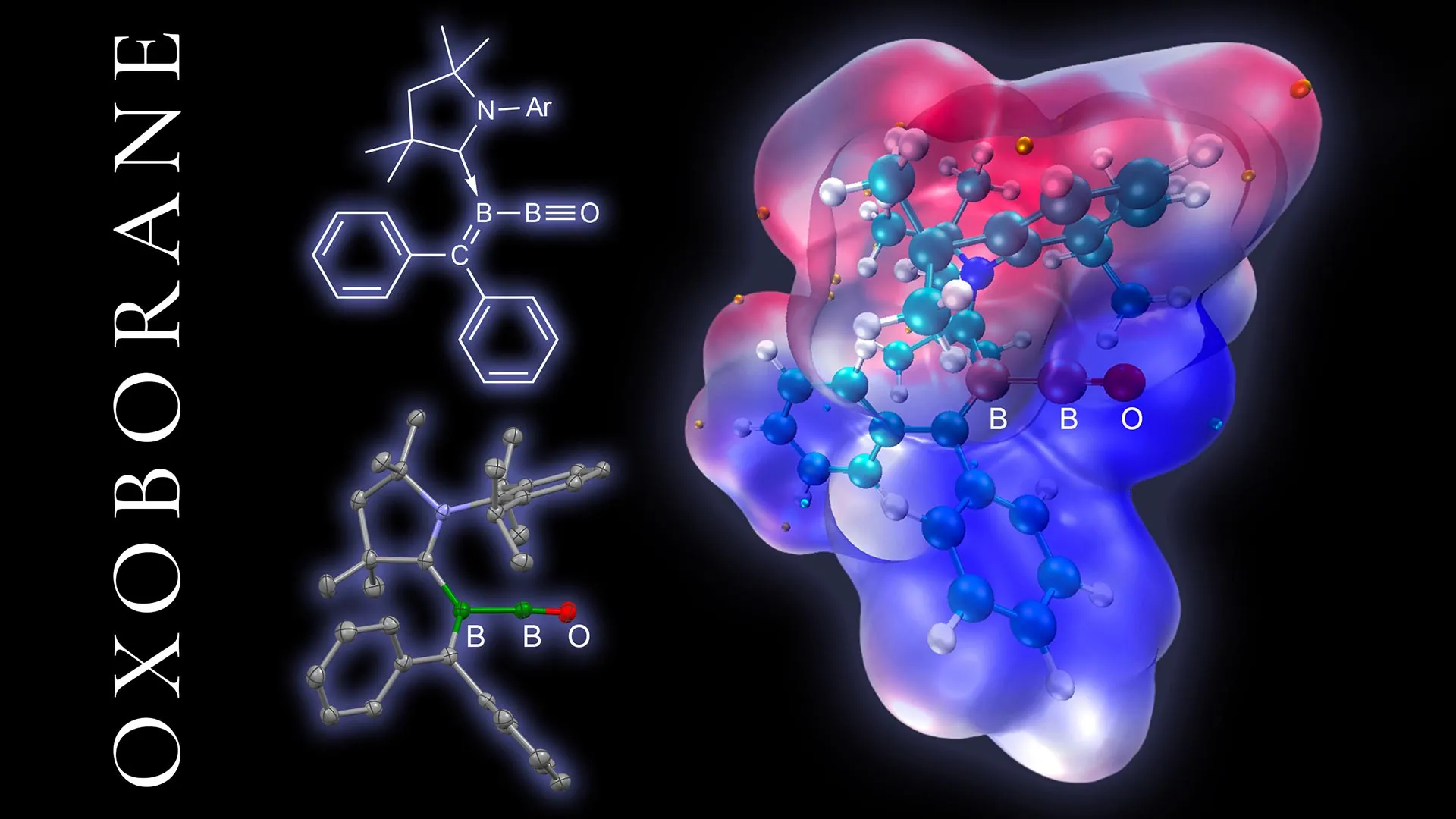
Scientists at the University of Würzburg in Germany have developed a method for producing and isolating oxoboranes, a class of molecules that researchers have struggled to study for more than 60 years because of their presumed instability. The discovery, led by Professor Holger Braunschweig with computational support from Professor Ashwini K. Phukan’s team at Tezpur University in India, produced three different oxoboranes and could provide a new route to other elusive compounds.
Overcoming a long-standing chemistry challenge
The results were published in Nature Chemistry. The work addresses a major challenge involving boron, an element that rarely forms triple bonds—chemical bonds in which two atoms share three pairs of electrons.
Braunschweig has spent more than 15 years developing molecules with unusual bonds, including bonds involving boron. In 2012, his research team reported the first molecule containing a triple bond between two boron atoms. In 2025, researchers achieved another milestone by producing the first neutral molecule with a triple bond between boron and carbon.
One major challenge remained among the elements in the first row of the p-block of the periodic table: the isolation of a stable organic oxoborane, a molecule characterized by a triple bond between boron and oxygen.
Chemists have studied oxoboranes since at least the early 1960s. Researchers working in organic and inorganic chemistry have detected and captured these compounds under extreme conditions, while other experiments have provided indirect evidence of their existence. Several related derivatives have also been produced, but stable oxoboranes that could be isolated and examined remained out of reach.
An unexpected reaction produces oxoboranes
The breakthrough came from an experiment that was initially intended to investigate a different reaction. University of Würzburg PhD students Lukas Lupczyk and Christian Markl were independently studying how a compound called diboracumulene reacted with various ketones, which are commonly used in organic synthesis.
The researchers noticed an unexpected result. The reactions produced a characteristic orange or yellow solid, but further analysis showed that oxoborane was the main product.
“This discovery was a pleasant surprise. I had no idea that divoracumulene would react in this way, let alone with several different simple substrates. And when Christian came to me with the compound, I knew we were on to something,” says Lukas Lubczyk.
The result was particularly surprising because other chemical outcomes initially appeared more likely. After decades of unsuccessful efforts to isolate oxoboranes, the researchers found that the molecules could form unexpectedly from relatively simple starting materials.
“Almost everyone in the field had given up on oxoboranes because they were thought to be too unstable to isolate. So we were stunned to see that oxoboranes formed spontaneously in these reactions and persisted long enough to be studied,” says Holger Braunschweig.
A potential route to other rare compounds
Using the new method, the scientists prepared three different oxoboranes. Its success with multiple compounds suggests that the approach could provide access to a wider range of oxoboranes that have previously been difficult to isolate.
The team is now investigating how broadly the method can be applied. In addition to producing further oxoboranes, the researchers want to determine whether a similar strategy could create other elusive compounds containing elements from across the periodic table.
The discovery resolves a problem that has challenged chemists for more than 60 years and demonstrates how unexpected reactions can reveal chemical possibilities once considered inaccessible.
International collaboration and funding
The study was conducted by the Würzburg research team in collaboration with researchers led by Professor Ashwini K. Phukan of Tezpur University in India. Phukan’s computational work supported the research.
Funding came from the German Research Foundation (DFG), the German Academic Exchange Service (DAAD), and the Indian Department of Science and Technology (DST).
Source: www.sciencedaily.com