


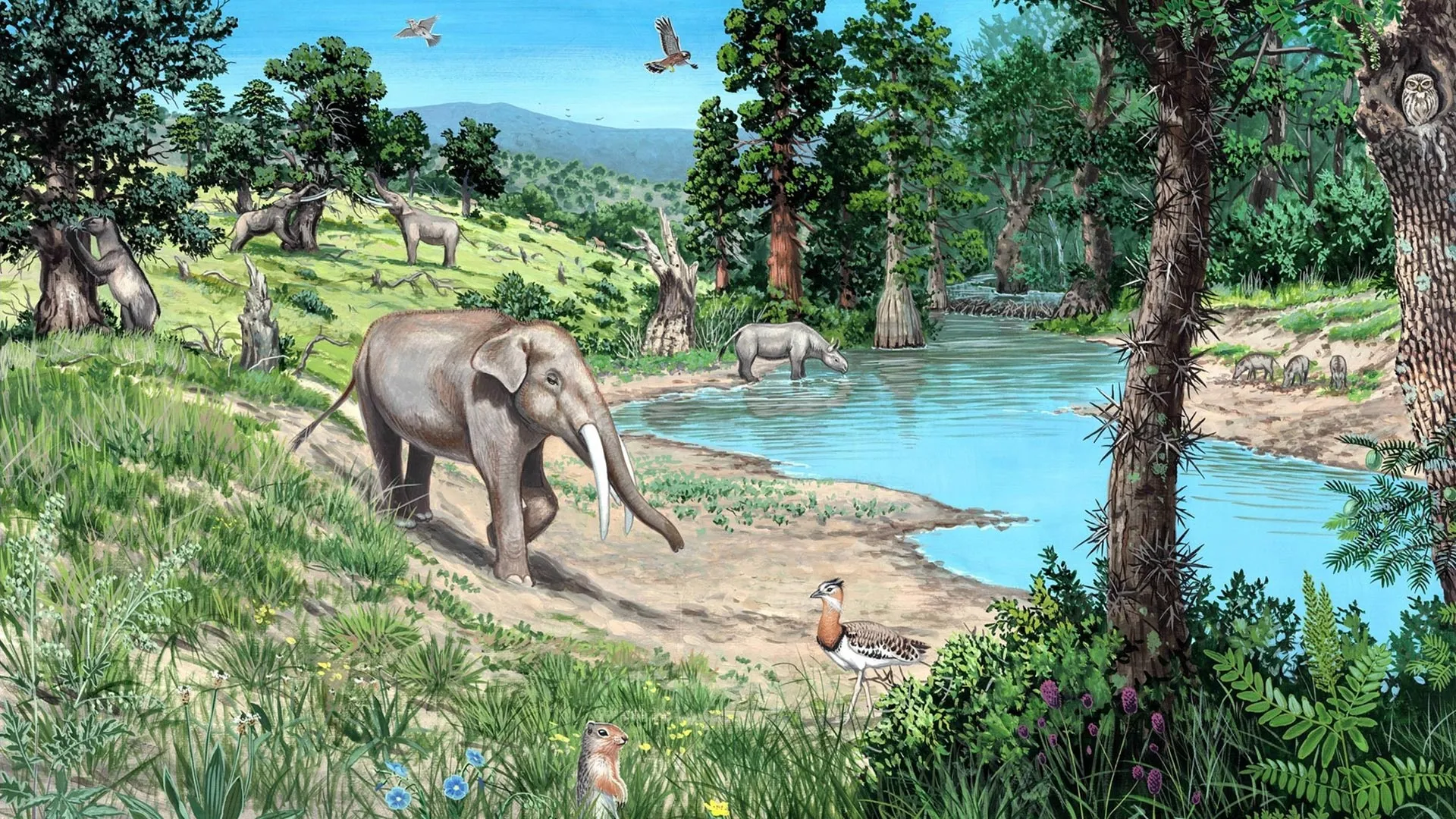
Europe’s ancient landscape was probably not dominated by vast, unbroken forests, according to a major study led by Aarhus University. Evidence spanning more than 20 million years suggests that much of the continent consisted of shifting mosaics of scattered trees, open woodlands, grasslands, and wildflower-rich meadows. Large herbivores such as elephants, rhinos, aurochs, and bison helped keep these habitats open, challenging the long-standing assumption that dense forest represented Europe’s original wilderness.
The findings, published in Biological Conservation, question the “closed forest paradigm” that has influenced conservation policy for decades. They also raise concerns about tree-planting programs that prioritize dense forests as a way to combat climate change and protect biodiversity.
“This study shows that current afforestation efforts are going in the wrong direction. Here in Denmark, subsidies are given only for planting dense forests, but also in other parts of Europe. This is not only detrimental to biodiversity, but also goes directly against the type of ecosystem in which European species have evolved over millions of years,” says Professor Jens Christian Svenning from the Center for Neobiosphere Ecodynamics (ECONOVO), a biologist at Aarhus University and the study’s lead author.
Challenging the myths of Europe’s ancient forests
The closed forest paradigm holds that, before humans cleared land for agriculture and settlements, Europe was covered largely by dense forests with nearly continuous tree canopies. Under this view, restoring nature often means allowing trees to reclaim open areas or planting forests where they have disappeared.
The new research suggests that this picture overlooks important parts of Europe’s ecological history. Rather than being uniformly forested, the continent appears to have contained varying combinations of grasslands, shrubs, and woodlands with different levels of tree cover.
These landscapes supported species adapted to both forest and open environments. Large herbivores also helped maintain that diversity through grazing and by disturbing vegetation and soil as they moved through the landscape.
What 23 million years of evidence reveals
To reconstruct Europe’s ancient environments, the researchers examined an unusually extensive paleoecological record covering the period from the Miocene, which began about 23 million years ago, to pre-industrial times.
Paleoecology uses clues preserved in fossils, sediments, and other natural records to study ancient ecosystems. Because no single type of evidence can provide a complete picture of the distant past, the team combined several independent methods.
The evidence included fossilized pollen and large plant remains, charcoal from ancient wildfires, and chemical traces preserved in the teeth and bones of plant-eating animals. The researchers also examined insect and mammal fossils, along with ancient environmental DNA recovered from sediment.
Environmental DNA consists of genetic material left behind by organisms in their surroundings. When preserved in ancient deposits, it can help scientists identify plants and animals that lived in an area long ago.
Combining these sources allowed the researchers to reconstruct not only which types of vegetation were present, but also how ecosystems changed over time and how animals influenced their environments.
“Each type of proxy provides a unique perspective, but by combining them we can see whether a landscape is covered by dense forest, open grassland, or a mixture of the two. By combining these datasets across time (from the Miocene to the pre-industrial era), we can… We were able to track long-term changes in vegetation and the role of large herbivores with much higher reliability than previous studies using only one method,” explains Simon Czeszewski, an ECONOVO PhD student at Aarhus University and the study’s lead author.
The evidence shows a consistent pattern: for more than 20 million years, European landscapes were typically shifting mosaics of trees, open spaces, and flowering plants rather than continuous closed forests.
These mixed landscapes were not limited to a particular climate. They existed during both warm and cold periods, as well as under temperate conditions comparable to those found in many parts of Europe today.
European wilderness shaped by elephants, rhinos, and bison
One of the study’s most notable findings concerns the influence of large wild herbivores.
Ancient Europe was home to animals including elephants, rhinos, aurochs, and bison. By eating vegetation and disturbing the ground, these animals helped keep parts of the landscape open. Their activity created opportunities for grasses, wildflowers, and other plants that might otherwise have struggled beneath dense tree cover.
This ongoing interaction between animals and vegetation helped maintain a diverse range of habitats and provided suitable conditions for many species.
Much of that ecological influence is absent from modern Europe. Many of the large herbivores that once shaped the landscape have disappeared, while traditional grazing practices have declined.
“Ecosystems found in Europe today lack the large wild herbivores that not only shaped the landscape but also maintained its biodiversity for millions of years. The most dramatic changes have occurred primarily within the last 100 years, when traditional large-scale grazing has disappeared from large parts of the landscape,” Czeszewski says.
The loss of grazing pressure has altered how vegetation develops across much of the continent, helping explain why many European ecosystems differ from those of the distant past.
Ancient woodlands were rich in wildflowers
The study also offers a different perspective on species commonly associated with farmland and other human-managed environments.
Birds such as larks and jackdaws are often viewed as features of agricultural landscapes, as is the European hamster. However, the researchers suggest that their evolutionary history may reach back to open forest environments that existed long before modern agriculture.
Familiar wildflowers may also be connected to these ancient ecosystems. Wild poppies are often found on farmland today, but they also thrived in areas where large herbivores disturbed vegetation within ancient forests.
These findings challenge the sharp distinction between “forest” and “open habitat” that often guides conservation planning. In Europe’s ecological past, trees, meadows, shrubs, and grazing animals were not necessarily separate elements of nature. They frequently occurred together, forming interconnected habitats that supported diverse wildlife.
Why planting more trees may not always benefit nature
The findings come as European countries continue to expand forests to capture carbon, address climate change, and restore biodiversity.
Forests can provide important environmental benefits. However, if the goal is to restore Europe’s native ecosystems, the researchers argue that planting uniformly dense forests across large areas may not always be the best approach.
Many European species evolved in landscapes combining trees and open spaces. Converting these habitats into continuous, closed-canopy forests could reduce the range of environments available to wildlife.
The study suggests that restoration efforts should place greater emphasis on maintaining diverse landscapes, including open grasslands, scattered woodlands, and areas shaped by natural grazing.
“Instead, restoration efforts should focus on creating and maintaining a mosaic of forest and open habitat, especially through the restoration of naturally occurring large herbivores,” Svenning concluded.
The findings add to a growing body of research from the same scientific group indicating that megafauna played a much larger role in shaping Europe’s ecosystems than previously recognized.
They also support the idea that Europe’s ancient landscapes were generally brighter, more open, and more diverse than the dense primeval forests often depicted in popular imagery. Protecting biodiversity may require more than planting trees; it may involve rebuilding the complex balance of forests, pastures, and herbivores that shaped the continent over millions of years.
Source: www.sciencedaily.com