


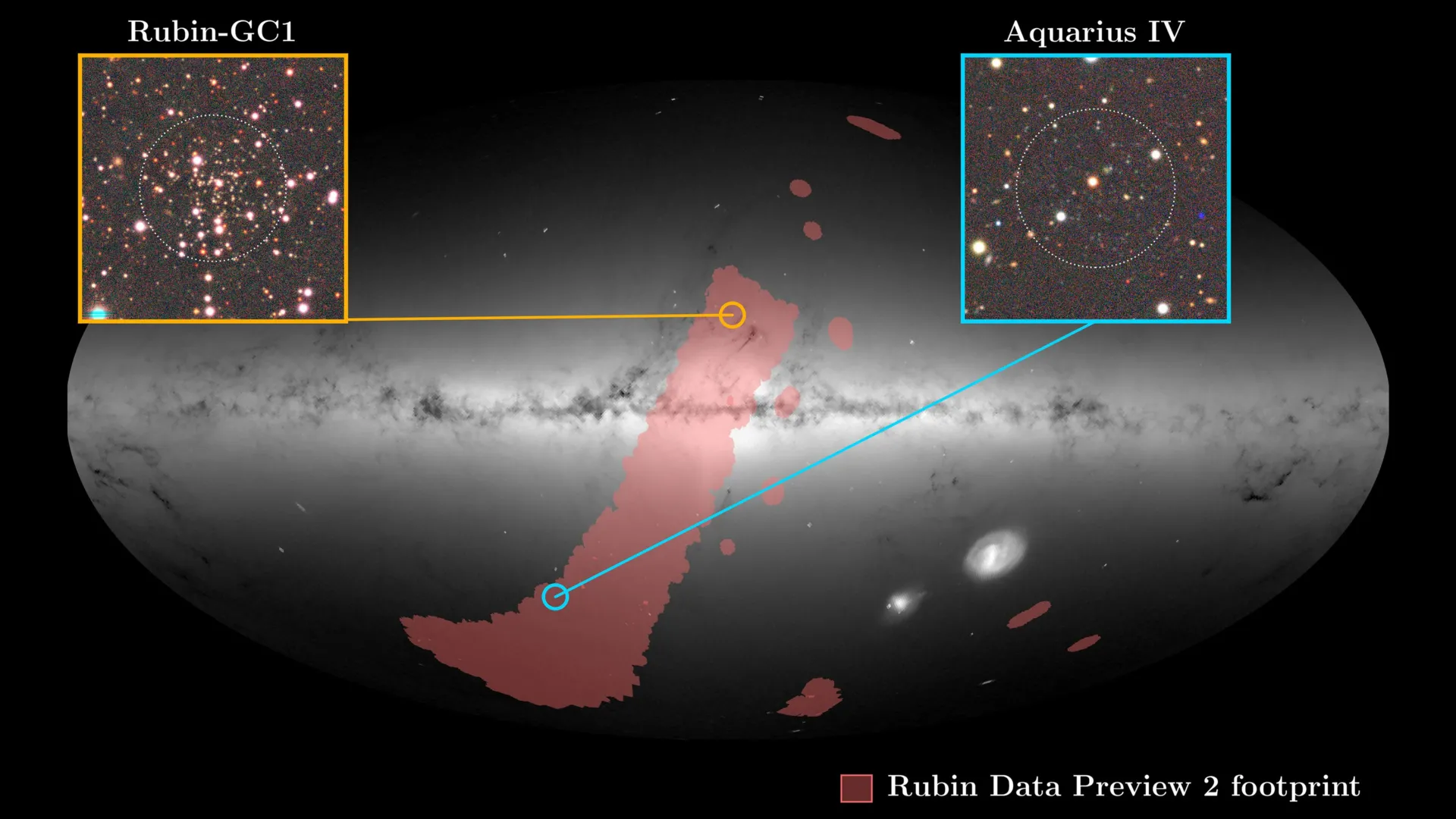
The Vera C. Rubin Observatory in Chile has discovered two previously unknown companions of the Milky Way in observations covering only about 7% of the night sky. The findings suggest that the observatory could uncover many more faint satellite galaxies and star clusters, potentially helping astronomers investigate galaxy formation, the Milky Way’s history and the nature of dark matter.
Located at Cerro Pachón in the Chilean Andes, the recently completed National Science Foundation–U.S. Department of Energy Vera C. Rubin Observatory is designed to survey the sky in exceptional detail. Its early observations have already revealed two elusive objects that had escaped previous searches, demonstrating the telescope’s ability to detect some of the faintest structures in the Milky Way’s neighborhood.
Two hidden companions of the Milky Way
Large galaxies such as the Milky Way are surrounded by smaller systems known as satellite galaxies. These include dwarf galaxies and star clusters, many of which contain very few stars and are consequently difficult to detect. Astronomers have identified about 65 satellite galaxies around the Milky Way, but some estimates suggest that hundreds more may remain undiscovered.
Two new studies, including one led by astronomers at Yale University, indicate that Rubin could play a major role in finding these missing objects and completing the picture of the region around our galaxy.
Using observations collected before the observatory’s official launch, researchers identified two extremely faint satellites that had never been seen before.
The first, Aquarius IV, is a small galaxy on the outskirts of the Milky Way, approximately 355,000 light-years from Earth. The second, Rubin GC1, is a star cluster on the opposite side of the galaxy. It lies behind thick clouds of cosmic dust that make the region particularly difficult to observe.
Both discoveries are notable because they were made using only a small amount of the data Rubin is expected to collect during its planned lifetime.
“What I find particularly exciting is that these discoveries are just the beginning for Rubin,” said William Cerny, an astronomy student at Yale University’s School of Arts and Sciences.
Cerny is the lead author of the Aquarius IV study, published in AAS Research Notes, and the second author of the Rubin GC1 study, published in Astrophysical Journal Letters.
“If the observatory can find such a faint and difficult system with only preview data, a full 10-year search will no doubt yield the discovery of many more Milky Way moons,” Cerny said. “These new satellites give us new opportunities to test models of galaxy formation, trace the history of the Milky Way’s assembly, and investigate the nature of dark matter.”
A 10-year survey of the changing sky
In June, Rubin began its ambitious 10-year Legacy Survey of Space and Time, or LSST. The project aims to create highly detailed records of changes in the night sky while revealing celestial objects that previous telescopes could not detect.
One of the survey’s main scientific goals is to map the Milky Way’s halo, the vast, nearly spherical region surrounding the galaxy’s main disk. The halo contains scattered stars, gas and dark matter, along with faint satellite galaxies, star clusters and other structures that preserve clues about the Milky Way’s past.
To conduct the survey, Rubin will use the 8.4-meter Simonyi Survey Telescope and the largest digital camera ever built. The camera can capture images at a resolution of 3.2 gigapixels. By repeatedly photographing broad areas of the Southern Hemisphere sky, the observatory will build an exceptionally comprehensive time-lapse record of the universe.
The facility is jointly funded by the National Science Foundation and the U.S. Department of Energy’s Office of Science.
Discoveries from just 7% of the night sky
For the new research, astronomers examined preview observations collected between April 2025 and January 2026. Although the images covered only about 7% of the night sky, they were sufficient to reveal the two previously unknown Milky Way satellites.
The result offers an encouraging indication of what Rubin may find as it gathers data across much larger areas of the sky.
“Finding new Milky Way satellites from Rubin Observatory data has been an exciting prospect for most of my career,” said Mara Geha, a professor of astronomy and physics at Yale University’s School of Arts and Sciences and a co-author of both studies. “It’s amazing that this has become a reality.”
The research involved extensive international collaboration. Participating institutions included Yale University, the University of Chicago, the University of Virginia, the University of Washington, Dartmouth College, the University of Tampa, NSF NOIRLab, Duke University, the University of Toronto, the Andalusia Institute for Astronomy in Spain, the University of Colorado Boulder and Lund University in Sweden.
Aashy Pai of the University of Chicago was the lead author of the study describing Rubin GC1.
Faint satellites could illuminate dark matter
Finding more Milky Way satellites could do more than expand the known population of galaxies surrounding our own. These faint objects could also help astronomers investigate one of the universe’s greatest mysteries: dark matter.
Dark matter is invisible because it does not emit or reflect light, so it cannot be observed directly with conventional telescopes. Scientists infer its existence from its gravitational effects on stars, galaxies and other cosmic structures. It makes up most of the matter in the universe and provides much of the gravitational framework that holds galaxies together.
Ultra-faint galaxies such as Aquarius IV are particularly valuable for dark-matter research. They contain only a small fraction of the stars found in larger galaxies, while dark matter accounts for most of their total mass. By studying the properties and movements of these systems, researchers can test theories about how dark matter behaves and how it influences galaxy formation.
The discoveries could also help scientists reconstruct the Milky Way’s long history. The positions, motions and properties of small satellite galaxies can reveal how larger galaxies assembled over billions of years, including how they accumulated matter and interacted with smaller stellar systems.
Rubin’s early findings may provide additional clues about how the smallest and faintest galaxies in the universe form, evolve and persist.
“These findings are very promising,” Geha said. “Continuing discoveries will enable us to complete the survey of satellite galaxies around the Milky Way, which is key to understanding how the faintest galaxies form.”
Source: www.sciencedaily.com