


James Webb Space Telescope Finds Unexpected Changes in Chariklo’s Rings
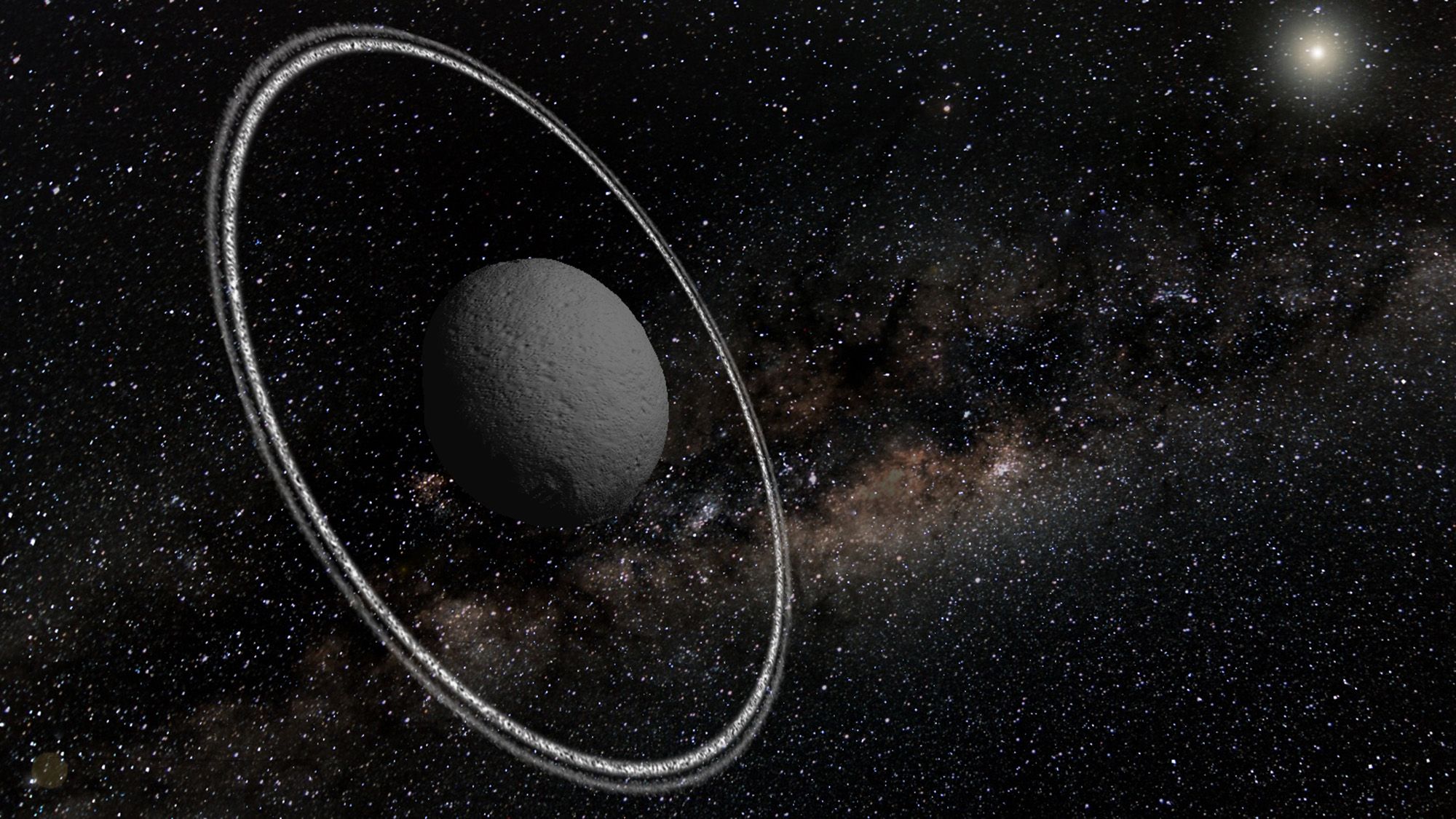
New observations from the James Webb Space Telescope (JWST) suggest that the rings around Chariklo—a strange, small body orbiting between Saturn and Uranus—look significantly different from previous observations.
Chariklo is a centaur, a type of object that shares characteristics with both asteroids and comets. It is about 250 kilometers (155 miles) across and belongs to a larger population of small bodies in the distant solar system.
Chariklo’s rings have changed over the past decade
Scientists discovered Chariklo’s rings in 2013. They were the first rings found around a small solar system object. Ground-based telescopes studied the rings in 2014 and again in 2017.
When JWST observed Chariklo in 2022, researchers found that the two rings had changed in opposite ways. The inner ring appeared significantly more opaque, while the outer ring appeared less opaque, according to a study published Sept. 9 in Science Advances.
“By comparing JWST observations with observations obtained over the past decade, we found opposite changes in the two rings: the inner ring shows significantly higher opacity, while the outer ring shows lower opacity,”
Pablo Santos Sanz, the study’s lead author and a researcher at the Andalucía Institute of Astrophysics
Why do Chariklo’s rings look different?
Researchers do not yet know exactly what caused the apparent changes. The study authors proposed three possible explanations:
- JWST’s high resolution may have allowed scientists to observe both denser and sparser regions of the rings than earlier telescopes could detect.
- The material or particles making up the rings may have changed.
- JWST may have detected wavelength-dependent optical properties, meaning that the particles’ composition and size affected how the rings appeared in different wavelengths of light.
Professor Santos Sanz said the findings suggest that even small objects far from the gravitational influence of planets may undergo more systematic changes than scientists previously realized.
“Our results force us to rethink how they form, how they evolve and what mechanisms maintain their stability,”
Pablo Santos Sanz
The researchers say future observations will be important for determining whether the differences reflect genuine changes in the rings over time or effects caused by wavelength-dependent scattering.
How astronomers study Chariklo’s rings
Chariklo’s rings are too thin to be imaged directly. Instead, astronomers study them using a technique called a stellar occultation.
During an occultation, Chariklo passes in front of a distant background star from the telescope’s perspective. As the body and its rings block some of the star’s light, scientists measure changes in brightness. Those changes reveal information about the rings’ structure and opacity.
The same general technique is used to study other objects, including the atmospheres of planets and worlds beyond the solar system.
JWST’s first dedicated stellar-occultation campaign
The new Chariklo observations marked the first time scientists planned a JWST observation campaign specifically focused on stellar occultations. Precise timing was essential because researchers needed to observe Chariklo as it passed in front of a particular distant star.
Chariklo’s apparent motion during the event was about 1.5 miles per second (2.5 kilometers per second), allowing JWST to study the rings in greater detail. Researchers used data from the European Space Agency’s Gaia mission, which has mapped more than 2 billion stars, to help time the observation.
They also calculated JWST’s orbit. The telescope is located about 930,000 miles (1.5 million kilometers) from Earth, on the opposite side of the Sun. The researchers described planning and carrying out the observation as requiring “extreme precision.”
Additional observations during Chariklo’s next stellar occultation could help confirm the results, including the apparent decrease in opacity on one side of the ring system and increase on the other.
“These observations will help disentangle the temporal evolution from wavelength-dependent scattering effects and elucidate the physical processes that form Chariklo’s rings,” the researchers wrote in their study.
Study details
Santos-Sanz, P., Gomez-Jr., A.R., Morgado, B.E., Kilic, Y., Karup, C., Kiss, C., Pereira, C.L., Holler, B.J., Morales, N., Ortiz, J.L., Sicardi, B., Rizos, J.L., Stansbury, J., French, R.G., Hammel, H.B., Lin, Z., Souami, D., Desmers, J., Milam, S.N., and Vara-Rubiano, M. (2026). “JWST’s stellar occultation reveals unexpected changes in Chariklo’s ring system.” Science Advances, 12(37), eaeh4794.
Topics: James Webb Space Telescope, Chariklo, planetary rings, centaurs, solar system
Source: www.livescience.com