


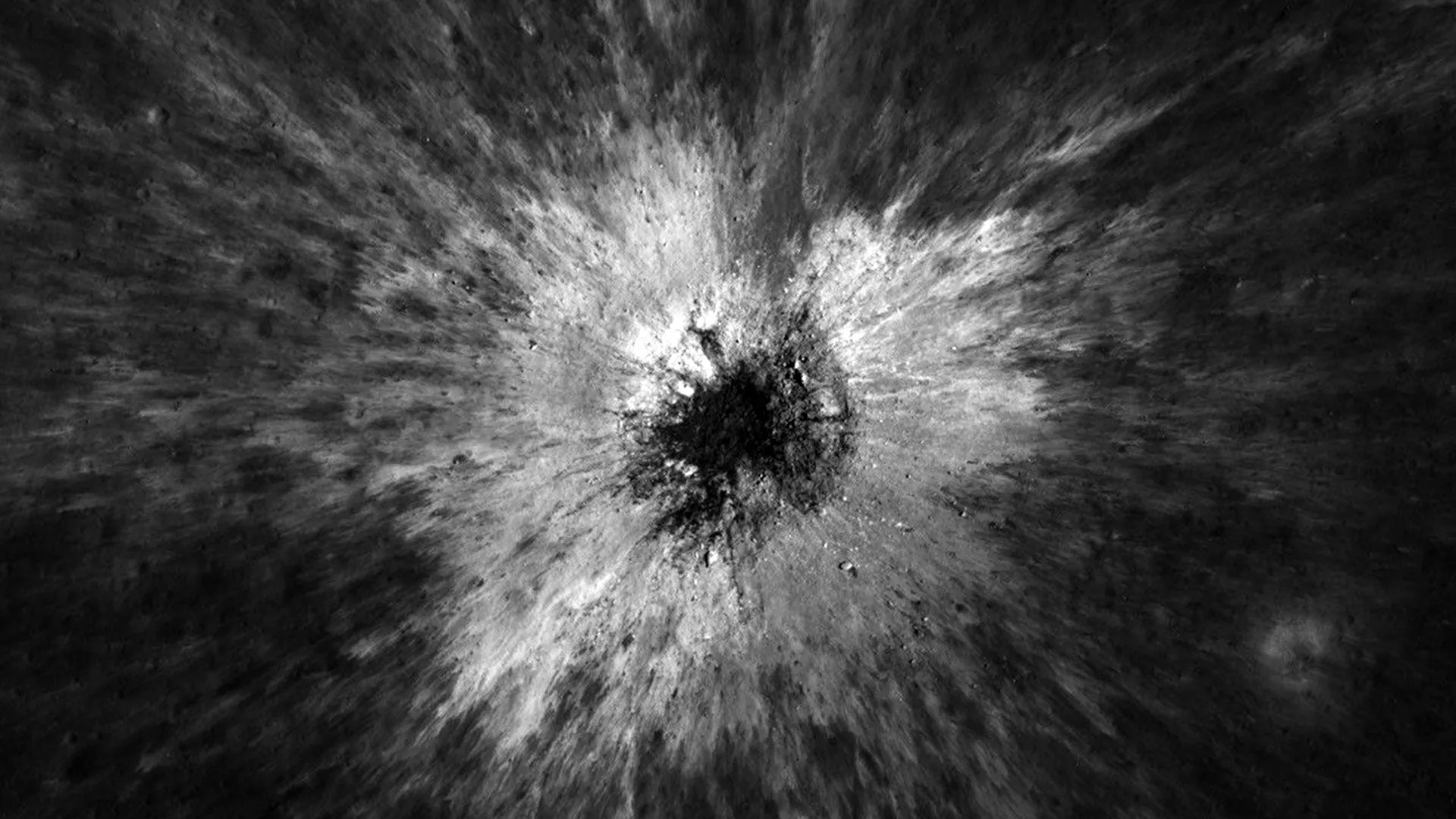
NASA Discovers the Largest Newly Formed Crater Ever Seen on the Moon
Routine analysis of lunar surface data has led NASA scientists to an unexpected discovery: a huge, newly formed impact crater on the Moon.
A bright spot revealed a massive lunar impact
Robert Wagner, a scientist working with NASA’s Lunar Reconnaissance Orbiter (LRO), was studying a large map of the Moon when he noticed something unusual on his computer screen: an exceptionally bright spot surrounded by a dark halo.
The pattern suggested that material on the lunar surface had recently been disturbed.
“I just stopped, dropped everything, and started looking at what the place was,” said Wagner, an image-processing specialist at Intuitive Machines who works with data from the Lunar Reconnaissance Orbiter Camera (LROC) system.
After comparing older and newer images of the same area, Wagner realized that the feature was a newly formed impact crater. Scientists reported the discovery on September 16. They identified it as the largest newly formed crater ever observed in the solar system.
The discovery demonstrates how long-term lunar observations can help NASA track changes on the Moon’s surface as the agency works toward a sustained human presence, along with expanded scientific and commercial activity.
Rare impact created a giant lunar crater
The crater was officially named McGettin after pioneering lunar scientist Tom McGettin. It formed near the Moon’s eastern edge sometime between April 11 and May 22, 2024, when an asteroid or comet roughly the size of a three- to six-story building struck the surface.
The impact created a crater approximately 728 feet wide—about the length of two football fields. At 141 feet deep, the crater is large enough to hold three yellow school buses stacked vertically.
Researchers estimate that an impact this large could occur on the Moon about once every 100 years, or even less frequently.
The Moon is constantly being hit by space debris
For more than 17 years, LRO has orbited the Moon with seven instruments studying its topography, surface composition, temperature, and radiation environment.
During that time, researchers have identified at least 1,000 new impact craters. They have also recorded roughly 100,000 additional surface changes caused by objects striking the Moon or by debris thrown outward during impacts.
Unlike Earth, the Moon has no atmosphere capable of slowing space rocks or burning them up before they reach the ground. Asteroids, meteorites, and other objects can therefore strike the lunar surface directly.
Most impacts are far smaller than the collision that created McGettin. The smallest crater scientists can reliably detect in LRO images is about 30 feet in diameter—roughly the length of a three-story building lying on its side. Craters of this size can be created by rocks approximately 43 inches wide, or about the size of monster-truck tires.
Scientists estimate that impacts of this size create about 140 new craters across the Moon each year. Microscopic objects cause even more collisions, but the craters they leave behind are too small to detect in orbital images.
A four-mile-wide cold spot surrounds the crater
LRO carries several instruments capable of revealing changes that are not visible in camera images alone. After identifying McGettin, scientists used the spacecraft’s Diviner instrument to measure temperatures around the crater.
The observations revealed an unexpected result: an area approximately four miles wide surrounding the crater is about 16 degrees Fahrenheit colder at night than nearby terrain.
In a second paper published in the same journal on September 16, researchers reported that the temperature difference appears to result from changes in the Moon’s regolith—the loose layer of soil and rock covering its surface.
The impact stirred and loosened the regolith, making it less dense and less capable of retaining heat after sunset.
The size of the cold spot surprised researchers because it shows that a large impact can alter the lunar surface far beyond the crater itself.
These changes could have practical implications for future lunar exploration. Differences in regolith texture and density, for example, can affect how rover wheels move across the surface.
How NASA found the new crater
The LROC system images the Moon from an altitude of about 90 miles while LRO follows an orbit that carries it from pole to pole.
LROC includes two cameras that capture detailed black-and-white images, along with another camera that collects medium-resolution multispectral images. After thousands of passes over the Moon, researchers have created maps detailed enough to identify possible new craters, landslides, spacecraft landers, earthquake faults, and lava tubes.
Scientists working with LROC regularly examine close-up images from its narrow-angle cameras. These observations are typically used to search for surface changes less than 30 feet in diameter.
Every few years, however, the team conducts a broader survey. Researchers create a global map of the Moon and compare it with earlier versions, searching for changes across areas larger than 150 feet.
That was the task Wagner was performing on October 24, 2025, when the striking feature appeared in the data.
Wagner used images from LROC’s wide-angle camera, which records large areas of the lunar surface at a resolution of about one pixel per football-field-sized area. He combined hundreds of “before” and “after” images with software designed to reveal differences between them.
Features that had not changed appeared gray. Any changes appeared as light or dark spots.
McGettin was impossible to miss
Although this method is effective, it requires extensive manual review. Small differences in shadows or lighting can trigger the software, producing hundreds of false signals.
Wagner checks the results by looking for small, fuzzy halos around bright spots. These halos, often just one pixel wide, can indicate regolith droplets thrown outward by a new impact.
McGettin did not resemble the typical small features found in the images. Its debris pattern stretched across hundreds of pixels and immediately stood out from the surrounding landscape.
“This was the most obvious impact debris pattern I’ve ever seen in any image,” Wagner said.
The researchers then used LROC’s narrow-angle camera to examine the site more closely. This equipment can capture details measuring approximately three feet per pixel.
Images taken during later passes over the site allowed scientists to measure the crater, study its shape, and determine how the surrounding landscape had changed.
Close-up observations also helped researchers estimate the size and energy of the object that created McGettin. More detailed findings about the impact will be presented in a future paper.
Source: www.sciencedaily.com