


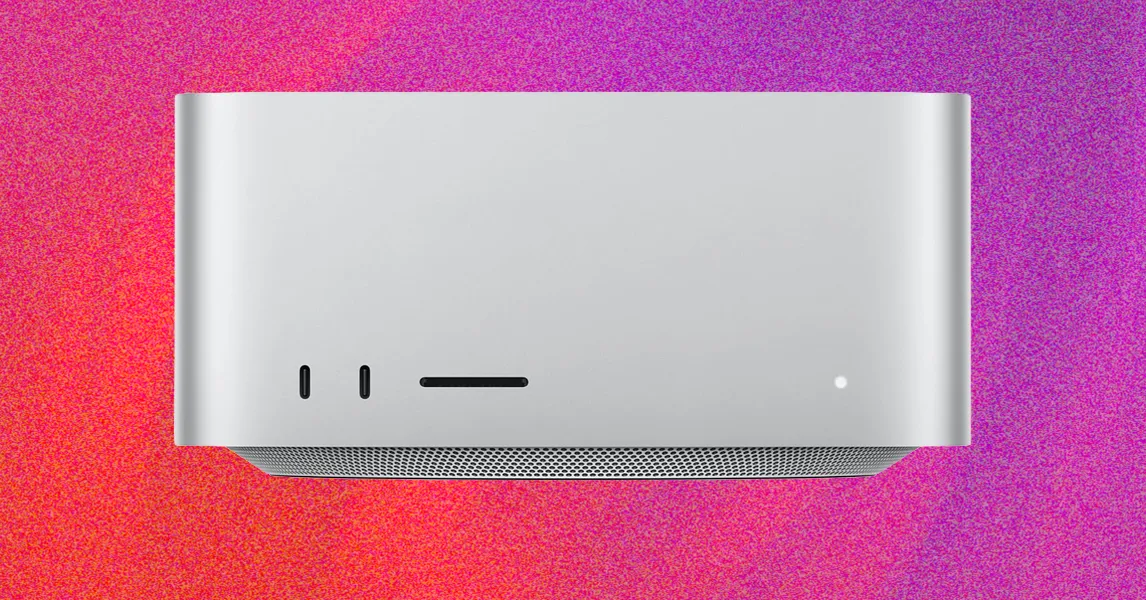
M5 Ultra Mac Studio AI Performance: Powerful, Hot and Still Highly Niche
On-device AI video generation is still in its early stages
For “Draw Things,” we tested image and video generation directly on the M5 Ultra Mac Studio to see what its 80-core GPU can do. Using the MiniMax H3 model, the Mac Studio took more than 11 minutes to generate a full 15-second video.
That result shows there is still a long way to go before local AI becomes a practical alternative to cloud-based services—or before it can avoid requiring a high-performance discrete GPU such as an RTX 5090 or RTX 5080 for demanding workloads. At this price, running AI locally on a Mac Studio is clearly a niche use case.
However, as AI models become more efficient and their output quality improves, the M5 Ultra Mac Studio’s capabilities should improve over time. We are still in the early stages of on-device AI.
Expect significant heat and loud fans under sustained loads
During these AI tests, I noticed how warm the Mac Studio becomes, especially when the system is fully loaded. Never touch or place anything on top of it. You should also leave space behind the computer because its vents expel a considerable amount of hot air.
The fans can spin very loudly, although, like those in other modern Macs, they take a few minutes to ramp up. The front ports remain cool, thanks to the thermal-system vents located just below the Mac Studio.
The M5 Ultra Mac Studio is powerful—but highly specialized
The Mac Studio is certainly unique. Mini Windows PCs typically use laptop chips and generally do not support more than 64GB of RAM. That is where the top-end M5 Ultra Mac Studio feels truly unbeatable—and where it delivers strong value from that perspective.
Add the upcoming 512GB memory option and the ability to connect four Mac Studios to use as a single computer, and you have a feature set that is extremely niche yet completely unrivaled.
The base M5 Max Mac Studio faces tougher competition
The base M5 Max Mac Studio has stronger competition. For $2,399, the Geekom A9 Mega Mini PC offers 64GB of RAM, 1TB of storage and AMD’s new Ryzen AI Max+ 388.
That means more memory and storage for less money. Importantly, AMD chips use unified memory in much the same way as Apple silicon, which is important for running local AI workloads. We are excited to test the Geekom A9 and see how it performs in real-world use.
More local AI competition is on the way
More competitors are coming soon. Nvidia’s RTX Spark “superchip” is its main rival going forward, offering up to 128GB of unified memory in both laptops and mini PCs.
It still does not offer 256GB of memory like the Mac Studio, but we are hoping to see more competition from the Windows and Linux ecosystem.
Source: www.wired.com