


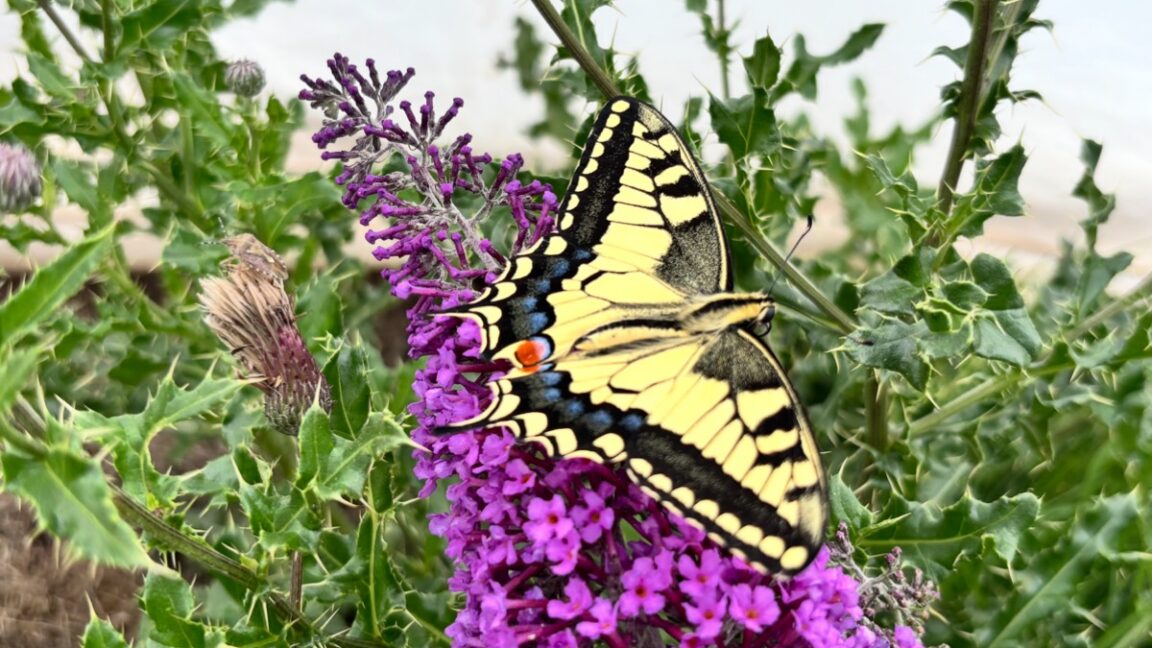
Butterfly Wings May Create a Motion-Dazzling Illusion to Evade Predators
Butterflies may use the motion of their wings to confuse predators, creating an illusion similar to the barber pole effect. This could represent the first empirical evidence of a motion-induced dazzling effect produced by butterfly wings.
How butterfly wing patterns confuse predators
The effect is related to the mechanics of butterfly flight. As the wings flap, they deform, joining together during the upward stroke and separating during the downward stroke. This changes the angle of the stripes and makes them appear to point in different directions.
Combined with the unpredictable flight paths of butterflies, the shifting patterns create a highly effective anti-predator strategy. The result is a visual distraction that may make it more difficult for predators to track a butterfly’s movement.
Simulations reveal motion dazzle across butterfly species
The researchers created simulations of about 400 species of European butterflies to determine whether these illusory patterns were widespread. They found that they were.
In a third phase of the study, human volunteers interacted with a virtual butterfly and attempted to capture it on a touchscreen. The team also developed a genetic algorithm to simulate the evolution of more than 50,000 wing patterns, selecting the patterns that produced the strongest motion-dazzle effect.
The algorithm selected patterns that were strikingly similar to those found in nature, suggesting that this visual illusion could have played an important role in the evolution of butterfly wing patterns.
Which wing patterns produce the strongest illusion?
The dazzling effect can be produced in several ways, including contrasting vertical stripes on the forewings, a single vertical band, or contrasting patterns along the inner wing margins.
This feature may complement other adaptive functions previously proposed for butterfly wing patterns. The next step is to improve the simulations by incorporating ventral wing patterns and more sophisticated flight dynamics. The authors do not believe these limitations change the overall conclusion, but they add nuance to the initial findings.
“It has long been suspected that the bright stripes of zebras and snakes confuse predators’ perception of motion, but hard evidence has been elusive,” Troscianko said. “Our study provides a truly new way to analyze motion vision, and we think that from the flapping of a bird’s wings to the tail flick of a lizard or a fish, motor disruptions are likely to be much more widespread in nature than previously realized. This opens up exciting new research avenues.”
Journal: Nature, 2026
DOI: 10.1038/s41586-026-11062-w
Source: arstechnica.com