


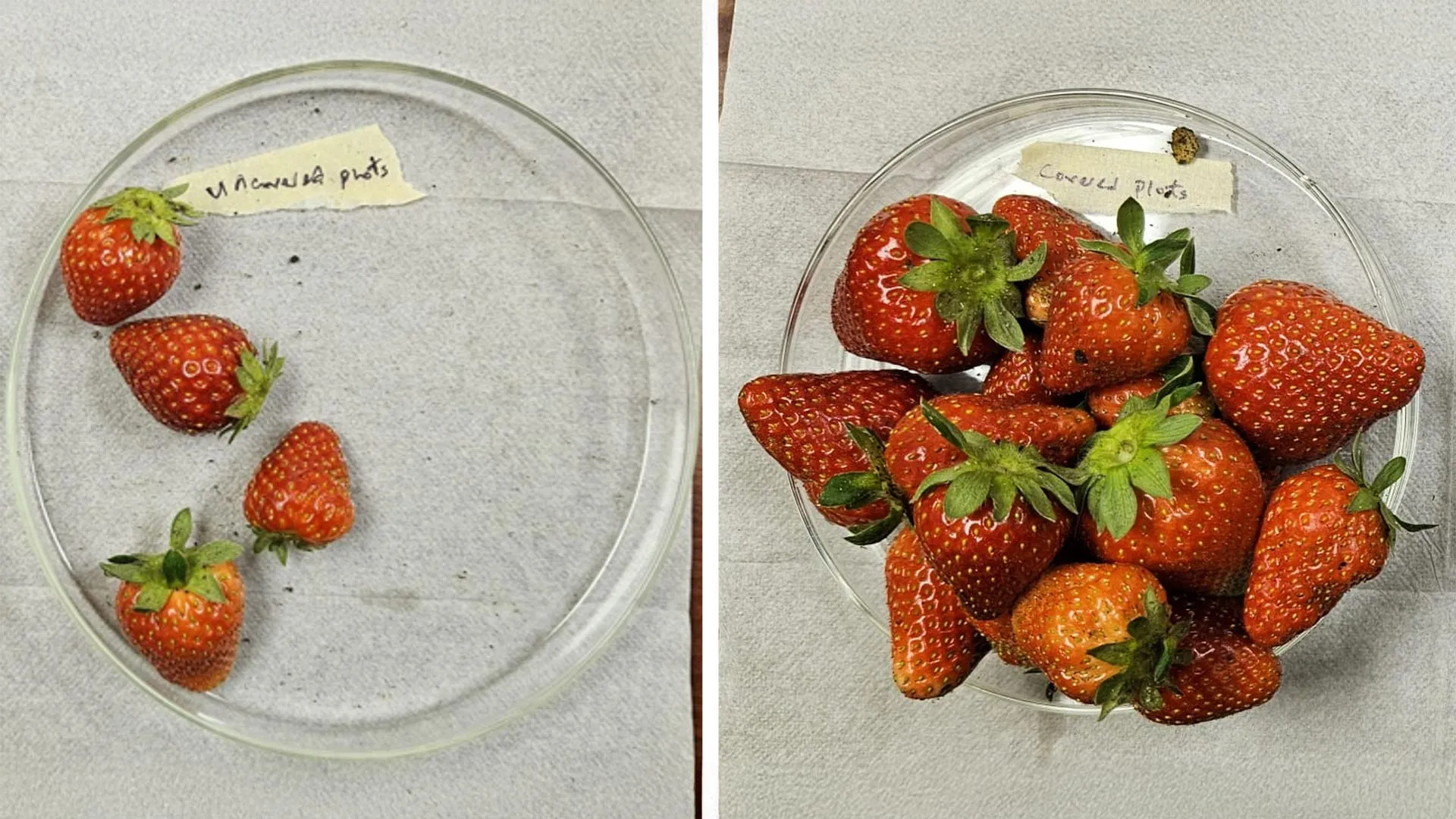
Plant Armor Fiber Cover Tripled Strawberry Yields in Tunnel Field Trials
A newly developed fiber cover helped strawberry plants produce 3.56 times more fruit than uncovered plants in tunnel field trials, without harming plant health. Researchers say the technology could also help reduce water use and reliance on pesticides in strawberry production.
Plant cover blocks insects while allowing light, rain and air through
The fabric, called Plant Armor, is designed to sit directly on top of strawberry plants. Its three-dimensional structure creates a physical barrier that prevents insects from reaching the plants, while its layered material allows sunlight, rain and air to pass through.
In tunnel field trials, strawberries protected with Plant Armor produced 3.56 times more fruit than uncovered plants. The fabric did not reduce light availability or negatively affect relative humidity.
Fiber cover protects strawberry plants without blocking sunlight
“Plants need sunlight to produce fruit,” said Gabriel Olawi, a graduate research assistant at North Carolina State University and lead author of the paper on Plant Armor. “We expected Plant Armor’s seemingly opaque fabric to increase vegetative biomass at the expense of fruit set, because reduced sunlight triggers a ‘shade avoidance’ response. This causes plants to divert energy to stem and leaf growth rather than fruit production. However, we found that this fabric did not impede access to light at all and significantly increased fruit production.”
The researchers also found that Plant Armor produced a stable warming effect across three growing seasons. According to Olawi, the added warmth helped covered plants reach the fruiting stage faster than plants grown without the fiber cover.
“Plants require a certain amount of stored heat, calculated as ‘growing degree days,’ to progress through developmental stages, including fruiting. Our plant covers have been proven to enhance these,” Olawi said. “The plants were optimally given the warmth they needed to go through the phenological stages leading up to production, and they produced much more than uncovered plants.”
Because Plant Armor physically prevents insects from feeding on plants, Olawi said the technology could also reduce the amount of traditional pesticides needed in agriculture.
From military textiles to strawberry production
The idea behind Plant Armor did not begin with agriculture. The technology grew out of research focused on making military uniforms more resistant to mosquito bites and improving the comfort of soldiers wearing body armor.
This unexpected transition from military clothing research to agricultural technology highlights the value of collaboration across scientific disciplines, said co-author R. Michael Roe, William Neil Reynolds Distinguished Professor at North Carolina State University.
“The path to Plant Armor started with trying to create a cloth that would go over a soldier’s chest to make their bulletproof vests more comfortable,” Roe said. “Then, through trial and error, we arrived at a product that tripled the production of strawberry farms here in North Carolina.
“We couldn’t have predicted anything like this when we started. We wouldn’t have gotten to this product if everyone here hadn’t done the research and followed the science.”
Research details and support
The paper, “Knitted 3D porous fiber cover to enhance strawberry fruit production and prevent insect feeding,” was published in the journal Agriculture. Co-authors include James Clothier, Matthew Bertone, Grayson Cave, Reuben Garshong, Andre West, Loganathan Ponnusamy and Clyde Sorenson of North Carolina State University.
The project was supported by a grant from the North Carolina Agricultural Foundation, grant number AG00463770. The research was also supported by Project Award No. 1 of the Research Capacity Foundation (HATCH) 02853, from the U.S. Department of Agriculture’s National Institute of Food and Agriculture.
The Plant Armor Gen 2 fabric studied in the paper is patented by North Carolina State University under U.S. Patent No. 11,582,968 B2, issued February 21, 2023, and licensed by the university for commercial development. The study was a joint project of the North Carolina State College of Natural Resources, Wilson College of Textiles, and College of Agriculture and Life Sciences.
Source: www.sciencedaily.com