


Seaweed May Have Fed Dinosaurs, Fossil Teeth Suggest
Carbon isotopes in the teeth of Cretaceous animals suggest that seaweed and other marine plants may have supplied food to dinosaurs and other coastal animals. A study by scientists from the University of Arkansas and Auburn University offers a possible explanation for why many ancient animals have unusually high levels of the heavier carbon isotope carbon-13 in their tooth enamel.
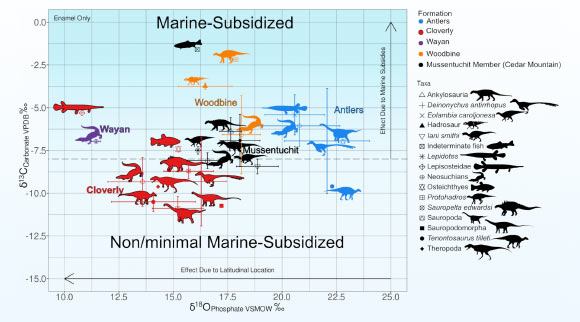
This graph shows the average chemical characteristics of tooth enamel from different animal groups during the Cretaceous period. The vertical axis tracks carbon. Higher carbon-13 values suggest that an animal’s food came more extensively from the ocean. The horizontal axis tracks oxygen and reflects the local waters, including rivers, lakes and seaways, that the animals drank from. Image credit: Forster et al., doi: 10.3389/fevo.2026.1895247.
Carbon-13 points to marine food sources
Paleontologists have repeatedly found that the teeth of many Cretaceous animals contain more carbon-13 than expected from their presumed plant-based diets. Earlier explanations have included dinosaur physiology, the effects of forest canopies and higher atmospheric carbon dioxide.
The new study proposes that marine plants may be the missing carbon source. Seaweed and other marine plants have distinctive carbon signatures, which can be passed through the food chain and preserved in the enamel of animals that eat them or consume prey that did.
“We show that coastal terrestrial organisms in the Cretaceous greenhouse climate relied on marine resources to supplement their diets, just like modern organisms do,” said lead author Dr. Clayton Forster, a geologist at the University of Arkansas.
“We can see marine resources moving up the food chain and into minerals in the bones and teeth of dinosaurs, crocodiles, turtles and fish.”
Study examined fossils from six North American formations
Forster and his colleagues analyzed fossils of fish, crocodile relatives, turtles and dinosaurs from six geological formations in North America. The formations date from approximately 100 million to 113 million years ago.
Five formations were located in coastal areas of Canada, Idaho, Utah, Oklahoma and Texas. The sixth was the inland Cloverly Formation of Wyoming and Montana.
“By measuring the carbon isotope composition of the tooth enamel of dinosaurs, fish and crocodiles, we can determine what their main dietary sources were and whether these differed by region,” Forster said.
Tooth enamel from coastal regions was consistently richer in carbon-13 than enamel from inland regions.
Marine resources may have reached dinosaurs through the food chain
“The organisms that live on the coast must have eaten some kind of organic matter from the sea, or some kind of prey,” Forster said.
“This pattern is common from fish to megaherbivores, indicating that the extra carbon source must have been low in the food chain to affect both aquatic and terrestrial animals.”
He added that the source must have been an organism that lived in coastal habitats rather than inland areas and was available for millions of years.
“Other than marine macroalgae and macrophytes, there are few organisms that meet these criteria.”
Given the widespread behavior of large coastal herbivores today supplementing their diets with seaweed, the researchers suggest that many of the herbivorous dinosaurs in the study may have done something similar.
“Our study highlights the connections between terrestrial and marine ecosystems,” Forster said.
“They are deeply intertwined and have been for hundreds of millions of years.”
“This highlights the connections of environments across time and space and the importance of protecting them where they exist today.”
The findings were published on September 30, 2026, in Frontiers in Ecology and Evolution.
_____
Clayton W. Forster et al. 2026. Marine subsidies for dinosaur ecosystems. Frontiers in Ecology and Evolution 14. doi: 10.3389/fevo.2026.1895247.
Source: www.sci.news