


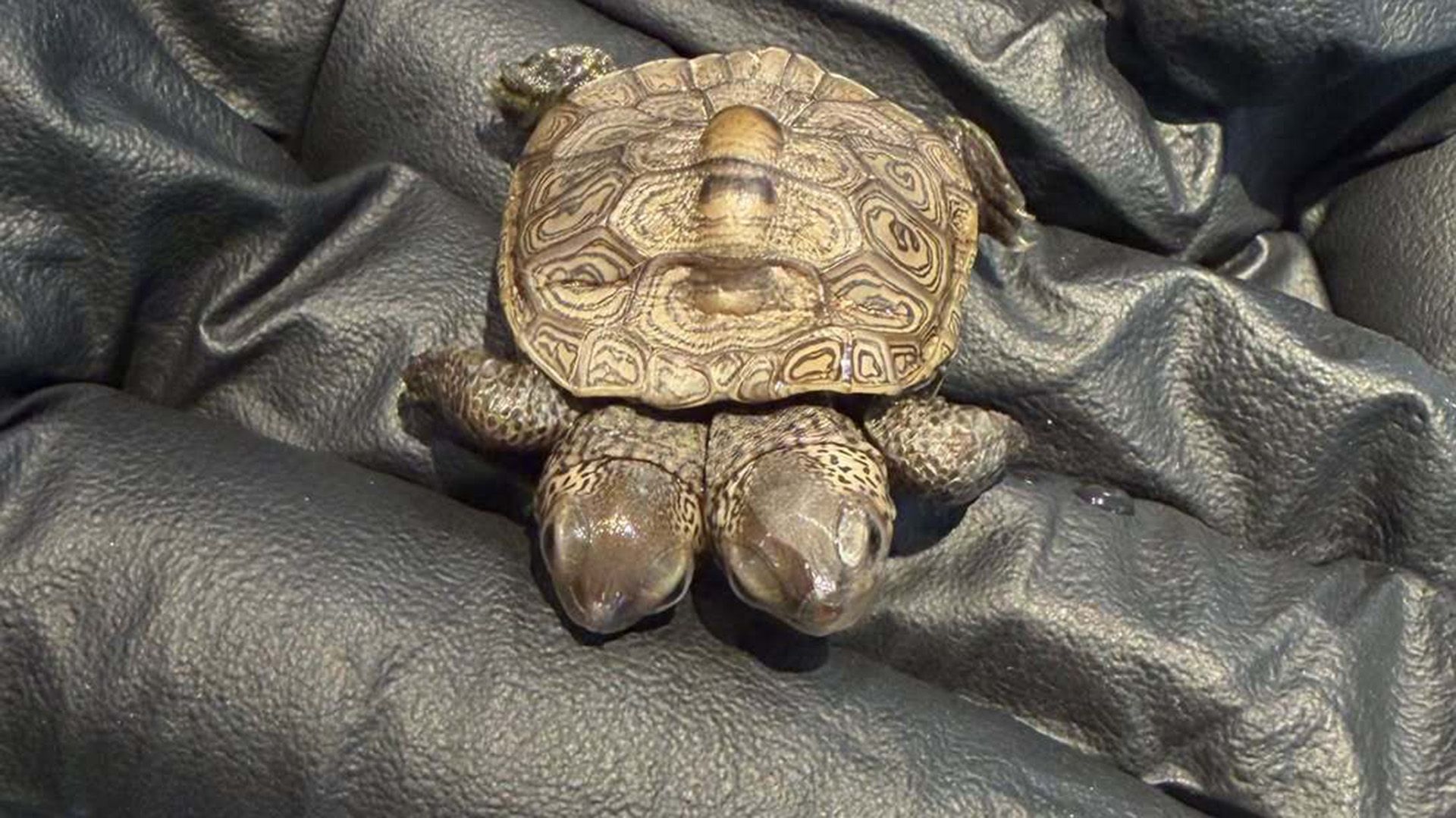
Rare Two-Headed Turtle Found on Cape Cod Is Being Closely Monitored
A rare two-headed diamondback terrapin is receiving care at the Cape Wildlife Center in Barnstable, Massachusetts, after being discovered at a protected nesting site in Wellfleet.
The hatchling weighed just 0.18 ounces (5.2 grams) when it arrived at the wildlife center on Sept. 17, officials said. Representatives of the Wellfleet Bay Wildlife Refuge originally found the unusual turtle.
(Image courtesy of New England Wildlife Center staff)
What causes a turtle to have two heads?
The condition, known as bicephaly, is a rare developmental disorder. It is usually caused by the incomplete division of a single embryo during the formation of identical twins. The result is a pair of conjoined twins that share one body but have two separate, fully formed heads.
Zach Martz, CEO of the New England Wildlife Centers, which includes the Cape Wildlife Center, said the hatchling is a rare example of bicephaly in turtles. Both genetic and epigenetic factors — the ways genes and environmental conditions interact — are thought to contribute to the condition.
“Our understanding, based on available research, is that bicephaly is caused by both genetic and epigenetic factors,” Martz told Live Science via email.
Environmental conditions may also play a role. Turtles often return to the same nesting sites, which can limit the gene pool in some populations. Factors such as temperature, humidity, the physical characteristics of the nesting site and what the parents are exposed to during incubation could also influence development.
A rare but documented phenomenon
Although two-headed turtles are unusual, they have been found before. According to the Cape Wildlife Center, this is the third two-headed terrapin discovered in the area during the past five years.
Other wild animals with bicephaly have also been documented in recent years, including a two-headed porpoise found off the coast of the Netherlands and a two-headed dolphin discovered on a beach in Türkiye.
Why two-headed turtles face survival challenges
A 2021 study found that bicephalic sea turtle embryos and hatchlings with partial body duplication often had significant craniofacial and spinal abnormalities. They were also generally smaller than typical hatchlings.
The turtles’ unusual anatomy can affect coordination, feeding and other functions necessary for survival. Researchers say monitoring these malformations may provide useful information about population health and environmental conditions.
About diamondback terrapins
Diamondback terrapins live in brackish wetlands along the Atlantic and Gulf coasts of the United States. Brackish water is saltier than freshwater but less salty than seawater, and it commonly forms where rivers and lakes meet the ocean.
In Massachusetts, the species is protected under the Massachusetts Endangered Species Act. Its broader federal protection status is currently under consideration.
Wildlife experts are monitoring the hatchling
Veterinarians at the Cape Wildlife Center are closely monitoring the rare turtle’s health and behavior.
“This is a fascinating area and certainly deserves further research,” Martz said. “We are excited to care for these two and learn as much as we can in the process to help inform future research.”
Source: www.livescience.com