



Scientists are studying how record ocean temperatures are affecting vulnerable marine ecosystems.Credit: Armando Babani/Getty
Global ocean temperatures are approaching record highs, threatening marine ecosystems and potentially weakening the ocean’s ability to absorb carbon dioxide from the atmosphere.
“That creates serious problems for the planet,” says Christina Dahl, a climate scientist at the nonprofit Climate Central in Princeton, New Jersey.
Data from the European Commission’s Copernicus Climate Change Service show that global sea surface temperatures have set monthly records during the past two months. The exceptional warmth is being driven by human-caused climate change and a strengthening El Niño climate pattern in the Pacific Ocean. Average sea surface temperatures outside the Arctic and Southern Oceans reached 20.96 degrees Celsius in July—0.07 degrees Celsius above the previous July record set in 2023, the service reported. June was the hottest month ever recorded (see ‘Hot Water’).
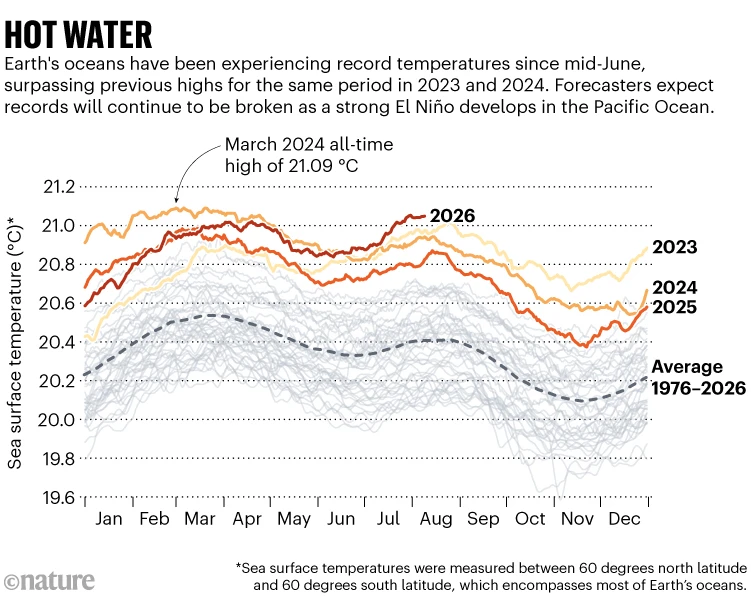
Source: Copernicus Climate Change Service/European Center for Medium-Range Weather Forecasts
The ocean is now warmer than at any point in the available record. Average sea surface temperatures are only a few hundredths of a degree below the current record, set in March 2024. Scientists expect that record to be surpassed this year because ocean temperatures typically increase in the months following an El Niño event. “It’s just a matter of when it happens,” says Samantha Burgess, a climate scientist and deputy director of the Copernicus Climate Change Service in Reading, UK.
Much of the extreme heat is concentrated in a band of warm water across the tropical Pacific, a defining feature of the El Niño climate pattern. The developing event could become the strongest on record. However, El Niño is not the only cause of the unusually warm ocean. Broad regions of the North Pacific and Atlantic Oceans, along with much of the Mediterranean Sea, are significantly warmer than the 30-year average through 2020.
Climate Central analysis tools show that human-caused climate change has made many parts of the ocean tens of times more likely to experience unusually high temperatures. “Essentially everywhere on Earth, ocean temperatures are warmer than normal,” Dahl says.
Record Ocean Heat Raises Concerns About Climate Change
The current ocean heat follows record-breaking sea surface temperatures in 2023 and 2024. An El Niño event also occurred during that period as global temperatures continued to rise, but the scale of the warming surprised scientists. The unusual heat has renewed debate over climate sensitivity—the amount Earth’s temperature increases in response to human emissions—and whether it could be greater than climate models have predicted. “We don’t know why the ocean has behaved differently over the past four years,” Burgess says.

This El Niño is expected to be the largest in recorded history by an ‘astonishing margin’
Jens Terhaar, a marine modeler at the University of Bern, says this year’s temperatures are only slightly above previous records. Nevertheless, another record-breaking marine heatwave could intensify questions about climate sensitivity. “That should definitely set off alarm bells,” he says.
Rising ocean temperatures are already affecting fisheries. The current El Niño has been linked to a sharp decline in anchovy populations off the Pacific coast of South America. Marine heatwaves also affect communities along nearby coastlines by increasing temperatures and humidity, including overnight conditions.
Coral reefs, however, are among the ecosystems most severely threatened by ocean warming. “This is basically a scary time for corals and reef ecosystems,” says Amy Aprile, a marine geochemist at the Woods Hole Oceanographic Institution in Massachusetts.
Source: www.nature.com