


NVIDIA and Microsoft Bring AI Agents to Windows With RTX Spark and DGX Station
At a Microsoft event in San Francisco on Wednesday, NVIDIA CEO Jensen Huang and Microsoft CEO Satya Nadella outlined how the companies are co-designing hardware and software for AI agents running on Windows PCs.
“NVIDIA was founded because of Windows,” Huang said. “AI agents are coming to Windows.”
“If you look at our entire journey, Windows has been at the heart of it,” Huang said, reflecting on NVIDIA’s decades of support for Windows and Microsoft. “Without Windows, there would be no GeForce.”
Huang connected that history to his long-term vision for the agent era during a fireside conversation with Nadella. The discussion was moderated by former White House senior policy adviser on AI Sriram Krishnan at the Windows AI and Surface event at Dogpatch Studios in San Francisco.
“Frankly, what I give Jensen full credit for is the consistency of his vision of what this is going to look like, not today or tomorrow, but as a long-term trend,” Nadella said. “And that’s what brought us to this moment.”
“The personal computer is the ultimate tool, it’s the ultimate tool for me, and for a whole generation of people, it’s our ultimate tool,” Huang said. “In the age of agents, what happens when your agent is on your computer? It’s now your personal assistant.”
Microsoft Builds Windows for Secure AI Agents
The event began with remarks from Nadella, followed by Pavan Davuluri, Microsoft’s vice president of Windows and devices, who discussed updates designed to prepare Windows for the agent era.
Microsoft announced the general availability of Microsoft Execution Containers (MXC), an operating-system-level infrastructure that enables AI agents to run securely and persistently in the background under the control of Windows.
“We are building these primitives directly into Windows, so we can secure, monitor, and manage our agents,” Davuluri explained. “Unleash the full potential of agents on Windows with MXC, Microsoft Security, and Agent 365.”
Nadella emphasized the importance of security during a discussion with attendees.
“We needed to make the desktop the most secure place our agents could run,” Nadella said.
“What Satya just said will be the foundation for the next generation of IT as we know it,” Huang said. “MXC will revolutionize the way agents are built and deployed, just as Windows and DirectX revolutionized the way applications are built.”
RTX Spark Brings Local AI to Windows PCs
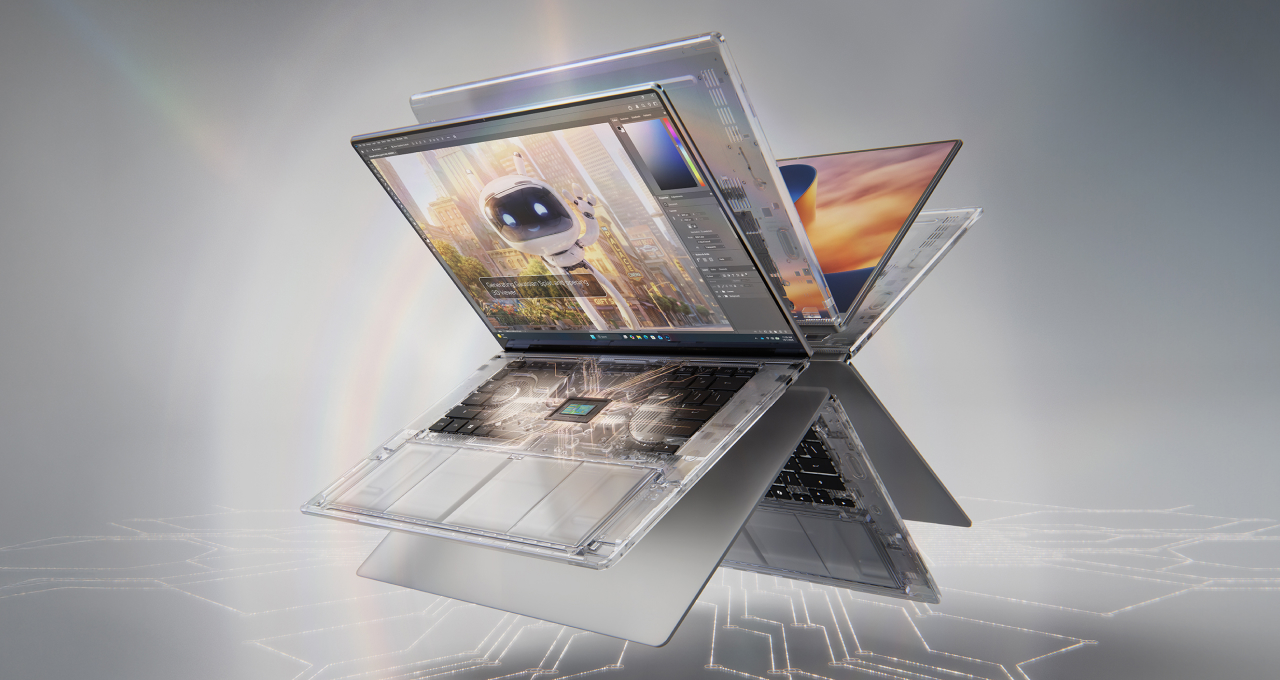
Huang and Nadella also outlined RTX Spark, which brings the complete NVIDIA AI stack to Windows laptops and compact desktops. Laptop pre-orders begin today, with shipping scheduled for October 16. The compact desktop will be available in November.
Windows brings local AI closer to everyday work, while new hardware gives developers more room to run increasingly capable models on their PCs. Introducing the Surface Laptop Ultra, Davuluri connected Microsoft’s vision for Windows AI to NVIDIA RTX Spark.
“We built Surface Laptop Ultra around NVIDIA RTX Spark. With up to 128 gigs of unified memory and up to 1 petaflops of AI compute, you can run models on this laptop that wouldn’t fit on a traditional machine,” Davuluri said.
RTX Spark systems will come from Acer, ASUS, Dell, HP, Lenovo, Microsoft, MSI and GIGABYTE. The product family includes designs ranging from slim laptops to compact desktops built for always-on AI agents.
RTX Spark combines up to 6,144 NVIDIA Blackwell RTX GPU cores with up to 20 NVIDIA Grace CPU cores connected at 600 GB/s.
With 1 petaflop of FP4 AI performance and up to 128GB of unified memory, RTX Spark is designed for local AI workloads. Models such as Qwen 3.8 Flash Next—a 125B model with 51B n-grams that rivals the intelligence of many cloud models—can run on a pay-as-you-go basis without sending data to the cloud.
RTX Spark runs the full NVIDIA CUDA platform, the same software stack used across NVIDIA hardware, and is designed to support a range of PC workflows.
- Developers: Run the same NVIDIA AI stack from RTX Spark to DGX Station, moving models, tools and workflows without rewriting.
- Creators: Use fifth-generation Tensor Cores with NVFP4 support, hardware-accelerated AV1, 4:2:2 video encoding and decoding, DLSS and RTX ray tracing across the production pipeline.
- Gamers: Use DLSS 5, Reflex and G-SYNC to run AAA games at 1440p at more than 100 frames per second.
The compact desktop configuration features the same RTX Spark superchip in a small chassis designed to operate 24/7. It is a dedicated local AI system built to keep agents running continuously.
NVIDIA DGX Station for Windows Brings Frontier AI to Desktops
NVIDIA also previewed NVIDIA DGX Station for Windows, a deskside AI supercomputer that brings GB300 Grace Blackwell-class AI infrastructure directly into the Windows ecosystem.
“This allows us to run frontier-class models locally,” Davuluri said. “Functions that previously required renting a cluster now reside on deskside supercomputers.”
Previously, DGX Station ran on Linux. As a result, enterprise developers maintained separate environments: Linux for demanding AI workloads and Windows for productivity tools, applications and everyday workflows.
Most Fortune 500 companies have standardized on Windows, creating a gap that can cost developers time and resources. Developers have had to move to Linux to access advanced AI computing or remain on Windows with limited hardware options for heavy model development and multi-agent workloads.
NVIDIA DGX Station for Windows runs on the GB300 Grace Blackwell Ultra desktop superchip, delivering 748GB of coherent memory and up to 20 petaflops of FP4 AI computing. This is sufficient to run models of up to 1 trillion parameters locally.
Teams of developers and researchers at AI-native companies, leading research labs and enterprises can build and run always-on AI agents that connect directly to the Windows applications and infrastructure they already use. They can also fine-tune and infer large-scale models without leaving their primary machines. The Linux AI toolchain remains accessible through Windows Subsystem for Linux (WSL) when needed.
Learn more about NVIDIA DGX Station for Windows and sign up to be among the first to know when it becomes available.
Follow NVIDIA RTX Spark on X, Instagram, TikTok and Facebook. Subscribe to the NVIDIA Local AI Newsletter. Follow NVIDIA Workstation on LinkedIn and X.
Source: blogs.nvidia.com