


The Milky Way May Have Formed From Thousands of Tiny Galaxies
Long before it became the majestic spiral galaxy we call home, the Milky Way may have been a chaotic swarm of thousands of small galaxies.
A new study suggests that during the first 2 billion years after the Big Bang, the region of space that would eventually become our galaxy was filled with small galaxies of different sizes and shapes. Over time, those galaxies collided and merged to form the Milky Way.
“These results make it clear that the physics that occurred in the immediate aftermath of the Big Bang has a direct impact on the shape of the local universe that we see today,” study co-author Harley Katz, an assistant professor of astronomy and astrophysics at the University of Chicago, said in a statement.
How Megatron simulates the early universe
To understand how the early universe evolved, astronomers build sophisticated computer models that encode the laws of nature. The new study is based on three years of supercomputer simulations and provides one of the most detailed reconstructions yet of how galaxies like the Milky Way formed.
The research comes as astronomers work to explain observations from the James Webb Space Telescope (JWST). JWST can peer farther into the early universe than any previous telescope, and its discoveries have sometimes challenged existing computer models.
For example, JWST has found surprisingly bright early galaxies and a mysterious class of compact objects known as “small red dots.” These anomalies suggest that current models need to account for more of the complex physics shaping the early universe.
To help address this gap, scientists created a new supercomputer simulation suite called Megatron. It predicts the distinctive light signatures of hypothetical galaxies by tracking ancient gas, starlight and chemical elements from 180 million to 2 billion years after the Big Bang.
Because JWST collects similar spectral data from galaxies that existed during comparable periods, researchers can directly compare the simulations with real observations. This may help reveal where older models fail to capture the evolution of early galaxies.
Megatron also traces how the universe’s first stars formed and died, as well as how they produced the elements needed for later stars, planets and life. When massive stars die, elements such as carbon, oxygen and iron spread into surrounding gas, enriching it and providing the raw materials for future cosmic structures.
“Combining these complementary observations allows us to test competing models of primary stars in ways that were not possible before,” the study’s authors said. Theoretical astrophysicist Martin Rey of the University of Bath also discussed the research in a separate statement.
One of six papers connected with the Megatron collaboration was published in The Open Journal of Astrophysics on September 30. The paper describes how the simulation reproduces the diversity of spectra observed in high-redshift galaxies.
How thousands of galaxies assembled the Milky Way
The simulation begins 180 million years after the Big Bang, when the universe contained no stars or galaxies—only gas. Over the next 2 billion years, the model follows the birth of the first stars and the gradual emergence of the cosmic dawn.
As those first stars formed and died, they released newly created heavy elements into space. These elements enriched the surrounding gas and helped create the building blocks of later stars and planets.
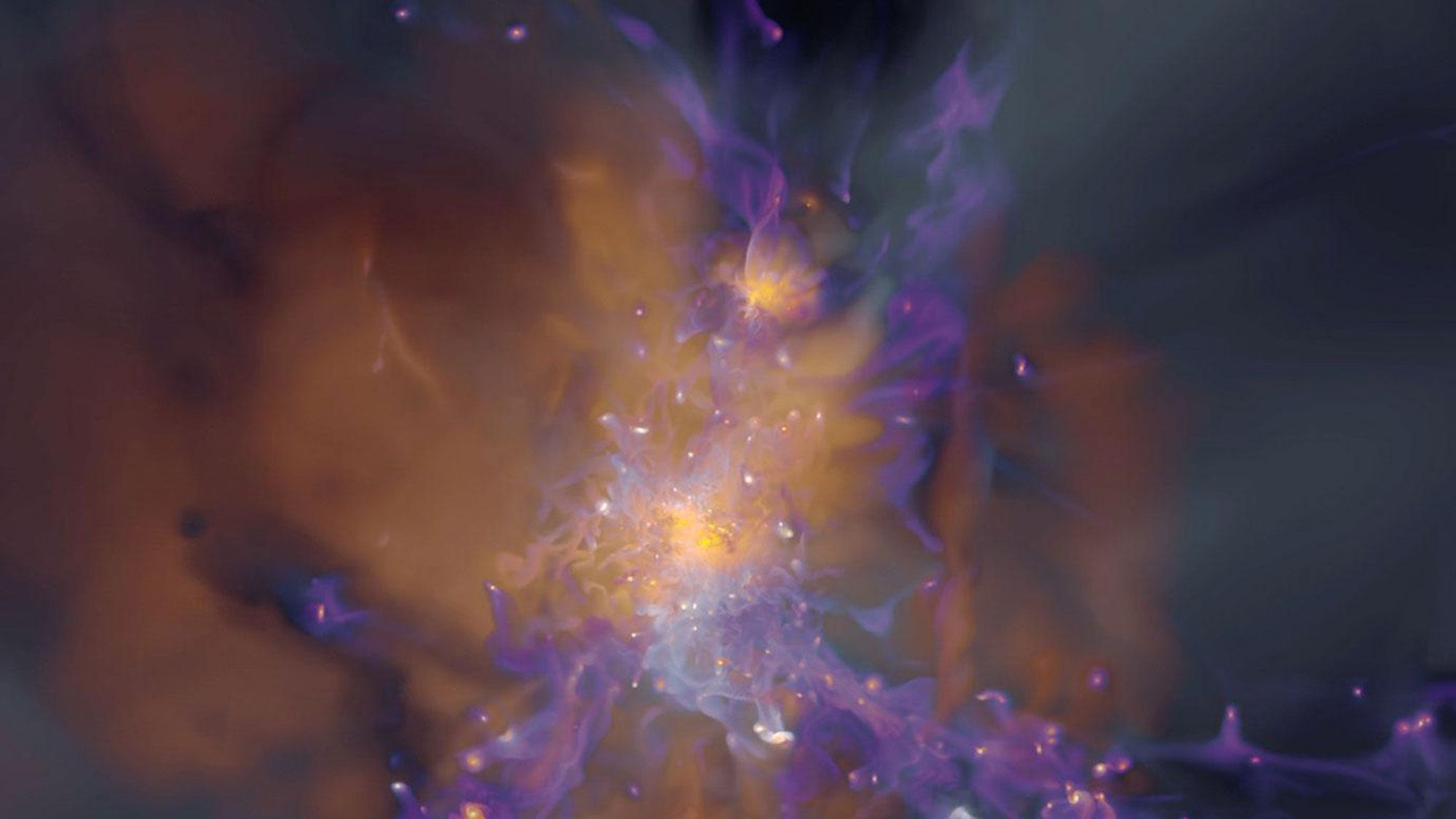
A diagram simulating what the Milky Way looked like 12 billion years ago. The band of light represents the remains of a galactic collision, one of thousands of mergers that may have helped create our galaxy.
Image credit: Harley Katz/MEGATRON collaboration
The simulation ends 2 billion years after the Big Bang, but the Milky Way continued to merge with other galaxies long afterward. A trace of one small galaxy remains from a past merger, while the Milky Way’s major merger with the Sagittarius dwarf galaxy began more than 6 billion years ago and is still ongoing.
What the simulation could reveal about galaxy formation
The simulation results may help scientists understand how physical parameters affected the early universe and improve the way computer models match JWST observations. They also highlight questions that remain unanswered.
“But there are some things we don’t get right, and that’s interesting too: What are we still missing?” Katz said in a statement. “It may lead you in new directions and new questions.”
Members of the UK’s Megatron team are now developing the next generation of simulations on the country’s supercomputers. These models will include more complex physics, such as the effects of active black holes, to better explain the surprising diversity of galaxies in the early universe.
Katz, Harley, Martin Rey, Corentin Cadiou, Oscar Agaats, Jeremy Brazot, Alex J. Cameron, Nicolas Choustikov and others. 2026. “Megatron: Reproducing the Diversity of High-Redshift Galaxy Spectra Through Cosmological Radiative Hydrodynamic Simulations.” The Open Journal of Astrophysics 9 (September). doi.org/10.33232/001c.169643
How much do you know about our home galaxy? Find out with our Milky Way quiz.
Source: www.livescience.com