


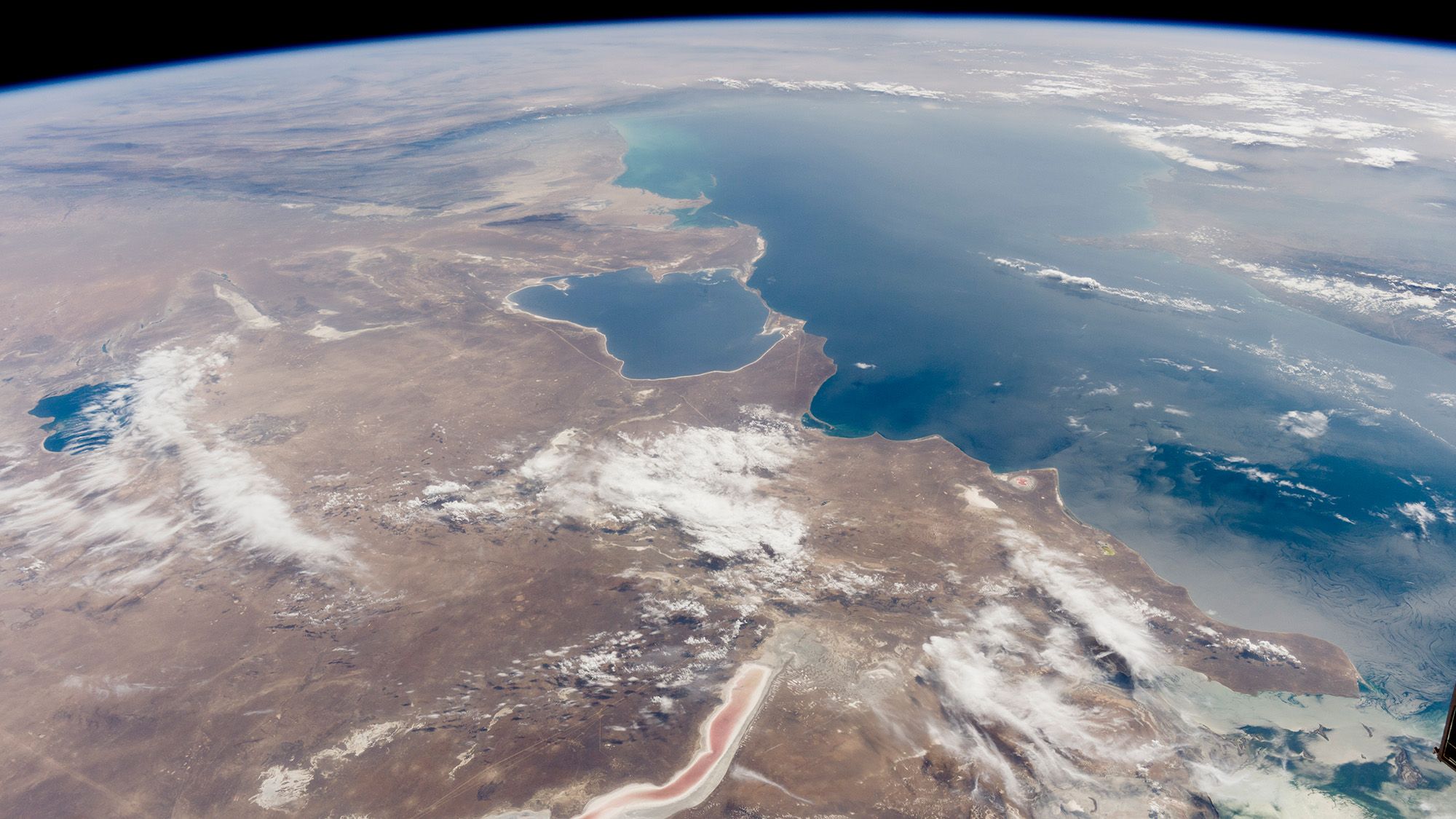
The Caspian Sea Is Shrinking: Human Water Use Drives Major Decline
The Caspian Sea, the world’s largest inland body of water, is rapidly losing water. Since the mid-1990s, the saline lake between Europe and Asia has lost approximately 24,000 square kilometers (9,300 square miles) of surface area—an area nearly the size of Sicily. New research has identified reduced river inflows, rather than climate change alone, as the primary cause.
In a study published June 5 in the journal Earth’s Future, researchers analyzed ground-based measurements and satellite observations to investigate the Caspian Sea’s falling water levels. The team linked the decline to a sharp reduction in river water flowing into the lake from Iran, Turkmenistan, Azerbaijan, Kazakhstan and Russia.
Researchers highlighted the Volga River in particular. The longest river in Europe, the Volga supplies approximately 80% of the Caspian Sea’s total inflow. Declining discharge from the river is therefore having an outsized effect on the lake’s water balance.
To understand why the Volga is delivering less water to the Caspian Sea than it did 30 years ago, we spoke with Amir AghaKouchak, a co-author of the study and professor of civil and environmental engineering at the University of California, Irvine.
AghaKouchak, who directs UC Irvine’s Center for Hydrometeorology and Remote Sensing, explained how dams, irrigation and other water withdrawals are reducing river inflows—and why the Caspian Sea could face severe ecological and economic consequences if water demand continues to rise.
Amir AghaKouchak is a professor of civil and environmental engineering at the University of California, Irvine.
Sascha Pare: Falling Caspian Sea levels have often been linked to natural variability, climate change and increased evaporation. What did your study reveal?
Amir AghaKouchak: Climate change is important, but it cannot explain the entire decline we have observed. Over the past 30 years, the Caspian Sea’s water level has fallen by approximately 2 meters (6.5 feet). That has reduced the lake’s surface area by about 24,000 square kilometers—roughly 5% of the total.
When we examined the causes, rainfall over the Caspian Sea and its upstream river basins had not changed enough to account for the decline. Evaporation has increased and likely explains about one-third of the water loss. The remaining decline is probably connected to human activities, including water withdrawals for irrigation and groundwater extraction.
SP: Which human activities are contributing to the Caspian Sea’s decline?
AA: Several countries surrounding the Caspian Sea have constructed large dams and water infrastructure, partly to generate hydropower and partly to support agriculture and economic development. As populations and economies grow, demand for water also increases.
The countries in the region do not routinely share detailed data about water use, making it difficult to identify the precise contribution of each project. In Russia, for example, the Volga-Don Canal is one of the developments that may be affecting water availability. Editor’s note: The Volga-Don Canal connects the Volga and Don rivers at their closest points.

Opened in 1952, the Volga-Don Canal connects the Volga River, which flows into the Caspian Sea, with the Don River, which empties into the Sea of Azov.
(Image credit: Gaika102 via Getty Images)
It would be incorrect to blame the crisis on one canal or one project. The more likely explanation is the combined effect of many water withdrawals throughout the Volga basin and other river systems. Because the Volga supplies more water than all the other rivers combined, changes in its discharge have the greatest impact on the Caspian Sea.
SP: Were you surprised that human water use played such a significant role?
AA: We began the project without a predetermined conclusion. We worked with researchers from Azerbaijan, Iran, Kazakhstan and other countries because we wanted local expertise and perspectives. The conclusions represent the collective assessment of a large international research team, including scientists from Finland and Germany.
The process was not easy, but involving researchers from different countries helped us test the results and reach conclusions that the group could support. We also included a researcher with ties to Russia, although not from an official Russian institution.

The Volga River contributes approximately 80% of the Caspian Sea’s inflow, but rising water demand has reduced its discharge.
SP: What is the worst-case scenario if countries bordering the Caspian Sea do not reduce water demand?
AA: The Aral Sea, which now contains only about 5% to 10% of its former water volume, and Iran’s Lake Urmia provide alarming examples. Both lakes have shrunk dramatically in a similar climate and have lost much of their ecological function.
The Caspian Sea is far larger, so a comparable collapse would likely take much longer—potentially around a century at the current rate of decline. However, the lake is on a concerning trajectory. Even if 20% of the Caspian Sea dried up, the environmental, economic and social consequences would be enormous.
SP: What environmental and social impacts could result from continued Caspian Sea water loss?
AA: As the shoreline retreats, the exposed lakebed will release salt and other minerals. Strong winds could carry these particles into the air, increasing the risk of respiratory and eye problems for nearby communities.
Salt deposited on farmland can also reduce soil productivity over time, potentially creating food security problems. The exact composition of the exposed lakebed is not yet fully known, so the long-term health and agricultural impacts remain difficult to predict.
The decline also threatens shipping. Much of the water loss is occurring in the northern Caspian Sea, where the lake is relatively shallow. A further 2-meter drop could make ports and shipping routes unusable, forcing companies to move operations farther south and invest in new docking facilities.
SP: What must countries do to protect the Caspian Sea?
AA: Water-demand management is essential. Unlike major construction projects, demand management often involves conservation, efficiency improvements and reductions that attract less public attention. However, it is one of the most practical tools available to countries in the region.
Improving irrigation efficiency, reducing unnecessary withdrawals and monitoring groundwater use could help preserve river inflows. Cooperation and transparent water-use data would also make it easier to identify the largest sources of depletion.
Political conflict makes investment in water management more difficult. Cotton production is another concern because it requires substantial irrigation. According to regional discussions, cotton is also connected to ammunition production, increasing demand from Russia and encouraging additional cultivation in Uzbekistan, Kazakhstan and other Central Asian countries. More cotton farming can mean more irrigation, groundwater extraction and surface-water depletion—putting further pressure on the Caspian Sea.
This interview has been condensed and lightly edited for clarity.
Source: www.livescience.com