


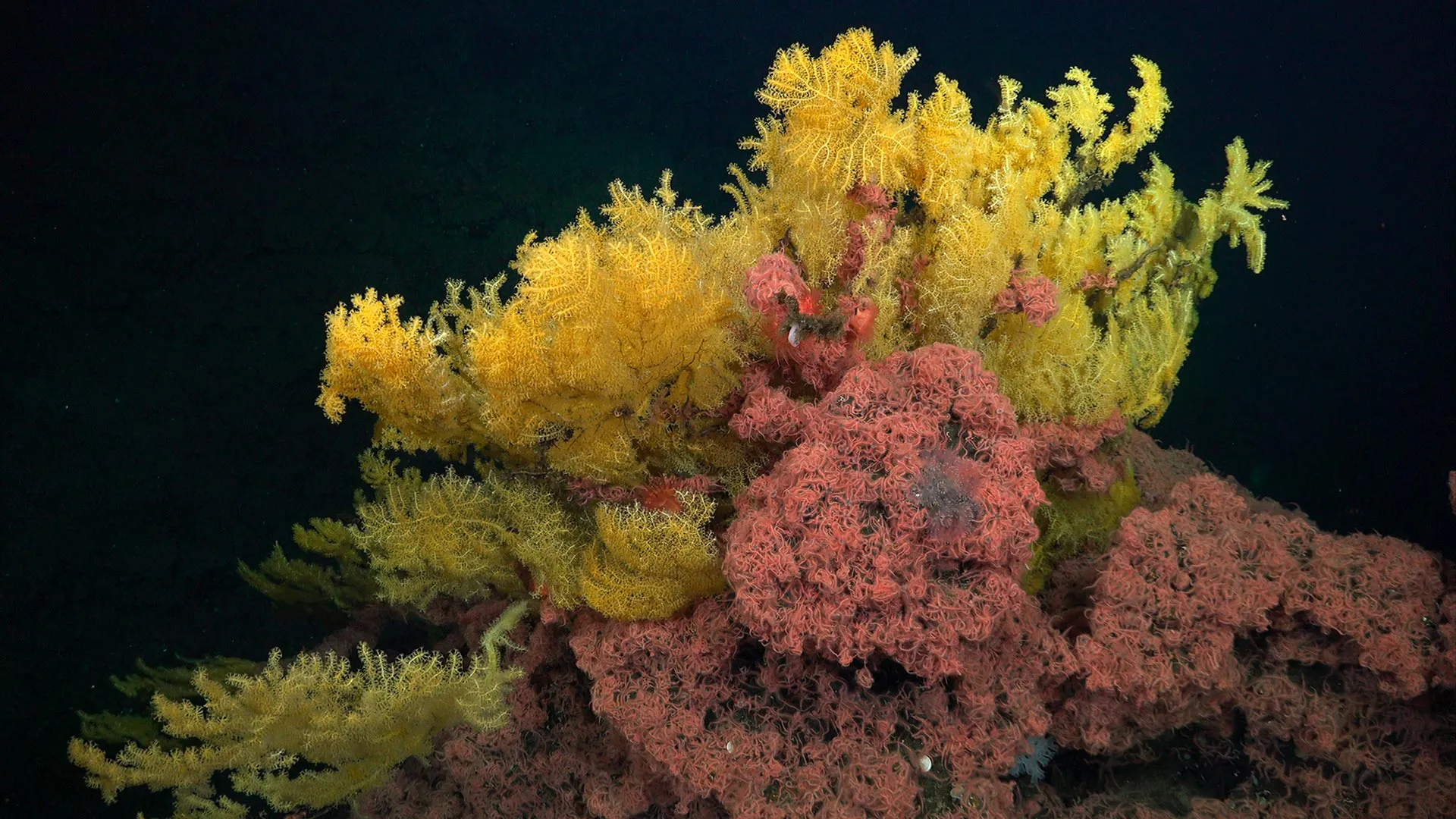
New Golden Coral Found Off Costa Rica Belongs to an Entirely New Family
Scientists exploring an underwater mountain range off Costa Rica have discovered a remarkable bright yellow coral unlike any previously known coral. Its genetic makeup and physical characteristics are so distinctive that researchers established an entirely new family to classify it.
The tree-like coral was found between 360 and 529 meters beneath the surface of the Pacific Ocean. Some colonies grow more than 1 meter tall. The findings were published in the open-access journal Zookie.
A golden coral in a starry deep-sea landscape
Researchers collected specimens with the remotely operated vehicle Subastian during expeditions in 2019 and 2023. The Schmidt Ocean Institute operated the research vessels used to explore seamounts near Coco Island and along Costa Rica’s Pacific coast.
The coral was especially abundant on rocky outcrops that covered nearly every available surface. Spider stars surrounded many of the colonies, creating a shimmering backdrop for the coral’s bright yellow, branching structures.
This striking scene inspired the coral’s scientific name. The new genus, Laurink, is derived from “Laurinquë,” a Quenya word meaning “golden tree.” Quenya is an Elvish language created by J.R.R. Tolkien for The Lord of the Rings and The Silmarillion.
The species name, Elenya, refers to the Quenya word for “star” and reflects the dense population of spider stars found around the coral colonies. Together, the names evoke what researchers describe as an almost mystical, elven landscape on the deep-ocean floor.
DNA reveals a new coral family
Determining where the coral belongs on the evolutionary tree proved more complicated than expected. Scientists initially sequenced three genes commonly used to identify and classify corals. However, each gene pointed to a different and seemingly unrelated family.
Because the genetic results were unusually inconsistent, the researchers turned to phylogenomics, a method that compares hundreds of genes at once. This broader analysis finally revealed the coral’s evolutionary position.
The researchers determined that the species does not belong to any previously recognized coral family. Although it is most closely related to the family Eunicellidae, its genetics and anatomy are sufficiently different to justify the creation of a new family, Laurinqueidae, as well as the new genus Laurink.
“I saw this octocoral garden for the first time in 2019 and was struck by its scenic beauty, which later inspired the elven name for this taxon,” said Dr. Odalisca Breedy of the University of Costa Rica, the study’s principal investigator.
“We thought this species might belong to a known family or genus, but after preliminary morphological analysis we realized it was something very different that could not be matched with any known taxa.”
“In 2023, we collected more samples and, thanks to intensive molecular analysis by our colleagues Kathy McFadden, Catalina Murillo and Andrea Quatrini, we were able to determine the taxonomic placement of this amazing species in one of the most mysterious locations.”
Costa Rica’s deep sea still holds surprises
Dr. Breedy led the research with a team of international collaborators. The expedition was supported by the Schmidt Ocean Institute and a research grant from the National Geographic Society.
The discovery adds to the growing number of previously undocumented species found on Costa Rica’s seamounts. It also highlights how much of the deep ocean remains unexplored, despite covering about two-thirds of Earth’s surface.
Coral gardens such as this one are considered vulnerable marine ecosystems. Their complex, three-dimensional structures provide shelter and habitat for many other deep-sea organisms, making them important centers of marine biodiversity that scientists are only beginning to understand.
Source: www.sciencedaily.com