


NASA Tests Next-Generation Heat Shields for Moon and Mars Missions
NASA is testing advanced heat shield materials and designs that could help protect astronauts and spacecraft during atmospheric reentry from future missions to the Moon and Mars.
Northrop Grumman’s 24th cargo resupply mission to NASA, which departed from the International Space Station, carried 12 small experimental capsules designed to test next-generation thermal protection materials. The results could help shape future heat shields for crewed and cargo missions.
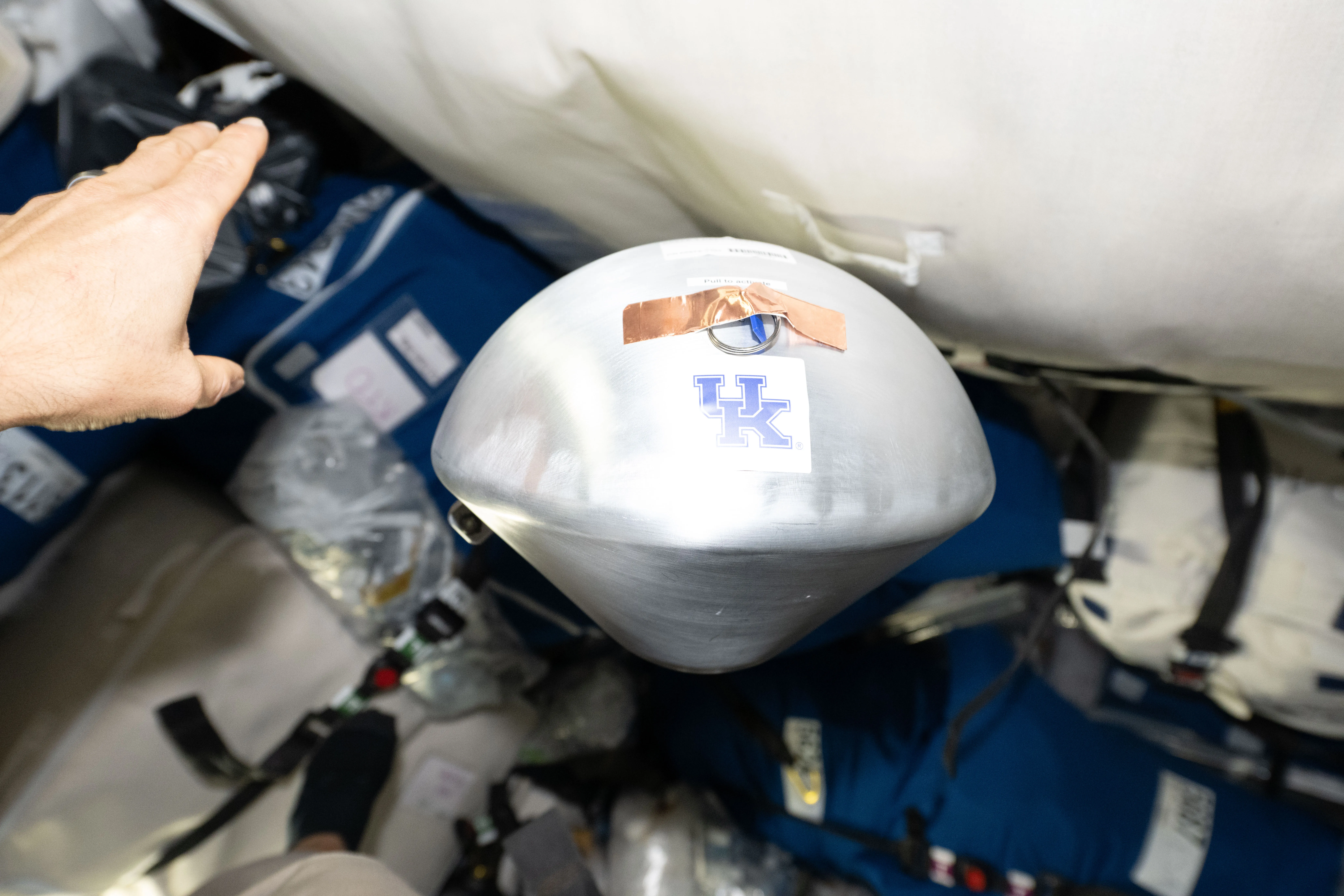
The experiment, known as the Kentucky Atmospheric Reentry Probe Experiment (KREPE-3), is the third in a series of low-cost, high-impact missions. The probes use the final moments of a cargo spacecraft’s mission to collect valuable data during atmospheric reentry.
KREPE-3 is a collaboration between the University of Kentucky, the Commonwealth of Kentucky, NASA’s Program for the Advancement of Competitive Research (EPSCoR), several NASA centers, and other federal and commercial partners.
“KREPE-3 is a great example of the goals of NASA’s EPSCoR program,” said David Berger, EPSCoR program manager at NASA Headquarters in Washington. “We support the next generation of scientists and engineers to develop unique projects that serve education and NASA mission goals.”
Turning Spacecraft Waste Into Reentry Data
Before the mission’s Cygnus XL spacecraft departed from the space station, astronauts filled it with waste and activated the 12 small capsules carried inside. Designed by students at the University of Kentucky, each capsule includes sensors that measure temperature, pressure, motion, magnetic fields, and light during atmospheric reentry.
After the vehicle disintegrates harmlessly in Earth’s atmosphere along its planned route, the capsules will be released and begin collecting data on how different experimental heat shield materials perform. Their signals will transmit data to researchers, providing insight into how larger heat shields could protect cargo and crew in the future.
“This is a smart way to get flight data on materials you’re developing,” said Keith Peterson, a materials engineer at NASA’s Ames Research Center in Silicon Valley, California. “We are essentially hitchhiking onto a vehicle that is already returning to Earth.”
Testing Ceramic Tiles, 3D-Printed Materials and Flexible Heat Shields
The KREPE-3 capsules will carry a variety of thermal protection components. These include proven technologies such as the ceramic tile materials used on the Space Shuttle, as well as experimental systems designed for future spacecraft.
Several companies will test new options, including 3D-printed heat shields developed through the Thermal Protection Systems additive manufacturing project at NASA Johnson and Oak Ridge National Laboratory.
NASA Ames researchers are contributing multiple materials to the experiment. Two capsules will carry a next-generation protective cover family known as Reentry Materials Design Using Innovative Needling Operations (MERINO).
MERINO is made from layers of carbon and phenolic fibers sewn together like felt. The material is more flexible, faster to manufacture, and less expensive than traditional protective materials, making it a promising candidate for Mars missions. Because Mars has a thin atmosphere, a landing mission there will experience a lower heat load, allowing for lighter thermal protection.
Using Reentry Probes to Validate Computer Models
A third capsule combines MERINO protective covers with other components. The Kentucky Instrument Cone Hypersonic Experiment uses a dual-cone design consisting of a tungsten tip attached to a cone layered with carbon and phenolic fibers, along with a rear cone wrapped in MERINO material.
This unusual configuration will help researchers compare computer models with real-world atmospheric reentry data.
Heat Shield Designs for Titan, Mars and Future Missions
Another capsule is shaped like the aeroshell planned to protect NASA’s Dragonfly mission as it travels to Saturn’s moon Titan. The capsule will test the design’s dynamic stability and is covered with a phenol-impregnated carbon ablator.
The material was developed at NASA Ames and has applications in commercial vehicles and NASA aircraft. It has also been used in NASA missions including Stardust, Mars Science Laboratory, and Mars 2020.
One capsule will test a deployable heat shield called Adaptable Deployable Entry and Placement Technology. Shaped like an umbrella, the shield increases surface area to slow descent. At full scale, the collapsible design could help deploy payloads larger than conventional launch vehicles can carry.
A Faster, More Affordable Way to Test Heat Shields
Some KREPE-3 capsules are testing materials for future Mars missions, while others are evaluating new shapes, designs, computer models, and sensor systems. Together, the experiments could support a new generation of atmospheric reentry technologies.
Additional capsules developed by domestic and international partners will test both established and experimental materials. One capsule will carry a heat flux sensor developed at the University of Stuttgart in Germany to help researchers measure how heat moves across a surface during atmospheric reentry.
“We’re pushing the boundaries of thermal insulation,” Peterson said. “And we’re testing them in a fast, affordable and incredibly effective way.”
Source: www.nasa.gov