


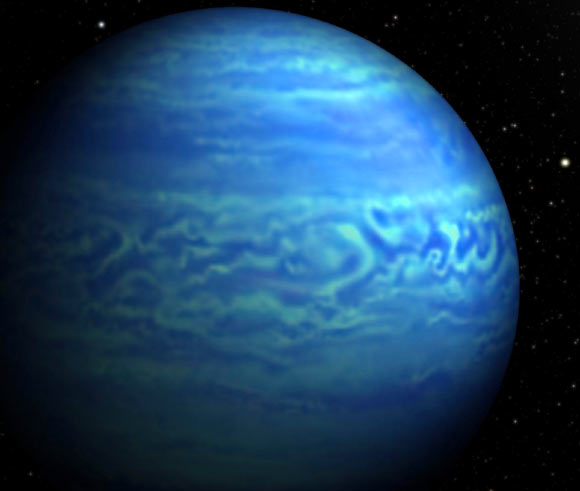
James Webb Telescope Reveals Changing Water Clouds on Nearby Brown Dwarf
Astronomers using NASA, ESA and CSA’s James Webb Space Telescope have obtained the first time-resolved, medium-resolution spectra of WISE J085510.83-071442.5, or WISE 0855—a cold brown dwarf just 7.4 light-years away. The observations show that its atmosphere is far from static.
Webb tracks weather on a nearby brown dwarf
“This is the first time we’ve been able to see water clouds getting thinner and thinner on the nearby world,” said Dr. Brittany Miles, a postdoctoral researcher at Steward Observatory.
“Before Webb, we only had photometry that mixed up the effects of clouds, chemicals and temperature all together. Now we can actually differentiate between them.”
WISE 0855 has about twice the mass of Jupiter and is approximately the same size. With a temperature of about 265 K (minus 8 degrees Celsius or 17 degrees Fahrenheit), the brown dwarf is cool enough to trap water clouds high in its atmosphere, but warm enough to prevent ammonia from condensing.
That combination makes WISE 0855 a rare natural laboratory for studying how clouds and atmospheric chemistry interact beyond our Solar System.
11 hours of atmospheric changes
Dr. Miles and her colleagues used Webb’s NIRSpec instrument to record WISE 0855’s spectrum every 15 minutes for 11 hours.
Because the researchers collected spectra rather than simple brightness measurements, they could determine not only whether the object became brighter or darker, but also which molecules were responsible for those changes.
“Photons escape through the atmosphere and into space,” said Dr. Mark Murray, an astronomer at the University of Arizona.
“It’s like looking at the world through a screen door where the screen is blocking some of the light. We’re learning about the world on both sides of the screen, but we also need to understand the screen itself.”
Water clouds and atmospheric chemistry
Astronomers compared the observations with atmospheric models and found that water clouds were needed to reproduce the overall shape of WISE 0855’s spectrum.
The best-fitting model described a cloudy world containing a mixture of chemicals.
“We’re watching the water cloud get thicker and thicker, the deep gas rising and falling, and we can actually observe those changes in real time,” Miles said.
“The real value of this discovery is not just what it tells us about WISE 0855 specifically, but what it suggests about the planet’s atmosphere more broadly.”
What WISE 0855 reveals about giant planets
“The fundamental physics of convection, clouds and chemistry that govern Jupiter also govern this cold, floating world more than seven light-years away,” Miles said.
“If that physics is universal, it also applies to gas giant exoplanets, which astronomers are now beginning to study in earnest with Webb.”
“Brown dwarfs are not true planets, but they exhibit planet-like behavior. There is a range of behavior, but there is no clear line between brown dwarfs and planets.”
“Jupiter and this object look clearly different, but their weather patterns are similar. There is basic physics and chemistry that can be applied to all of these worlds.”
The team’s paper will be published in Astronomy Magazine.
_____
Brittany E. Miles et al. 2026. “Water Clouds and Chemical Changes in the Coldest Brown Dwarfs.” A.J., in press. arXiv:2609.20664
Source: www.sci.news