


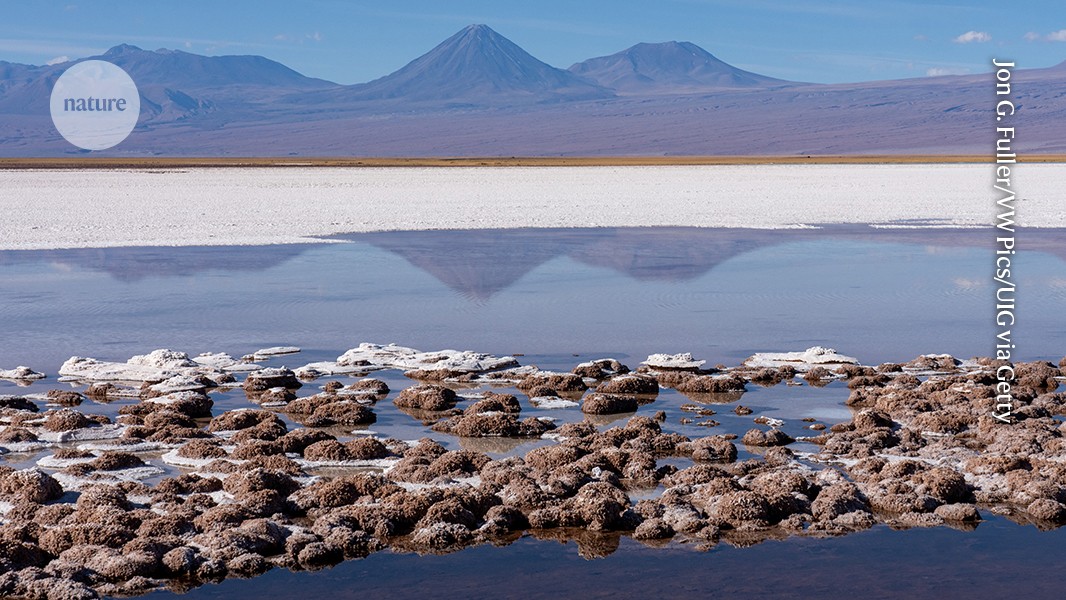
Fossilized microbial mats, known as stromatolites, preserve important evidence of some of Earth’s earliest life.
Credit: Jon G. Fuller/VW Pics/UIG via Getty
Earth and Life: 4 Billion Years of Dialogue Andrew H. Knoll Princeton University Press (2026)
On 14 February 1990, NASA’s Voyager 1 spacecraft briefly turned its camera toward Earth before continuing its journey toward the outer Solar System. The resulting images, famously known as the Pale Blue Dot, became some of the most memorable photographs in the history of space exploration.
Astronomer Carl Sagan, who proposed taking the photograph, reflected on its meaning in his 1994 book Pale Blue Dot. Seen from the edge of the Solar System, Earth appeared as “a lonely dot in the darkness of a vast, enveloping universe”. Everything humanity has known, experienced and created exists on this small, rocky planet surrounded by a thin layer of atmosphere. The image challenged ideas of human importance while inspiring awe, gratitude and a deeper appreciation of life on Earth.
‘Climate freefall’: why the biggest risk to our economy is still unrecognized
For centuries, scientists and philosophers have asked how life began on Earth, how it transformed the planet and whether life exists elsewhere in the Universe. What conditions made life possible? Is biology common beyond Earth? And will humanity ever find definitive answers?
These questions drive Andrew Knoll’s book Earth and Life. Written for a general audience, this ambitious work draws on the geobiologist’s long career and builds on the ideas explored in his earlier book, Life on a Young Planet (2003). Knoll examines how physical, chemical and biological processes have interacted and changed across geological time — an ongoing dialogue that shaped both Earth and life.
Knoll introduces readers to geobiology through the history of the discipline and his own scientific experiences. He describes how, as an undergraduate, he first recognized that living organisms and the planet influence one another. That insight became a defining moment in his career. The book also traces the development of geobiology over the past three centuries, from the Enlightenment to modern research, while acknowledging the scientists who established the field.
To solve the origin of life, treat discoveries as pieces of a larger puzzle
The book explores Earth’s major biogeochemical cycles, the availability of life-sustaining elements, the origin of life and the evolutionary relationships among organisms. It shows how microorganisms repeatedly transformed the global environment. During the Great Oxidation Event, for example, microbial activity helped drive the initial rise of atmospheric oxygen. Yet Knoll emphasizes that biology was only one part of the process: plate tectonics, weathering and other chemical and physical mechanisms also helped create the conditions for planetary change.
Atmospheric oxygen is presented as a story told in three acts. Knoll explains how interactions among geological, chemical and biological processes produced different oxygen levels at different stages of Earth’s history. The book concludes by considering how evidence from the deep past can improve our understanding of modern climate change and guide the search for life on other planets.
How to Understand Earth’s Deep Past
Reconstructing ancient history has enormous intellectual appeal, but it is also extremely difficult. Understanding events from decades or centuries ago can be challenging; interpreting events that occurred millions or billions of years ago is far more demanding. To investigate the history of life on Earth, scientists examine evidence preserved in ancient rocks. That geological record is incomplete. Some periods are represented by abundant material, whereas other evidence has been altered or destroyed by tectonic activity.
Even when researchers identify ancient rocks that appear to contain signs of life, interpreting them can be difficult. Did a suspected biosignature come from a living organism, or was it created by an entirely abiotic process? Because scientists cannot observe Earth’s past directly, they must compare different lines of evidence and reconstruct the most plausible explanation. Earth conducted the experiment only once, leaving researchers to assemble its history from the fragments that remain.

A spider star fossil from the Jurassic period, which lasted from approximately 200 million to 145 million years ago.
Credit: G. Cigolini/De Agostini via Getty
Building a coherent account of Earth’s four-billion-year history requires imagination, technical expertise, persistence and a willingness to acknowledge uncertainty. Good historians of Earth remain open to new evidence and revise their interpretations when discoveries challenge established ideas. Knoll shows how this approach has shaped modern geobiology.
He brings the field’s major debates to life, describing the disagreements, discoveries and passionate arguments that have influenced scientific thinking. By explaining how consensus developed around key questions, Knoll also gives readers a more human view of science. Researchers agree that the Great Oxidation Event occurred roughly 2.4 to 2.2 billion years ago, for example, but they continue to debate why atmospheric oxygen increased at that particular time.
How do we know if there is life on Earth? This bold experiment revealed:
Above all, Knoll explains the practice of geological reasoning. Geologists are, in many ways, detectives working in the field. They use rocks, fossils, chemical signatures and geological context to test competing explanations. The book shows that reconstructing Earth’s past is not speculation, but a rigorous, evidence-based process in which contextual clues help scientists determine which interpretation is most convincing.
The book is enriched by Knoll’s personal experiences. He introduces the researchers who influenced and inspired him and takes readers to remote locations where he collected geobiologically important samples. With clarity and precision, he covers subjects ranging from the origin of life and the evolution of organisms to the geological processes that made Earth habitable. Earth and Life offers an accessible and compelling account of how life and the planet have shaped one another across deep time.
Source: www.nature.com