


Editor’s note: Today’s story is our October puzzler.
Spider Crater: NASA Image Reveals an Ancient Meteorite Impact in Western Australia
Viewed from above, the unusual geology of Western Australia’s Spider Crater is striking—and even a little unsettling. Located in the Kimberley region, the feature was created by a meteorite impact and shaped by hundreds of millions of years of erosion.
A Spider-Shaped Impact Structure
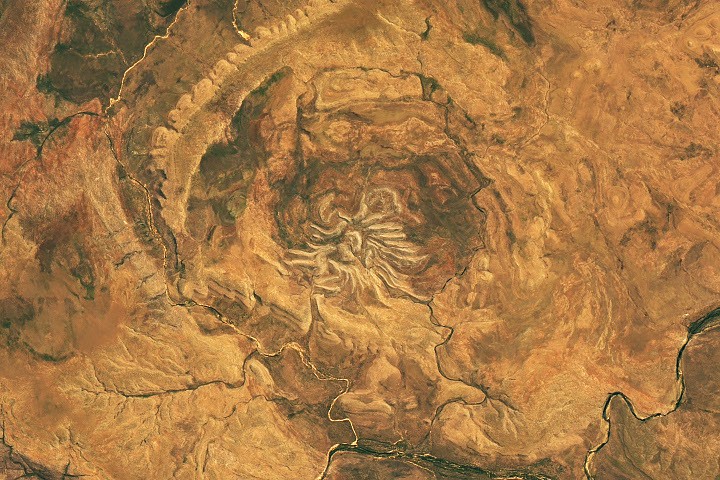
The Operational Land Imager (OLI) aboard the NASA–USGS Landsat 9 satellite captured this image of Spider Crater on September 20, 2026. The entire impact structure is oval-shaped, measuring approximately 13 kilometers by 11 kilometers (8 miles by 7 miles). At its center is a spider-like formation about 4 kilometers (2.5 miles) in diameter.
According to geologists, the unusual arachnid pattern includes a central uplift—a raised area on a crater floor formed when rock rebounds after a major impact. The light-colored “legs” are sandstone ridges that resisted erosion better than the surrounding rock formations.
Evidence of a Meteorite Collision
For decades after Spider Crater was discovered, scientists debated how it formed. Some proposed that ancient volcanic activity created the feature. However, geological research at the site has identified clear evidence of a high-energy impact, including shatter cones.
Shatter cones are distinctive fractures that form when powerful shock waves pass through rock. They occur throughout Spider Crater’s central dome, supporting the conclusion that the structure was produced by a meteorite impact rather than volcanic activity.
How Old Is Spider Crater?
Scientists have also conducted laboratory analyses of shocked quartz and zircon crystals collected from the sandstone. These minerals may help researchers reconstruct the meteorite’s angle of impact.
The precise age of the impact remains unknown. Based on the ages of rocks in the surrounding area, estimates suggest that Spider Crater formed approximately 900 million to 600 million years ago, making it a late Precambrian impact structure.
NASA Earth Observatory image by Michala Garrison, using Landsat data from the United States Geological Survey. Story by Lindsay Dorman.
References
- Abels, A. (2005). Spider impact structures on the Kimberley Plateau, Western Australia: Interpretation of formation mechanisms and ages based on integrated map scale data. Australian Geoscience Journal, 52(4–5), 653–664.
- Cox, M.A. et al. (2021). Asymmetric impact deformation in the Western Australian spider impact structure. Meteoritics & Planetary Science, 56, 331–351.
- Impact Earth. Spider – Hypervelocity Impact Crater. Accessed October 8, 2026.
- Kenkman, T., and Pohlchau, M.H. (2013). Central uplift of Spider Crater, Western Australia. Large Meteorite Impacts and Planetary Evolution V.
- Lunar and Planetary Institute. Planet Formation: Impact Craters. Accessed October 8, 2026.
- McHone, J.F. et al. (2002). Spider impact structure, Western Australia, photographed by Space Shuttle radar. Lunar and Planetary Science XXXIII.
Source: science.nasa.gov