


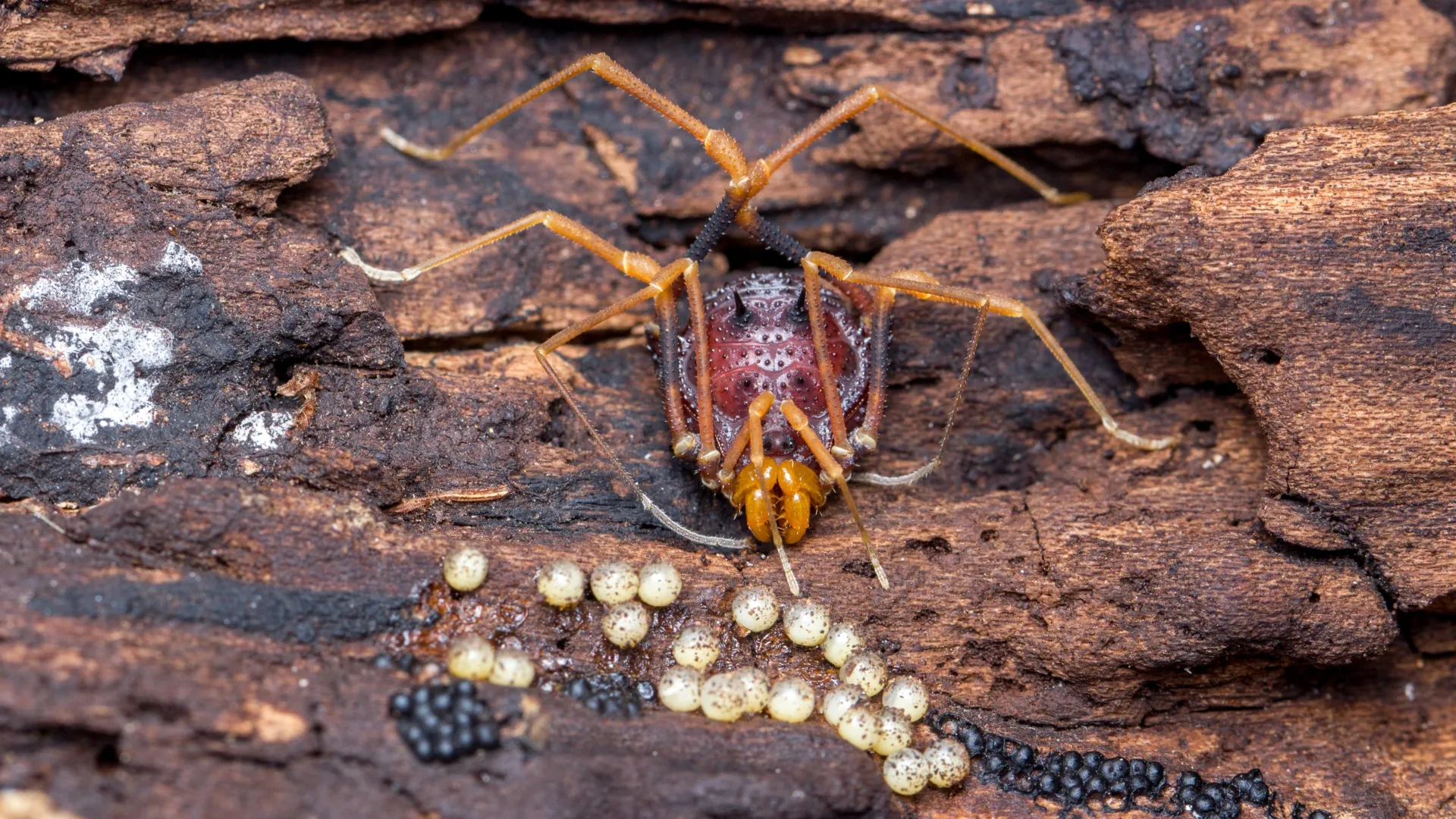
Citizen scientists are playing a pivotal role in helping researchers uncover the evolution of parental care in harvestmen, a fascinating group of spider-like arachnids. By contributing observations through the popular nature platform iNaturalist, these passionate individuals have aided in revealing groundbreaking insights. Recent findings published in the Zoological Journal of the Linnean Society demonstrate that parental defensive behaviors in harvestmen have evolved, vanished, and re-emerged multiple times throughout the group’s evolutionary history.
By combining nearly three decades of field research with observations submitted to iNaturalist, an international team led by scientists from the University of São Paulo has significantly increased the documented instances of parental care in harvestmen. This expanded dataset has allowed researchers to reconstruct the evolution of both maternal and paternal care within the superfamily Gonileptoii for the first time.
The Role of Citizen Science in Understanding Parental Care Evolution
The analysis uncovered that the evolution of parental defensive behavior is not linear; instead, it has appeared, disappeared, and later reappeared across different lineages. Interestingly, maternal care seems to have evolved solely from species lacking parental care, aligning with similar patterns observed in insects. Conversely, paternal care emerged through two distinct evolutionary pathways, either directly from species without parental involvement or from those where females were already protecting their eggs. This highlights diverse evolutionary pressures influencing maternal and paternal care development.
Researchers suggest that when paternal care evolved from maternal care, it may symbolize a form of sexual selection termed “fertility enhancement,” where females prefer males that have already exhibited caregiving behaviors toward their eggs.
Why Harvestmen are Ideal for Studying Paternal Care
With over 6,900 identified species, harvestmen stand out as one of the most diverse groups of arachnids. Although they make up just around 0.6% of total arthropod diversity, they account for over half of the documented instances of uniquely evolved paternal care among arthropods, making them a prime subject for studying the evolution of child-rearing behaviors.
Lead author Glauco Machado stated:
“Paternal care is rare in nature, with this behavior evolving independently numerous times. Observing harvestmen allows us to explore factors that lead to the development of this behavior. In many species where males exclusively care for their offspring, this caregiving is often a sexually selected trait, indicating that females prefer males who actively care for eggs.”
iNaturalist: Expanding the Dataset of Parental Care
Citizen science enables individuals lacking formal scientific training to provide crucial observations. Globally, volunteers have contributed to monitoring bird populations, rediscovering lost species, and even uncovering ancient writing systems through cave paintings. Their contributions serve as an invaluable source of scientific data.
Machado and his team pivoted to the global iNaturalist platform after learning about its successful application in bird research. This platform allows users to upload georeferenced observations of various plants and animals from nearly anywhere in the world.
The findings demonstrate how citizen science can accelerate research significantly. From 1936 to 2025, scientific studies documented parental vigilance behavior in only 80 species of harvestmen. However, thanks to iNaturalist, the researchers more than doubled that count, adding 62 new records exclusively from the platform. Notably, the search on iNaturalist itself took only two days.
Advantages of Citizen Science in Research
According to Machado, the primary advantage of iNaturalist lies not only in the volume of observations but in scientists’ ability to access these records globally.
“This is an invaluable resource that accelerates the accumulation of biological information. Collecting data through traditional museum visits is prohibitively expensive and time-consuming. In contrast, we completed our search in just one week.”
By reducing costs associated with museum research and extensive fieldwork, citizen science platforms are making large-scale biological research increasingly accessible, particularly for scientists based in the Global South.
The Ongoing Need for Taxonomists
Despite the growing significance of citizen science, researchers emphasize the continued necessity for professional taxonomists. Accurately identifying species, differentiating between male and female caregivers, and distinguishing true parental care from behaviors like mate guarding all require specialized knowledge.
Machado highlighted the crucial role of taxonomists:
“The role of the taxonomist in modern science is more critical than ever. You cannot conserve a species without its name, which only taxonomists can provide. Thus, their work is vital.”
Research Limitations and Future Directions
The researchers acknowledge that their study has limitations, particularly regarding sampling bias; species actively guarding their eggs are far easier to observe than those showing no parental care. Nonetheless, they argue that studies such as this help fill substantial gaps in understanding which species exhibit parental care.
With over half of the analyzed records being newly documented, Machado believes that citizen science will continue to grow in importance for researching parental behaviors across various animal groups.
“This represents a significant advancement for researchers studying insects, frogs, and other animal groups exhibiting both maternal and paternal care behaviors.”
Source: www.sciencedaily.com