


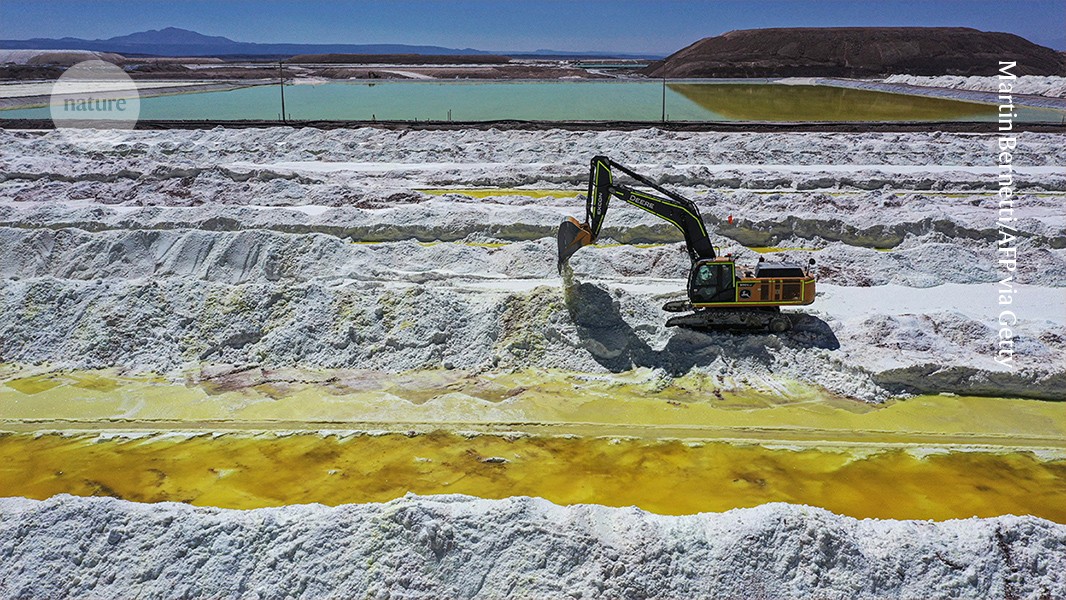
Lithium salts being recovered from brine pools in South America.Credit: Martin Bernetti/AFP via Getty
Rising demand for electric vehicles and renewable-energy storage is increasing the need for lithium, a key material in most rechargeable batteries. However, conventional lithium mining can place significant pressure on water supplies and ecosystems. New extraction technologies could help make lithium production more efficient and environmentally sustainable.
Electric vehicles represented more than one-quarter of global car sales last year, according to the International Energy Agency. The agency estimates that lithium demand from electric vehicles could reach approximately 665 kilotonnes by 2035. Existing and planned mining projects are expected to produce only about 450 kilotonnes, creating a considerable supply gap unless production capacity expands.
Growing demand for lithium-ion batteries used to store renewable electricity will add further pressure to global lithium supplies, says Zhikao Li, a chemical and biological engineer at Monash University.
Approximately 25% of the world’s lithium is projected to come from regions of Chile and Argentina. There, mining companies pump lithium-rich brine from underground aquifers into large evaporation ponds. Over months or years, sunlight and wind evaporate the water, concentrating the brine until lithium-containing salts can be collected. Although widely used, this approach is inefficient, researchers say. Brine contains several dissolved salts with different solubilities. As water evaporates, less-soluble compounds crystallize first, while lithium salts are among the last to separate. As much as 50% of the lithium can remain in the evaporation ponds, and additional freshwater is often required to refine the remaining material.
“The key limitation for existing processes is the fresh water, and also it’s a very slow process,” says Huanting Wang, who is developing alternative lithium-extraction methods at Monash University in Melbourne, Australia.
Water consumption is especially concerning because lithium brine deposits are often found in arid and semi-arid regions, where freshwater is already limited, says Ehsan Vahidi, a metallurgical-engineering researcher at the University of Nevada in Reno.
Researchers also warn that brine mining can affect Indigenous communities and threaten sensitive wetland ecosystems.
Greener alternatives for lithium extraction
Direct lithium extraction is emerging as a potential alternative to conventional evaporation ponds. These systems use membranes, solvents or electrochemical processes to selectively separate lithium ions from brine, potentially reducing water use and shortening production times.
One approach is being developed by Wang’s team at Monash University. The researchers first evaporated brine to create a solid mixture of salts. They then used acetone and ethanol to dissolve lithium salts selectively while leaving most other compounds behind. In a laboratory study published last month, the team reported recovering approximately 95% of the lithium present1.
According to the researchers, the process uses substantially less freshwater than traditional lithium extraction. It could also be combined with solar-powered systems that capture and condense evaporated water, enabling the water to be recycled rather than released into the atmosphere. The solvents may likewise be recovered and reused.
Wang says the technology could eventually be adapted to recover lithium from industrial waste streams and mining residues, helping to extract valuable material that would otherwise be discarded.
Peter Sherrell, a materials scientist at RMIT University in Melbourne, says the approach offers several potential advantages over conventional lithium production, including a high recovery rate and the ability to reuse the solvents. However, he adds that it remains uncertain whether the mining industry will invest in scaling the technology for commercial use.
Source: www.nature.com