


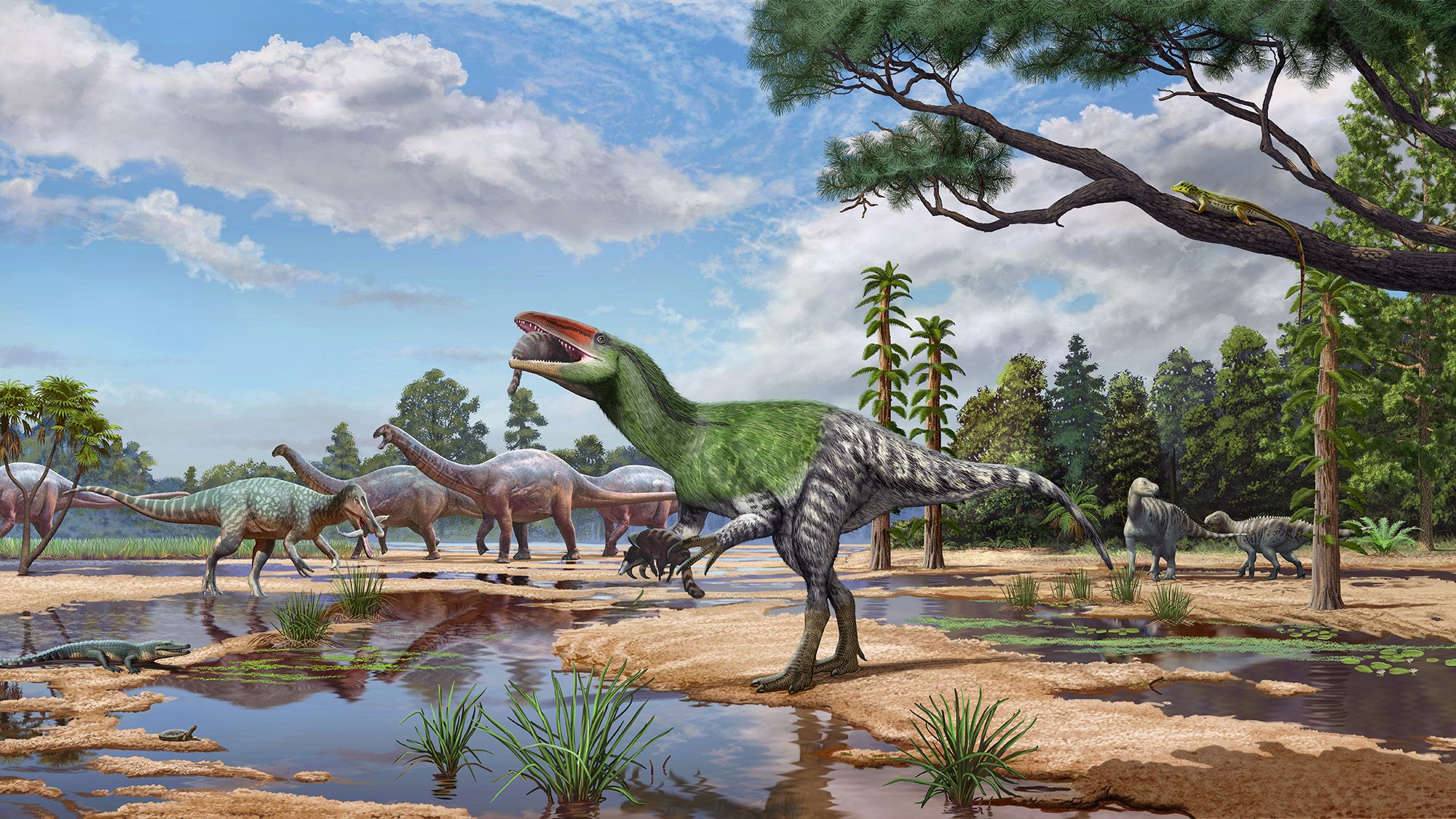
Century-Old Museum Fossil Reveals a New Megaraptor Dinosaur from Europe
A fossil that sat largely unnoticed in a museum collection for nearly a century has been identified as a previously unknown species of predatory dinosaur. The discovery marks the first confirmed megaraptor found in Europe and offers new clues about how these powerful hunters spread across the ancient world.
The dinosaur lived on the Isle of Wight in what is now southern England approximately 120 million years ago, during the Cretaceous Period. It belonged to Megaraptora, a group of two-legged carnivorous dinosaurs related to tyrannosaurs. Unlike tyrannosaurs, megaraptors are thought to have relied on strong arms and large, curved claws to attack prey and defend themselves.
A forgotten fossil from the Isle of Wight
The story began in 1924, when an amateur fossil collector discovered part of a dinosaur skull on the Isle of Wight. The specimen eventually entered the collection of the Natural History Museum in London, where it remained largely forgotten.
Researchers recently reexamined the fossil during a study of dinosaur braincases. Using micro-CT scans, they examined the skull’s internal structure and created a detailed 3D model of the space where the dinosaur’s brain once sat.
“It’s a real mystery that this fossil has been sitting in a drawer for nearly 100 years, overlooked for so long,” said study lead author Cassius Morrison of the Department of Earth Sciences at University College London. “Many bones have been discovered on the Isle of Wight. Who knows what else is waiting to be discovered?”
Meet Invictivellatrix amberina
The researchers compared the fossil’s anatomy with that of other carnivorous dinosaurs, including tyrannosaurs, Spinosaurus and other theropods. Several features distinguished it from those species, including an approximately oval-shaped opening where the spinal cord entered the skull and an unusual hourglass-shaped bulge at the rear of the braincase.
Computer-based evolutionary analysis placed the fossil within the megaraptor family tree, supporting the conclusion that it represented a new species. The researchers named the dinosaur Invictivellatrix amberina. The genus name combines Latin words meaning “unconquered” and “woman warrior,” while the species name refers to amber found in rocks associated with the fossils.
Although the fossil does not preserve the dinosaur’s arms or claws, its closest relatives suggest that the claws may have measured approximately 4 to 8 inches (10 to 20 centimeters) long. The researchers also suggested that I. amberina may have had feathers, although the specimen cannot directly confirm this.
How big was this newly identified dinosaur?
Megaraptors lived from approximately 125 million to 66 million years ago and varied considerably in size. Early species were relatively small, while some later members became enormous predators.
Maip macrothorax, discovered in Argentina, may have reached approximately 33 feet (10 meters) in length and weighed as much as an elephant. By comparison, I. amberina was probably 10 to 13 feet (3 to 4 meters) long and about 5 feet (1.5 meters) tall. Researchers estimated that it weighed approximately 440 to 660 pounds (200 to 300 kilograms), making it one of the smallest known megaraptors.
“Although it wasn’t an apex predator at the time, this dinosaur would have been more dangerous to humans than Tyrannosaurus,” Morrison said. “We would have had a perfectly sized catch, about a third of our body weight. They definitely would have followed us.”
The first confirmed megaraptor in Europe
The study, published in Royal Society Open Science in October 2026, fills an important gap in the fossil record of megaraptors. The group’s evolutionary history remains poorly understood, in part because European fossils have been scarce.
Scientists have long suspected that megaraptors originated in Asia before spreading to other parts of the world. Some researchers have proposed that they eventually reached Gondwana, the southern supercontinent that included present-day Africa, South America and Antarctica.
The new evolutionary model suggests that I. amberina descended from Asian megaraptors that dispersed to Europe approximately 130 million years ago. From Europe, members of the group may have migrated through what is now Africa and into Gondwana, possibly using temporary land connections and shallow routes across the Tethys Ocean.
“This new species is the first evidence that megaraptors also existed in Europe and that they reached Gondwana in this way, rather than hopping around islands further south,” said Charlie Scherer, a UCL Earth Sciences PhD student and study co-author.
A possible route across the ancient world
The exact route these dinosaurs took over millions of years remains unknown. Researchers also cannot yet explain why megaraptors disappeared from northern regions, although climate change and competition from other dinosaur predators may have played a role.
Additional research on megaraptor fossils, including I. amberina, could reveal more about the group’s migration, behavior and eventual extinction.
“Studies like this demonstrate the extraordinary value of working with historic museum collections, where much remains to be discovered,” said Paul Barrett, a dinosaur evolution researcher at London’s Natural History Museum.
Why museum collections still matter
The discovery shows how modern tools such as micro-CT scanning and computer-based evolutionary analysis can transform long-overlooked fossils. A specimen collected more than 100 years ago has now provided evidence that megaraptors once lived in Europe and may have played a role in the group’s journey to the southern continents.
Source: Morrison, Cassius; Scherer, Charlie R.; Mannion, Phillip; Polo, Laura B.; Clark, Brett; Foulkes, Daniel D.; and Barrett, Paul M. “A new megaraptoran dinosaur discovered from the Lower Cretaceous Wessex Formation of Britain and its implications for theropod evolution and biogeography.” Royal Society Open Science, October 2026.
Source: www.livescience.com