


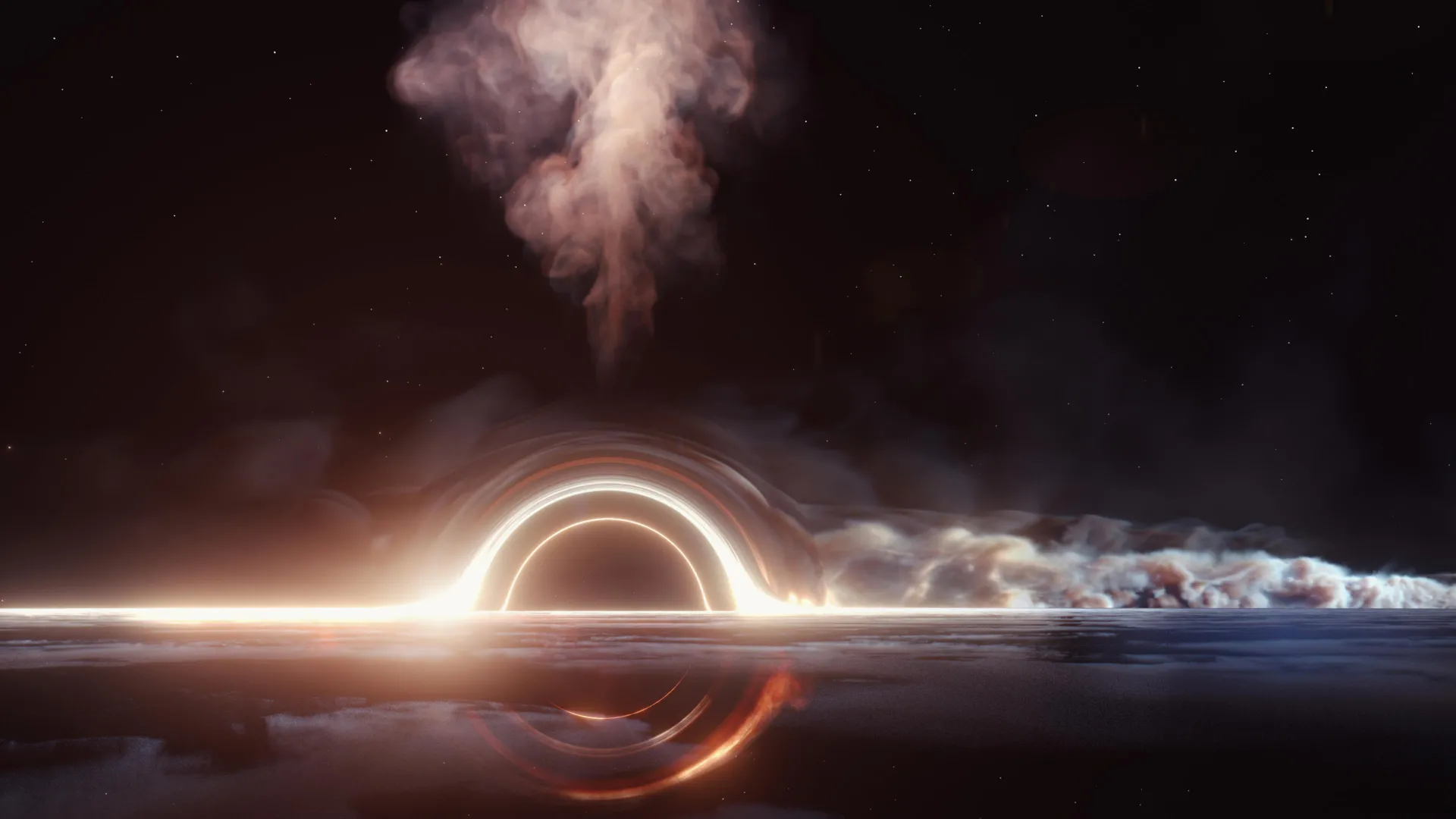
Black Holes Follow a Universal 2% Rule When Launching Powerful Jets
Astronomers have discovered a surprising rule that appears to determine when black holes launch powerful jets of matter into space. Although black holes can differ in mass by millions of times, they seem to follow the same basic pattern when producing these enormous cosmic outflows.
The discovery suggests that whether a black hole is about 10 times more massive than the Sun or millions of times more massive, it can activate jets at the same critical stage of its feeding cycle.
The research was led by Dr Adele Goodwin, an astrophysicist and Forest Research Foundation Fellow at Curtin University’s International Center for Radio Astronomy Research (ICRAR), with co-author Dr Andrew Mummery from the Institute for Advanced Study in Princeton.
The breakthrough emerged from years of research into supermassive black holes tearing apart stars. By combining observations from telescopes in Australia, the United States, India, South Africa and space, scientists developed a clearer picture of how black holes behave as they consume matter.
Surprisingly, the key insight did not emerge while researchers were examining telescope data. It came during a conversation at a bar in Madrid, where Goodwin and Mummery were attending a scientific conference. They realized that the same laws governing jet formation in relatively small black holes also appeared to apply to their supermassive counterparts.
Why Do Some Black Holes Launch Jets Years After Swallowing a Star?
One of the biggest mysteries researchers wanted to explain was why black holes do not always launch jets at the same time.
When a supermassive black hole tears apart a star, it can generate powerful jets almost immediately. In other cases, the black hole can remain relatively quiet for months or years before suddenly emitting detectable radio waves.
“We were looking at these events and wondering why the timing was so different,” Dr Goodwin said.
“Then a pattern became clear: the delayed jets were emerging when the black hole’s feeding rate dropped to the same critical point already known for much smaller black holes.”
“This was the moment we realized that this was not just a quirk of some kind of black hole, but rather a law that applied throughout the universe.”
Black holes are often depicted as cosmic vacuum cleaners that swallow everything nearby, but their feeding behavior is much more complex.
As matter spirals toward a black hole, not all of it disappears beyond the event horizon—the boundary beyond which nothing can escape. Some material can instead be ejected into space through powerful jets and other outflows.
“When a black hole tears apart a star, it doesn’t swallow everything cleanly,” Dr Goodwin said.
“Some of the material is consumed and some is launched into space in powerful jets or outflows.”
“You can think of this as a black hole burp, but this burp can send material far away and affect surrounding galaxies.”
These massive outflows carry energy and matter far from the black hole, potentially influencing the surrounding galaxy.
How Scientists Studied Supermassive Black Hole Jets
Astronomers have long suspected that black holes operate according to the same underlying laws of physics, regardless of their mass. However, proving that connection has been difficult.
One major obstacle is time. The feeding behavior of supermassive black holes can change over thousands of years, making it nearly impossible for astronomers to observe an entire feeding cycle.
Goodwin and her colleagues addressed this problem by investigating a rare phenomenon known as a tidal disruption event.
Tidal disruption events occur when a star passes too close to a supermassive black hole and is torn apart by its extreme gravity. Some of the resulting debris falls toward the black hole, temporarily increasing its feeding activity.
Unlike the much longer changes typically associated with supermassive black holes, these dramatic episodes can unfold over just a few years. This gave scientists a rare opportunity to track how supermassive black holes respond to changes in their supply of matter.
The research team initially examined 20 tidal disruption events using observations collected at visible, ultraviolet, X-ray and radio wavelengths. The researchers then selected 10 events for which the available data made it possible to reliably estimate both the rate at which each black hole consumed matter and the timing of its radio outflow.
By comparing these events, researchers identified a surprisingly consistent pattern.
The Universal 2% Rule for Black Hole Jets
The observations revealed two distinct stages in which black holes can produce jets.
The first occurs early in the feeding process, when the black hole consumes matter at a very high rate.
The second can occur long after the star has been destroyed—hundreds or even thousands of days later.
At this later stage, the jet emerges when the black hole’s feeding rate falls to about 2% of the Eddington limit.
The Eddington limit is a theoretical benchmark describing the point at which the outward pressure produced by radiation balances the inward pull of gravity. Astronomers use it to measure how intensely a black hole is feeding relative to its physical limits.
What makes the discovery particularly important is that the same 2% threshold has already been linked to jet formation in much smaller black holes in the Milky Way.
In other words, black holes separated by enormous differences in mass appear to activate delayed jets at essentially the same relative feeding rate.
“Although these black holes are separated by large differences in mass, they appear to switch on their jets at the same point in their feeding process,” Goodwin said.
“This tells us something fundamental about black holes. Physics doesn’t seem to care about how big they are.”
The finding offers a potential explanation for an otherwise puzzling observation. Some black holes produce radio jets immediately after destroying a star, while others appear inactive before generating powerful outflows much later.
Rather than being unpredictable, these delayed eruptions may be controlled by a common physical threshold.
Could Astronomers Predict When a Black Hole Will Launch a Jet?
The discovery not only reveals important information about black hole physics; it could also help astronomers make more effective use of powerful radio telescopes.
Observation time at major scientific facilities is limited and highly competitive. Researchers must decide which objects to study, how frequently to observe them and when they are most likely to reveal important activity.
If astronomers can estimate when a black hole’s feeding rate is approaching the critical threshold, they may be able to predict when a delayed jet will appear.
“Radio telescopes are incredibly powerful, but knowing when to look is just as important as knowing where to look,” Dr Goodwin said. “If we can predict when a black hole is likely to fire a jet, we can run more targeted campaigns, reduce wasted observations and increase our chances of catching these rare events at the most important moments.”
This could reduce unnecessary follow-up observations while improving the likelihood of detecting rare jet-launching episodes at critical moments.
The finding is particularly relevant to Western Australia, which hosts the low-frequency component of the Square Kilometre Array Observatory (SKAO), one of the largest and most ambitious radio astronomy projects ever undertaken.
The Australian Government is investing $387 million in the SKA, bringing the project’s total cost to more than $2 billion. More efficient use of these expensive facilities could benefit astronomers and the wider scientific community by enabling more discoveries with the available observing time.
As next-generation astronomical surveys identify more tidal disruption events, researchers will face the increasingly difficult task of determining which events deserve closer attention.
The newly identified relationship between feeding rate and jet formation could provide a valuable guide, helping scientists focus their observations on the black holes most likely to produce detectable outflows.
A Black Hole Breakthrough Driven by Curiosity
Professor James Arvanitakis, director of the Forest Research Foundation, said the discovery highlights the importance of supporting young scientists as they pursue ambitious questions without knowing in advance where the answers will lead.
This type of open-ended investigation, sometimes described as “bolt-in-the-blue” research, can produce unexpected discoveries with benefits that extend far beyond the original scientific question.
“The Forest Research Foundation did not fund predetermined answers. We supported excellent researchers who asked difficult questions,” Professor Arvanitakis said.
“That question has led to internationally significant discoveries. This is precisely why basic research is important. It extends what we know, sharpens how we use key scientific infrastructure and builds capabilities far beyond astronomy.”
“The fact that this discovery was made in Western Australia speaks to the strength of our research ecosystem and the value of giving talented people a reason to build a career here.”
By linking the behavior of relatively small black holes to that of supermassive giants, the discovery strengthens the idea that the same fundamental physical processes operate across vastly different scales.
It also gives astronomers a more reliable way to predict when a black hole may begin shooting powerful jets into space—one of the most dramatic phenomena in the universe.
Source: www.sciencedaily.com