


“Pac-Man” Enzyme Helps Bacteria Break Down Bioplastics—and Penicillin
Plastic pollution is one of the world’s most persistent environmental problems. Huge amounts of discarded plastic accumulate in the oceans, sometimes forming vast garbage patches that threaten marine life. Most conventional plastics decompose extremely slowly because microorganisms struggle to digest the synthetic polymers they contain. Instead of disappearing, these materials gradually fragment into smaller particles, including microplastics and nanoplastics.
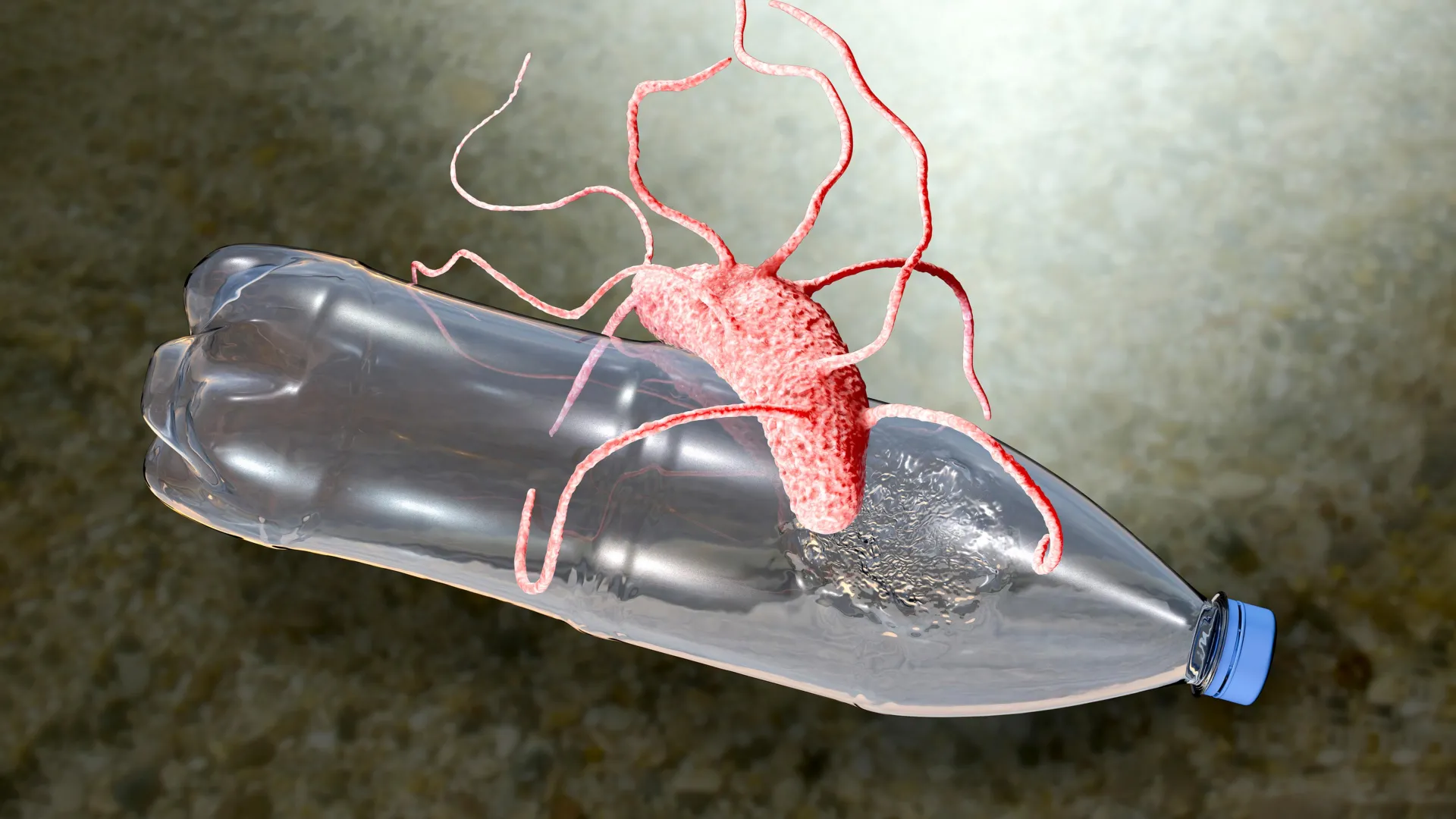
However, plastic waste is not completely beyond the reach of nature. Bacteria and other microorganisms can colonize plastic surfaces, creating communities known as biofilms. Scientists call this distinctive microbial ecosystem the plastisphere.
Researchers at the University of Konstanz have discovered an unusual enzyme that may help explain how some bacteria are becoming better equipped to break down certain types of plastic. The enzyme can digest particular polyesters and biodegradable plastics. It can also break down penicillin, revealing a surprising structural connection to antibiotic resistance.
Scientists have nicknamed the enzyme “Pac-Man” because its molecular structure features an unusually wide opening at its active site, where chemical reactions occur. The discovery suggests that bacteria may be adapting to digest some plastic materials more quickly than researchers previously believed.
There is an important limitation, however. Microorganisms are unlikely to make a meaningful contribution to reducing plastic pollution unless more products are made from biodegradable materials containing chemical bonds that microbes can break apart.
How Scientists Tested Bacterial Plastic Decomposition
To investigate how microorganisms digest biodegradable plastics, University of Konstanz biologists Harry Lerner and David Schleheck studied the entire process of microbial decomposition. They wanted to determine whether the materials could be completely broken down, which microorganisms were responsible, and which biological mechanisms enabled the process.
The researchers analyzed the composition of the microbial communities involved and examined their collective genetic information, known as the metagenome. This approach allowed them to search for genes that might produce enzymes capable of breaking apart plastic polymers.
Their experiments focused on long-chain aliphatic polyesters, or LCAPs. These biodegradable plastic materials were developed by a research team led by chemist Stefan Mecking. Unlike the resistant structures found in many conventional plastics, LCAPs contain chemical bonds that some microorganisms may be able to break down.
The collaborative findings were published in The ISME Journal.
To observe how the bioplastics behaved in a natural environment, the researchers placed samples beneath the surface of forest soil at the University of Konstanz’s botanical garden.
“We buried small pieces of LCAP bioplastic film in the upper humus layer in the forest at the university’s botanical garden, about ten centimeters deep,” explains Harry Lerner.
“This layer is where the breakdown of cellulose and other natural polymers, such as cutin—a plant-based polyester—takes place.”
Humus is the upper layer of soil rich in decomposing organic matter. It contains microorganisms that play a major role in recycling nutrients. Cellulose is the main structural component of plant cell walls, while cutin is a naturally occurring polyester that helps form the protective outer covering of plants.
The researchers selected this environment because its microorganisms already possess the biological machinery needed to break down complex natural materials.
Bioplastics Decomposed in About a Year
Alongside the outdoor experiment, the scientists conducted laboratory tests using soil collected from the same forest. They mixed powdered bioplastics into the soil and monitored microbial activity over an entire year.
One important measurement was the amount of carbon dioxide, or CO2, released by the samples. When microorganisms consume and metabolize organic materials, they produce carbon dioxide through respiration. Tracking this gas helped the researchers determine how actively microbes were breaking down the plastics.
The buried plastic films remained in the forest soil for a full year. This allowed the team to compare decomposition under natural conditions with the closely monitored laboratory experiments.
The researchers also tested cellulose, other biodegradable plastics, conventional polyethylene, and soil samples without added materials.
“Cellulose, other types of bioplastics such as PHBV and PCL, as well as high-density plastic (HDPE) and untreated soil were used as controls in the laboratory. We found that all bioplastic materials were completely degraded within roughly 250 to 330 days. Cellulose broke down after about 80 days, whereas virtually no degradation occurred for HDPE,” says Lerner.
The difference was striking. The biodegradable plastics completely decomposed in approximately nine to eleven months, while conventional high-density polyethylene showed almost no decomposition.
These results demonstrate why the chemical composition of plastic matters. Some polymers contain bonds that microbial enzymes can attack, enabling bacteria to dismantle them into smaller molecules. Others, including widely used polyethylene, are much more resistant to biological degradation.
Microscopic Holes Reveal How Bacteria Attack Plastic
When the researchers recovered the plastic films from the forest soil, they discovered an unexpected pattern.
Using electron microscopy, the team examined the surfaces of the buried materials. They found numerous tiny holes, each approximately matching the dimensions and shape of an individual bacterial cell.
The pattern suggested that the bacteria were doing more than simply attaching themselves to the plastic. They appeared to be breaking into the material itself.
“We hypothesized that bacteria are coated with plastic-depolymerases anchored to their cell surfaces. This would enable them to digest their way into the material and become embedded within the film, leaving behind microscopic holes of exactly this type,” explains Lerner.
Depolymerases are enzymes that break large molecules called polymers into smaller chemical units. When attached to the outside of a bacterium, these enzymes could allow the microorganism to digest nearby plastic while remaining in direct contact with it.
This mechanism could explain the microscopic cavities observed in the plastic films. Instead of relying entirely on enzymes released into the surrounding environment, the bacteria may break down the material directly at their cell surfaces.
Scientists Identify the Plastic-Degrading “Pac-Man Enzyme”
To identify the biological machinery behind this behavior, Lerner extracted DNA from the entire community of microorganisms living in the soil samples.
He then sequenced the genetic material and analyzed the data to determine which microbes and genes became especially abundant as the LCAP bioplastics decomposed.
One gene stood out. It was strongly enriched in forest soil containing LCAP, suggesting that it could play an important role in breaking down the biodegradable polyester.
Further analysis showed that the gene produces an esterase, an enzyme capable of splitting certain chemical bonds found in esters. These bonds occur in many natural substances and in various biodegradable polyesters.
The enzyme’s position on bacterial cells made it especially interesting. Its genetic instructions included a secretion signal that directs the enzyme outside the cell, along with a lipid anchor that holds it to the cell membrane.
This arrangement allows the enzyme to remain attached to the bacterium’s surface while attacking nearby plastic molecules. Its unusually exposed active site also provides room for the enzyme to interact with polymer chains.
The researchers had identified both the molecular mechanism they were looking for and the enzyme they named “Pac-Man.”
A Surprising Link to Antibiotic Resistance
The discovery became even more intriguing when the scientists examined the enzyme’s molecular structure.
Although the enzyme resembled esterases, which break down ester bonds, it also shared structural similarities with another important family of bacterial enzymes: beta-lactamases.
Beta-lactamases are well known for their role in antibiotic resistance. Some bacteria produce these enzymes to disable antibiotics such as penicillin by breaking open a critical part of their chemical structure called the beta-lactam ring.
“Its structure resembles that of esterases, but also that of beta-lactamases, which are bacterial enzymes that are capable of cleaving the beta-lactam ring of certain antibiotics, such as penicillin, thereby making bacteria resistant to antibiotics,” says Lerner.
Laboratory experiments confirmed that the newly discovered enzyme could perform both types of chemical reactions. It could break polyester chains into their individual building blocks, known as monomers, while also cleaving penicillin.
This dual activity was surprising because plastic degradation and antibiotic breakdown are usually considered separate biological functions.
The finding raises the possibility that some enzymes involved in plastic decomposition could also contribute to antibiotic resistance. However, showing that an enzyme can chemically break down penicillin in the laboratory does not establish that it provides antibiotic resistance to living bacteria.
Could Plastic-Degrading Bacteria Help Reduce Pollution?
The discovery raises a broader question: how quickly can microorganisms adapt to synthetic materials introduced into their environment?
For most of Earth’s history, plastic pollution did not exist. Microorganisms evolved enzymes to digest naturally occurring substances, including plant fibers and other complex organic molecules.
Modern plastics have introduced a vast new collection of potential carbon sources into the environment. Yet many of these materials remain chemically inaccessible to microbes.
“The plastisphere is a new habitat in our environment,” explains Schleheck.
“Humans have only been introducing plastic into the environment in significant quantities for around 50 to 75 years. Since then, it has theoretically been available to microbial communities—such as bacteria, yeasts and fungi—as an additional source of carbon and energy for their growth. By ‘theoretically’, I mean that they would certainly like to use the plastic as a growth substrate—but they cannot, because the materials are actually indigestible to microbial metabolism and are therefore hardly degraded.”
The Pac-Man enzyme suggests that this barrier may not apply to every type of plastic.
Some bacteria appear capable of using specialized enzymes to attack biodegradable polyesters, potentially allowing them to use these materials as sources of energy and nutrients.
For scientists studying plastic pollution, the discovery offers a promising clue about how biological degradation might be improved. It also suggests that microbial communities could adapt to certain synthetic polymers more rapidly than previously anticipated.
However, the findings do not mean that bacteria can suddenly consume the enormous quantities of conventional plastic already accumulating in the environment. In the experiments, polyethylene remained largely unaffected even as the biodegradable plastics decomposed.
Designing Plastics That Microbes Can Digest
Instead, the researchers emphasize the importance of designing materials that microorganisms can actually break down.
“I find this encouraging, because it seems that bacteria can adapt to breaking down polyester plastics more quickly than we expected. To tackle the environmental problem of plastic pollution, we humans need to work with the capabilities of microbes. Ideally, this would involve using only polymers with biochemical breaking points, such as the hydrolysable ester bonds in polyesters like LCAP or other types of bioplastics,” concludes Schleheck.
The discovery offers a glimpse of a potentially more sustainable approach to plastic production. Rather than expecting microorganisms to decompose materials that are naturally resistant to breakdown, scientists could develop plastics with chemical structures that make biological recycling possible.
The Pac-Man enzyme illustrates how bacteria can exploit molecular weak points. It provides new insight into the relationship between plastic pollution, microbial adaptation, biodegradable materials, and the future of biological plastic recycling.
Source: www.sciencedaily.com