


IceCube’s Nobel-winning neutrino discoveries show what it takes to build big science
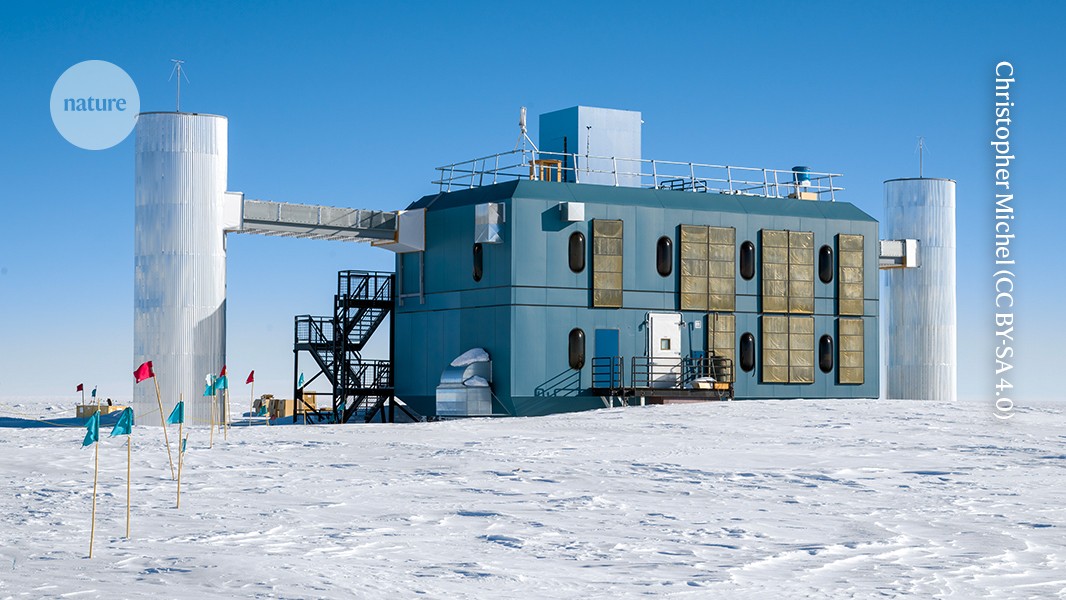
IceCube Neutrino Observatory in Antarctica.
Credit: Christopher Michel (CC BY-SA 4.0)
I vividly remember the first time I read Francis Halzen’s paper on high-energy neutrinos. In the late 1990s, I was an undergraduate student at the University of California, Berkeley. Astroparticle physics was still a young field, and Halzen had made predictions that could not be tested using traditional particle accelerators.
On October 6, Halzen was awarded the Nobel Prize in Physics for his work at the IceCube neutrino observatory in Antarctica. The experiment uses sensors embedded in the ice to detect high-energy neutrinos, a type of fundamental particle, beamed towards Earth from accelerators in distant space.

Nobel Prize in Physics awarded for cosmic neutrino detection
The next generation of neutrino and dark-matter experiments
Astroparticle physicists have many ideas for experiments with the same discovery potential as IceCube. The Underwater Pacific Neutrino Experiment (P-ONE), a collaboration between North America and Europe, is currently under construction off the coast of Vancouver Island, Canada.
Several projects are also exploring dark matter, the matter that neither interacts nor emits light. These include the XLZD collaboration, a European and North American consortium, and China’s PandaX experiment.
However, realizing these experiments is not easy. The story of Halzen and IceCube is a lesson not only about basic science, but also about what it takes to build infrastructure capable of supporting discoveries for decades.
From AMANDA to IceCube: the cost of discovery
When I first read Halzen’s paper in the late 1990s, IceCube had not yet been built. Its predecessor, the Antarctic Muon and Neutrino Detector Array (AMANDA), was operational. AMANDA cost approximately $7 million to construct, far less than the $271 million required to build IceCube.
Even experiments on a smaller scale can be difficult to achieve. They require more resources than an initial proof-of-concept project, but they do not always have the same access to funding needed to make new discoveries.

Astronomy’s ‘adrenaline junkies’: Nobel Prize captures the thrill of neutrino physics
Why small and medium-sized science projects need support
Many countries are facing difficult decisions about research funding and are concerned that small and medium-sized projects may be especially vulnerable to cuts.
For example, the 2023 U.S. Particle Physics Strategic Plan, known as P5, recommends creating a portfolio of small-scale experiments. However, because of budget constraints, it remains unclear whether the proposed portfolio will be implemented.
IceCube’s success demonstrates the scientific potential of ambitious experiments, while its history also shows the long-term investment required to turn a promising idea into a discovery-making observatory.
Read the original paper: F. Halzen et al., 1999.
Source: www.nature.com