


Hazardous Solvents Still Dominate Chemistry Despite Decades of Green Initiatives
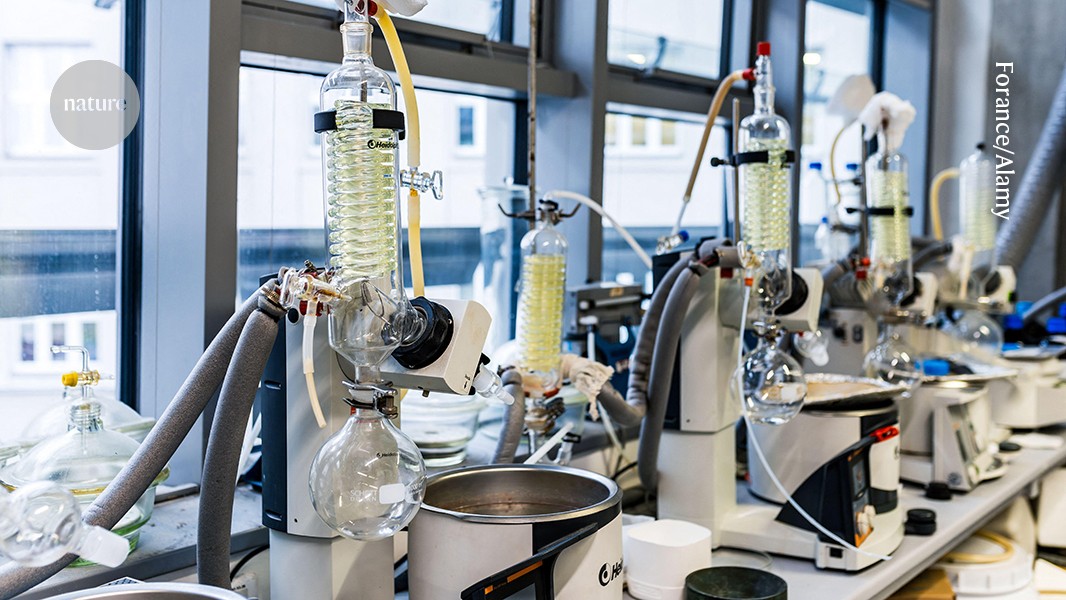
Rotary evaporators are used to remove chemical solvents from reaction products.
Credit: Forance/Alamy
A 40-year analysis of 1.3 million chemical reactions described in patents has found that chemists still rely heavily on hazardous solvents, despite nearly three decades of efforts to promote safer and more sustainable alternatives. The study is the largest and most comprehensive analysis of its kind.
Solvents are the workhorse liquids used to dissolve chemicals during reactions. Chemists also use them to extract and purify reaction products. Some of the most common solvents, including dichloromethane (DCM), pose health risks or are dangerous in other ways. Many are flammable, and almost all are derived from oil or natural gas, giving them a significant environmental impact.
A study published this month in Angewandte Chemie1 found that solvents classified as hazardous accounted for about 60% of reactions described in patents in 1976. By 2016, that figure had risen to more than 70%.
“I’m more disappointed than surprised,” said Helen Sneddon, a sustainable chemistry researcher at the University of York in the UK. She co-authored the analysis with Maarten Dobbelaere, a researcher applying artificial intelligence to chemistry at the Swiss Federal Institute of Technology in Lausanne.

Source: Helen Sneddon and Maarten Dobbelaere/Ref. 1
Bruce Lipshutz, an organic chemist at the University of California, Santa Barbara, said the findings highlight the urgent need to move chemistry away from petrochemical-based solvents. “It has to stop,” he said.
Many of the patents cover early exploratory research in the drug-discovery pipeline. “It’s a little discouraging because there’s hope that we’re going to see progress,” said David Leahy, chairman of the advisory committee at the American Chemical Society’s Green Chemistry Institute in Washington, D.C. “I hope that many medicinal-chemistry groups and academic groups will see this and think about their options.”
How researchers tracked solvent use
The analysis relied on an existing database compiled from the U.S. Patent and Trademark Office. The researchers converted chemical names and structures in the patents into a computer-readable format.
“This is more or less the only large open-source repository of chemical reactions available for this type of investigation,” Dobbelaere said.
Dobbelaere developed an artificial-intelligence system called Rxn-INSIGHT that can process chemical databases and answer questions about which reagents, catalysts and solvents chemists should use to make new molecules.2 With the system in place, Sneddon and Dobbelaere tracked solvent use across more than 500 types of chemical reactions in an annotated patent database.

Why can’t chemists stop using palladium?
Regulations often lead to substitution, not greener chemistry
The study shows that hazardous solvents such as DCM remain popular among chemists. It also found that when regulations restrict toxic solvents, chemists are more likely to switch to another hazardous fluid than to choose a safer, greener alternative.
Use of trifluoroacetic acid (TFA), which is important in the synthesis of common peptide drugs, has also increased significantly. By some definitions, TFA is a “forever chemical” and belongs to a growing group of persistent per- and polyfluoroalkyl substances (PFAS) found in waterways, soils and living organisms.
According to Leahy, chemists working in early-stage drug discovery often aim to produce many different molecules as quickly as possible. As a result, they commonly rely on precedent in the scientific literature when selecting solvents.
“There’s almost no incentive for medicinal chemists to make these molecules in more environmentally friendly conditions,” said Leahy, vice president of drug-substance development at Biohaven, a pharmaceutical company in New Haven, Connecticut.
Why the data may not show all recent progress
The analysis has important limitations. Its database ends in 2016, so it does not capture changes made since then. It also does not measure the amount of solvent used in each reaction. The trend towards smaller or miniaturized laboratory reactors may therefore be reducing overall solvent consumption even if hazardous solvents remain common.
In addition, patents primarily document early-stage research. Large-scale manufacturing processes often exclude harmful solvents such as DCM, Sneddon said.
Source: www.nature.com