


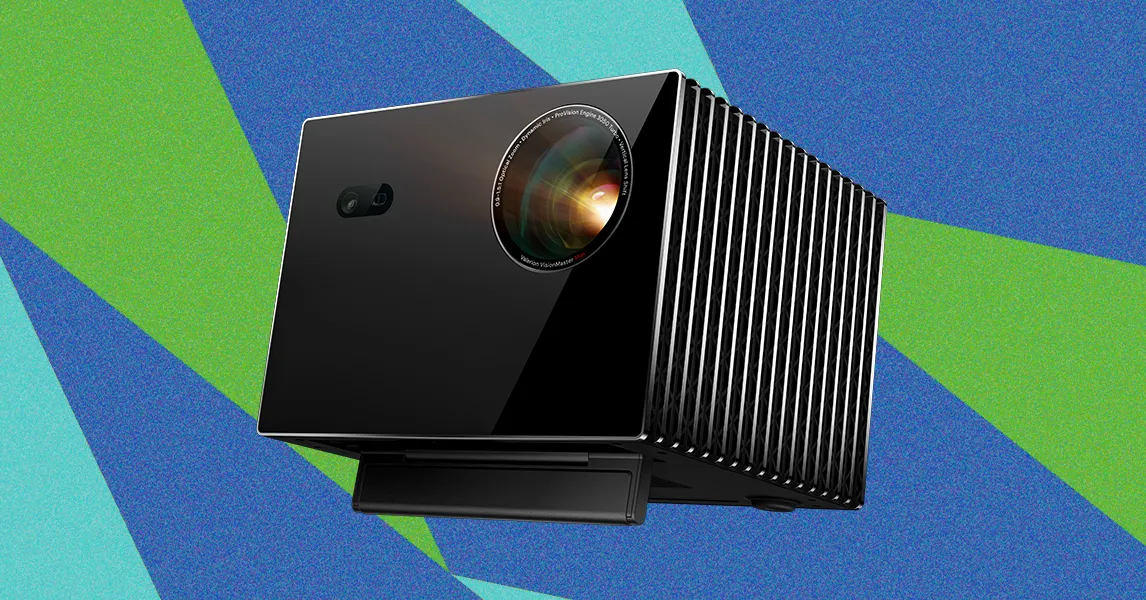
Valerion VisionMaster Max Review: A Brilliant 4K Projector That Needs Better Sound
Although I didn’t extensively test the Valerion VisionMaster Max for video games, its gaming specifications are impressive. The projector supports refresh rates of up to 240Hz at 1080p and is rated for input lag as low as 4 milliseconds (ms). At 4K and 60Hz, input lag is rated at 15ms. Two HDMI 2.1 inputs and an automatic low-latency mode further strengthen its gaming credentials, although the projector lacks variable refresh rate (VRR) support for dynamically smoothing out lag.
Excellent image quality, but the built-in speakers fall short
What’s more impressive than the VisionMaster Max’s gaming performance is its picture quality. However, the projector’s sound is also notable—though not for the reason you might expect. It has two 12-watt speakers that produce clean, detailed audio, with sound effects separated well from dialogue.
Even so, the speakers are limited by the projector’s box-shaped form factor. With the exception of products such as Anker’s removable satellite-speaker design, including the Nebula X1, audio often struggles to match the image quality offered by lifestyle projectors. At this price, an all-in-one projector should ideally deliver sound to match its pixel-perfect picture.
The VisionMaster Max’s speakers are fine for everyday viewing, but above level 25 out of 100, they mostly get louder rather than better. Thankfully, the projector supports both DTS and Dolby Atmos, allowing you to connect it to a 5.1- or 7.1-channel home theater system.
You can also connect the projector wirelessly to Bluetooth speakers for a tidy living-room setup, although latency can be an issue. For reliable audio-video synchronization and true surround sound, HDMI eARC remains the better option.
Competition and verdict
Photo: Chris Haslam
Valerion faces intense competition, including from its own product lineup. The Nebula X1 offers a similarly simple Google TV setup and 3,500 lumens of brightness, along with optional wireless surround sound. That makes it suitable for casual viewing in the living room or outdoors.
The Leica Cine Play 1, which earned a 9/10 WIRED Recommend rating, combines superior optics with a more lifestyle-friendly design. Valerion’s VisionMaster Pro 2 costs $2,999 and retains key features such as Google TV, RGB triple-laser projection, optical zoom, and EBL. However, it drops the Max’s iris and vertical lens shift.
For casual movie watching, that is a reasonable compromise and leaves more money in your pocket. The VisionMaster Max, meanwhile, is best suited to viewers who want extensive image controls, exceptional brightness, deep black levels, and a more cinematic picture.
Its weight and advanced controls encourage a careful setup with a proper screen and external sound system. Those requirements may be excessive for occasional big-screen streaming, but they allow the projector to perform at its best as the centerpiece of a home theater.
Valerion appears to agree that the VisionMaster Max is aimed at a more committed home cinema audience. At the time of publication, the company offered a deal allowing buyers to bundle up to $3,999 and choose a screen plus four stands, including a tripod and ceiling mount, without paying extra.
While the Valerion VisionMaster Max may be overkill for occasional streaming, we highly recommend it as a compact projector designed to serve as the centerpiece of a home theater.
Power up with unlimited access to WIRED. Get best-in-class reporting and subscriber-only content that’s too important to ignore. Subscribe now.
Source: www.wired.com