


Tesla Roadster 2: How Compressed Air Could Deliver 0–60 mph in 1 Second
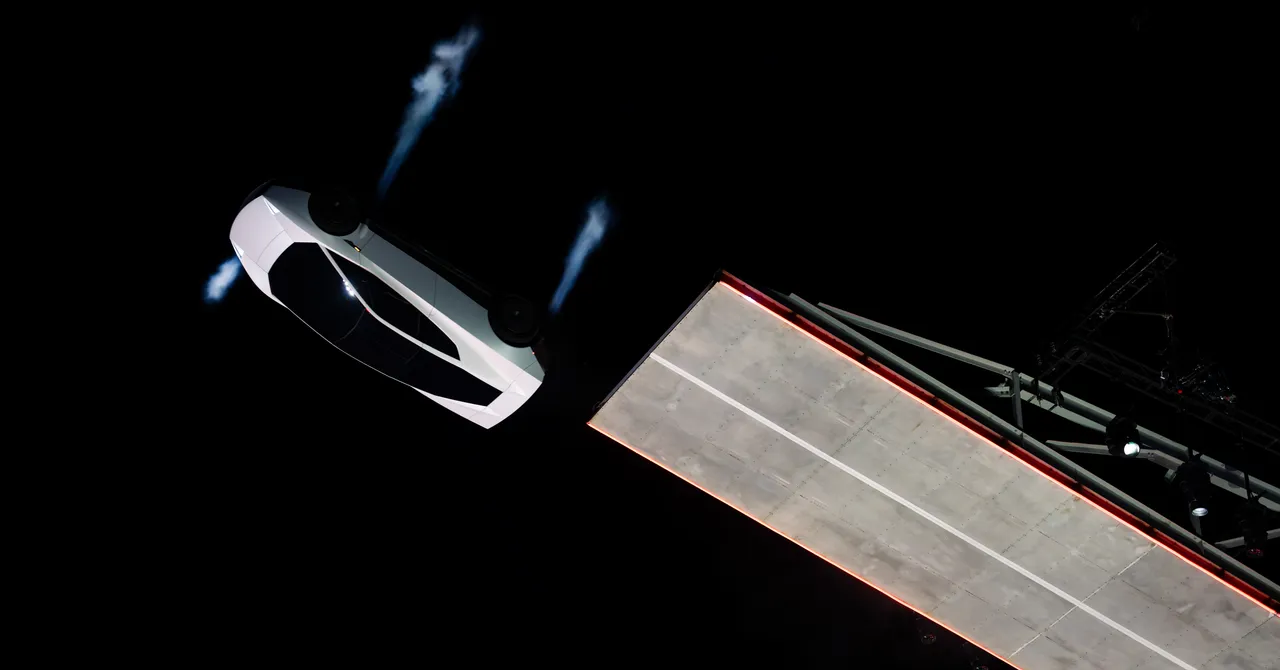
The upside-down Roadster 2 makes for a convincing sales pitch, but its compressed-air system has a strong use case when the car is driving normally. Friction is what accelerates a car: the greater the frictional force, the better the performance. Pushing the car down increases its ability to accelerate, brake and take sharper turns. High-performance automakers have used this principle for decades, although not to the same extent as Tesla’s new prototype.
How the Roadster 2 Could Accelerate From 0 to 60 mph in 1 Second
The Roadster 2 is also claimed to accelerate from 0 to 60 mph in less than a second. Conventional cars cannot achieve this using tire friction alone. Normal cars accelerate through the frictional force between their tires and the road, which limits performance according to the coefficient of friction.
With a friction coefficient of 0.6, a reasonable value, a car could accelerate from 0 to 60 mph in approximately 4.56 seconds. Better tires can improve traction, and aerodynamic downforce can increase friction as the car moves faster. Even with these improvements, however, it would not be able to reach 60 miles per second.
The Roadster 2 relies on another source of propulsion: compressed air expelled from the rear of the vehicle. This is the same basic principle used by rockets. Since most people do not have a rocket available, a toy car powered by an inflated balloon provides a simple comparison.
When a balloon is released, its stretched rubber pushes air through the attached tube. Because air has mass, force is required to accelerate it from rest to its exhaust speed. This demonstrates Newton’s third law: a force is an interaction between two objects. When the balloon pushes on the air, the air pushes back on the balloon with an equal and opposite force. That reaction force propels the toy car. Instead of using a balloon, the Roadster 2 uses compressed-air tanks.
Can the Roadster 2 Really Fly?
The Roadster 2’s flying-car feature uses the same compressed-air principle to push the vehicle upward and away from the ground. However, this goes beyond the usual meaning of “flight,” particularly because the tank provides only a few seconds of thrust before its pressure falls. As the tank pressure decreases, air velocity and thrust also decrease. A practical flying car would need to remain airborne for at least 10 minutes.
Acceleration creates a second challenge. Because the rocket-like propulsion system operates for only a short time, it must apply a large amount of force to change the car’s speed and allow it to jump over tracks or other obstacles. A large force produces large acceleration, which can have negative effects on people.
This acceleration can be estimated using video analysis. Tracker marks the car’s position in each frame as it jumps over a Tesla Semi truck. Because the truck’s height is approximately 4 meters, the car’s position can be determined as a function of time. The vertical position of the Roadster 2 during this jump is:
Source: www.wired.com