


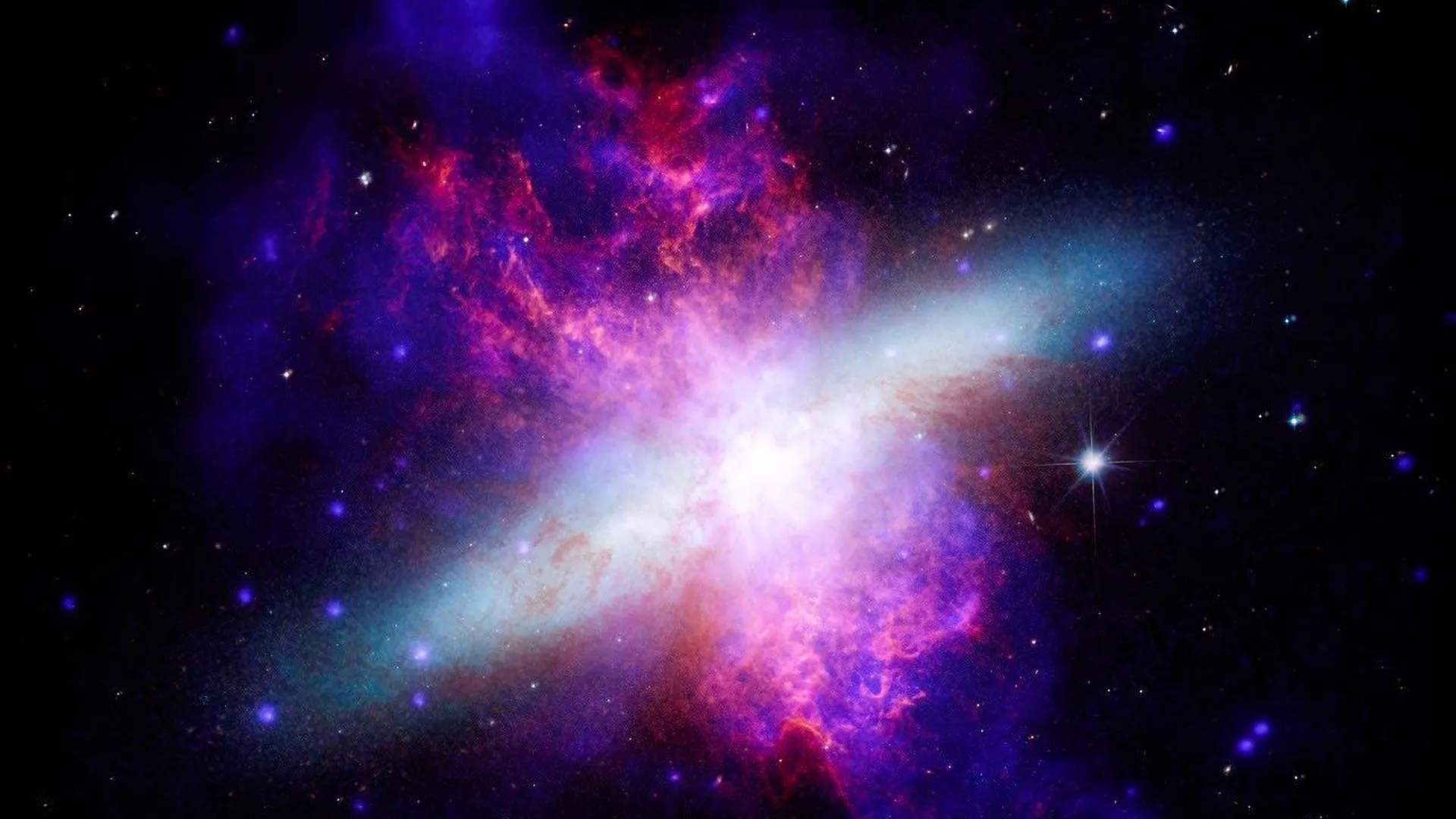
NASA’s 16-Galaxy Gallery Reveals Explosive Star Formation, Black Holes and Cosmic Collisions
Some galaxies shine with outstretched spiral arms, while others are shaped by violent collisions, powerful black holes and explosive bursts of star formation. A newly released collection of 16 images from NASA’s Chandra X-ray Observatory and other telescopes reveals the remarkable diversity of these cosmic structures.
Like precious gemstones, galaxies come in many shapes and sizes, and each one contains clues about its history. Astronomers generally classify galaxies into three major groups. Spiral galaxies, including our own Milky Way, have winding arms extending from their centers. Elliptical galaxies usually contain older stars and are thought to form through galaxy mergers. Irregular galaxies have less uniform structures and can display a wide range of cosmic activity.
Just as gemstones preserve evidence of the geological processes that shaped Earth, galaxies record the forces that formed the universe. Studying these distant star systems helps astronomers reconstruct the history of the Milky Way and better understand what may happen to our galaxy in the distant future.
NASA’s Chandra, Webb and Hubble reveal the hidden activity of galaxies
NASA’s new galaxy gallery features 16 images based on observations from some of the world’s most powerful telescopes. Each image includes X-ray data collected by Chandra during its decades of operations in space.
These observations are combined with data from NASA’s James Webb and Hubble Space Telescopes, IXPE (Imaging X-ray Polarimeter Explorer), the Neil Gehrels Swift Observatory, NuSTAR (Nuclear Spectroscopic Telescope Array), and other observatories on Earth and in space.
X-ray observations are especially valuable because they reveal extreme activity that can remain hidden at other wavelengths. Chandra can detect enormous clouds of gas heated to millions of degrees by powerful winds from massive stars, material ejected by supermassive black holes and debris from exploding stars. These processes also spread chemical elements through space, including elements that eventually become part of planets, the air we breathe and our own bodies.
By combining X-rays with observations at other wavelengths, astronomers can examine what happens inside galaxies in greater detail. The resulting images show how these vast systems form stars, interact with their surroundings and change over billions of years.
Spiral galaxies reveal explosive star formation
Several images highlight the remarkable activity inside spiral galaxies. Messier 33 and NGC 3938 are viewed almost directly from above, allowing astronomers to study their sweeping arms and identify regions containing energetic star pairs or the aftermath of stellar explosions.
Other galaxies show how internal structures can help trigger the birth of new stars. NGC 1672 and NGC 1385 are barred spiral galaxies, meaning they contain an elongated central structure made of stars, gas and dust. These bars can funnel material toward the inner regions and provide fuel for intense periods of star formation.
NGC 4725 demonstrates another way galaxies can produce new stars. Observations revealed how earlier encounters with other galaxies can disrupt gas and stimulate star formation.
The collection also includes dramatic side views of NGC 4631, known as the Whale Galaxy, and Messier 82, the Cigar Galaxy. Both are characterized by huge halos and powerful winds of gas heated to millions of degrees. Driven by violent stellar explosions, these outflows can carry material thousands of light-years into space and spread important chemical elements into intergalactic regions.
Supermassive black holes send energy across galaxies
Some of the gallery’s most dramatic features come from the massive black holes at the centers of galaxies.
When these black holes actively consume surrounding matter, their central regions become highly energetic. These bright regions, known as active galactic nuclei, can generate particle jets or enormous explosions that influence the entire host galaxy.
Centaurus A is a notable example. Observations by Chandra and IXPE reveal powerful streams of high-energy particles shooting tens of thousands of light-years into space from the galaxy’s central region.
In Messier 106, jets fired from the central supermassive black hole interact with and heat the surrounding gas. This activity produces an unusual spiral structure that differs from the familiar arms normally associated with spiral galaxies.
The famous Sombrero Galaxy, or Messier 104, offers another striking view. Its supermassive black hole sits within a concentration of stars at the galaxy’s vast core. Chandra’s X-ray observations revealed an extensive halo of gas heated to millions of degrees, along with the hot remnants of stars. These features surround the galaxy’s prominent dust bands and provide a deeper look at the energetic environment hidden within its elegant exterior.
Galactic collisions offer clues to the Milky Way’s future
Not all galaxies evolve peacefully. Some undergo enormous transformations as gravity pulls them toward neighboring galaxies, distorts their structures and strips away the gas needed to form new stars.
Arp 143 captures the aftermath of a particularly dramatic encounter. A direct collision between galaxies produced expanding rings that resemble ripples spreading outward after an impact. The disturbance also triggered a new wave of star formation.
Other images show the chaotic results of galaxy mergers. NGC 3256 and II Zw 096 provide examples of violent interactions. II Zw 096 contains a powerful burst of star formation hidden behind thick dust and illustrates the kinds of galactic encounters that were especially common in the early universe.
These collisions also offer clues about the possible future of the Milky Way. Our galaxy is expected to merge with neighboring Andromeda billions of years from now. By observing mergers in other galaxies, scientists can better understand how such encounters unfold.
Unusual galaxies reveal many paths of cosmic evolution
The gallery includes several other unusual systems. NGC 1569 provides a nearby example for studying intense episodes of star formation that occurred in young galaxies billions of years ago.
NGC 660 displays an unusual “polar ring” structure in which rings of stars orbit around the galaxy’s poles rather than following its main plane.
Messier 90 represents another type of galactic transformation. As it travels through the Virgo cluster, the galaxy is losing the gas needed to form new stars. Movement through galaxy clusters can strip away this material and alter how galaxies evolve.
Taken together, these 16 cosmic portraits show that galaxies are not static collections of stars. They are constantly shaped by gravity, stellar explosions, supermassive black holes and interactions with neighboring systems. NASA’s Chandra X-ray Observatory and its partner telescopes reveal these processes in astonishing detail, helping astronomers understand the forces that shape galaxies—including our own Milky Way.
Source: www.sciencedaily.com