


James Webb Telescope Finds Clues to Moon Formation in Rare Planetary Collision Disks
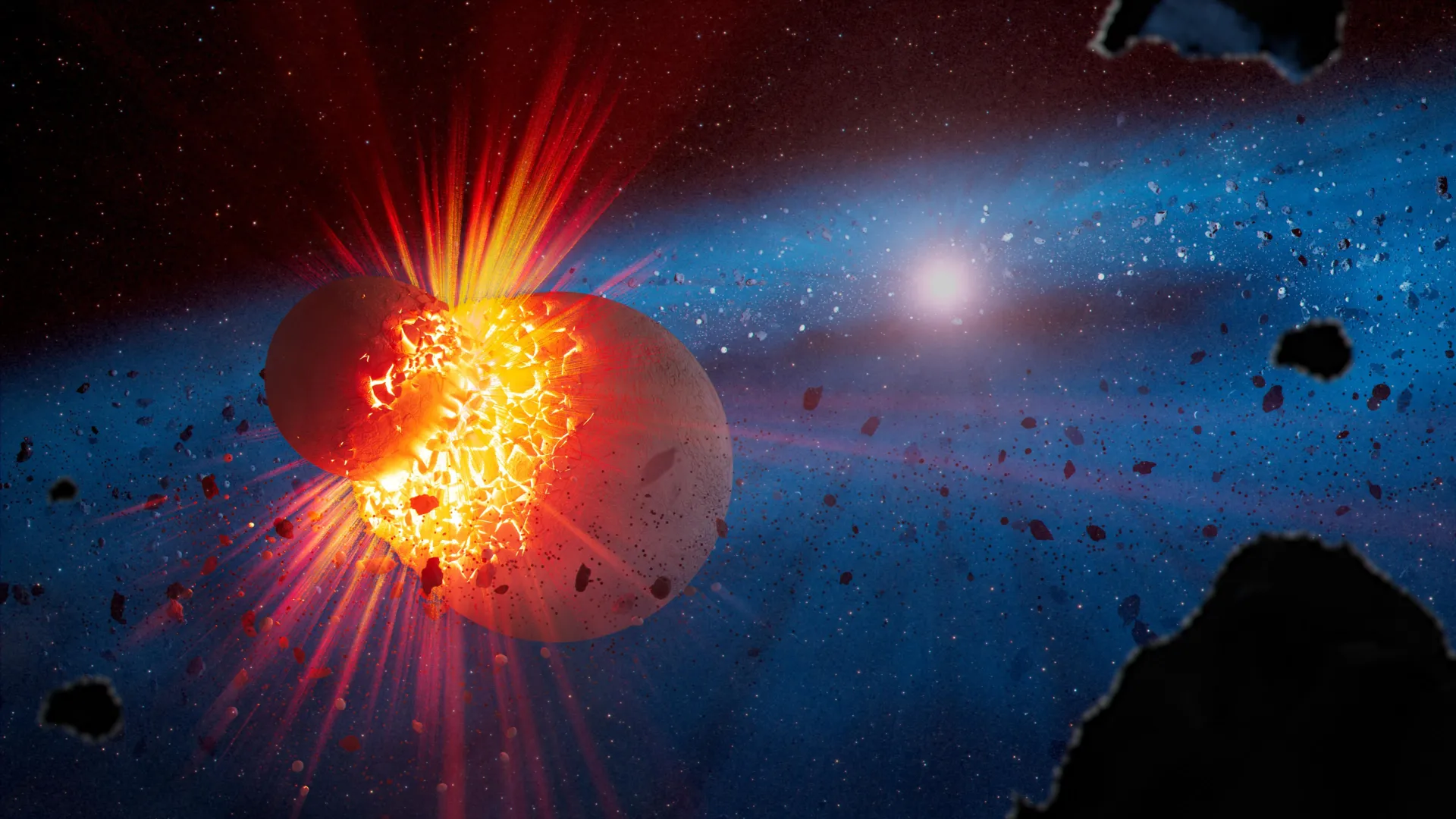
Scientists believe one of the most important events in the early solar system was the giant collision between young Earth and a Mars-sized object known as Theia. The impact likely vaporized large amounts of rock and sent debris into space. Some of that material eventually came together to form the Moon. NASA’s Artemis mission is returning humans to the Moon, helping prepare for future Mars missions and shaping the next era of space exploration.
That ancient impact dramatically changed Earth. Now, astronomers are using NASA’s James Webb Space Telescope to study young star systems that appear to be experiencing similar violent collisions. By examining these systems, researchers can estimate how energetic the impacts were and learn more about how rocky planets form and evolve.
The team’s findings were published October 1 in The Astrophysical Journal.
Webb studies rare extreme debris disks
The material surrounding a star changes significantly over time. Young stars begin with gas-rich protoplanetary disks that can host forming planets. As a system matures, its surroundings develop into a gas-poor debris disk.
NASA’s retired Spitzer Space Telescope studied these debris disks and identified an unusual category known as extreme debris disks. These systems contain exceptionally large amounts of warm dust close to their stars, roughly where rocky planets orbit in our solar system.
Kate Hsu of the Space Science Institute in Boulder, Colorado, led a team of astronomers who used the James Webb Space Telescope to study these unusual systems in greater detail.
Although theoretical models suggest that extreme debris disks should be relatively common, observations indicate otherwise. Based on available data, scientists estimate that only about 1% of young stars show observable signs of this stage. Our own solar system may have passed through similar stages during its formation.
Although these systems are uncommon, the researchers assembled a sample of 21 extreme debris disks. Five came from Spitzer’s archival observations, while 16 were studied with Webb. Of the Webb sample, 12 disks were newly observed and four were follow-up observations of systems previously investigated by Spitzer.
“This is the first time we have assembled enough systems to truly understand this subclass, called extreme debris disks,” said Su, the lead author of the paper. “Before Webb’s observations, we had limited information. We knew these disks were unusual and very different from the typical cold debris disks we know, such as Vega and Fomalhaut. Now that we have more data, we can learn what these disks reveal about planet formation and evolution.”
Warm dust reveals the nature of planetary collisions
The researchers identified three defining characteristics of extreme debris disks. Their dust particles are smaller than those found in protoplanetary or typical debris disks, they contain unusually high concentrations of warm dust, and their brightness changes erratically over time. Webb and Spitzer revealed these features through mid-infrared spectra.
To determine what creates these unusual characteristics, the researchers examined the minerals present in each disk. Their analysis divided the systems into two broad groups: silica-rich disks and silica-poor disks.
On Earth, volcanic glass such as obsidian is an example of silica-rich material. Forsterite, a mineral with less silica, is found in green sand grains on some beaches in Hawaii.
The amount of silica in a disk can reveal important information about the collision that produced it. This difference may also help explain why the infrared brightness of some disks changes more dramatically than others.
“What was most exciting for me was that we were able to determine the composition just by observing the mid-infrared emission and beautiful spectral features in Webb’s data,” said Agnes Kospal of the Konkoly Observatory in Budapest, Hungary, and a co-author of the study. “The planetary embryos are so small that we have no choice but to study them indirectly.”
Mars-sized worlds may collide around young stars
Approximately one-third of the disks in the sample are silica-rich. Researchers say these systems likely formed after extremely high-energy collisions between Mars-sized bodies. Such an impact would be powerful enough to vaporize significant amounts of rock.
The remaining two-thirds are silica-poor. These systems are thought to result from lower-energy collisions, such as grazing impacts between moon-sized objects.
The researchers also found a significant age difference between the two groups. Silica-rich disks have been found only around stars less than 300 million years old. Silica-poor disks, however, occur around stars across a much wider age range and show stronger variations in brightness.
The researchers suggest that the changing brightness may result from the rapid evolution of newly generated debris. Changes in the material’s trajectory and additional collisions can increase or decrease its infrared brightness over time.
The discovery may help scientists reconstruct the history of our own solar system, which may have passed through multiple extreme debris disk stages.
“How rocky planets formed and giant planets evolved are part of the broader story of solar system formation. It’s all one story,” Hsu said. “Our research on extreme debris disks helps put together a more complete picture of what we currently understand.”
Extreme debris disks offer clues to the Moon’s formation
Computer simulations suggest that terrestrial planets, including Earth, should form within the first few hundred million years of a solar system’s development.
That timeline matches the ages of the extreme silica-rich debris disks observed so far. It is also consistent with estimates that Earth and the Moon formed approximately 100 million years after the Sun. The Moon was probably created by a collision between Earth and a Mars-sized body.
Scientists are also investigating whether the Sun may once have passed through a silica-poor extreme debris disk phase.
If the old silica-poor disk and its seemingly random changes in infrared brightness were caused by orbital instability, the pattern could be broadly consistent with the late heavy bombardment hypothesis for our solar system.
Under that scenario, a giant planet would have moved significantly from its original position. The movement would have disturbed the orbits of smaller objects, triggering catastrophic collisions and producing large amounts of dust for short periods—similar to what astronomers observe in extreme debris disks.
“Of course, there is still much we don’t know about these disks,” said study co-author Attila Moore of the Konkoly Observatory. “We expect that silica-rich systems are not present in older extreme debris disks. Only three disks in our sample meet that age criterion, so it would be useful to observe more of these systems to test our hypothesis.”
The James Webb Space Telescope is the world’s premier space science observatory. Webb investigates the mysteries of our solar system, studies distant worlds around other stars, and explores the structure and origins of the universe and humanity’s place within it. Webb is an international program led by NASA and its partners, the European Space Agency and the Canadian Space Agency.
Source: www.sciencedaily.com