


How Crocodiles Survived the Asteroid That Wiped Out the Dinosaurs
Crocodile ancestors remained loyal to warm climates through mass extinctions and greenhouse worlds. That climate preference may have helped crocodilians survive the asteroid impact that wiped out non-avian dinosaurs 66 million years ago, according to a new study.
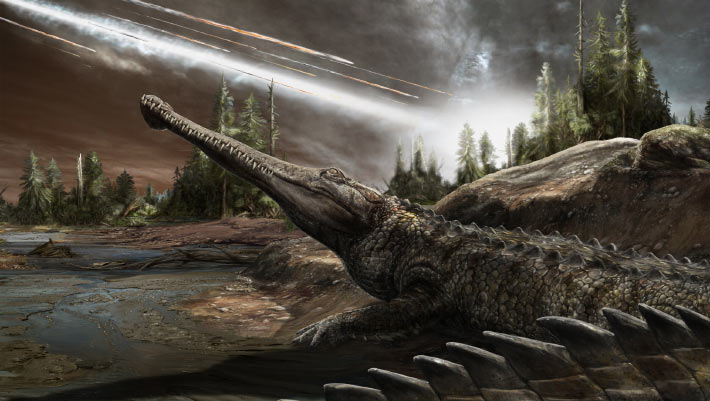
Crocodilians survived the asteroid impact that caused the extinction of non-avian dinosaurs. Image credit: Davide Bonadonna.
“While crocodiles are often referred to as living fossils, their ancestors and relatives changed significantly over time. They included bus-sized giants that may have eaten a Tyrannosaurus rex, as well as small, cuddly animals with pug-like faces,” said study lead author Dr. Alfio Alessandro Chiarenza of University College London.
“Our study shows that despite this diversity, one thing that was surprisingly consistent was their relationship with climate.”
Crocodile ancestors stayed within a narrow climate range
Chiarenza and his colleagues tracked the climate preferences of a group of crocodilian relatives called Pseudosuchia.
The researchers combined family trees covering more than 400 fossil and living species with more than 7,000 fossil occurrences and 130,000 records of living crocodiles. They then used climate simulations to predict where suitable habitats existed over the past 245 million years.
Pseudosuchians once included land-dwelling, ocean-dwelling, giant and even plant-eating species. Their range also extended into polar regions. Despite this variety, the study found that their preferred temperatures and rainfall remained within relatively tight limits.
The model suggests that the optimal temperature for the group’s ancestors was approximately 23 degrees Celsius (73 degrees Fahrenheit). The living lineage that includes alligators prefers temperatures between 26 and 30 degrees Celsius.
As the planet warmed, these animals expanded toward the poles. When temperatures fell, they retreated toward the equator. Rather than adapting to entirely new conditions, the researchers concluded that crocodilian relatives generally followed stable climatic niches as they moved around the world.
Two major climate exceptions
The analysis identified two notable exceptions.
- About 94 million years ago, during one of the most extreme greenhouse episodes of the dinosaur era, the thermal optimum shifted upward to approximately 35 degrees Celsius in early members of the group that includes modern crocodilians.
- About 34 million years ago, as Earth became drier, an Australasian lineage of now-extinct crocodile relatives moved into more arid environments. Scientists believe this shift was connected to the continent’s increasing aridity.
Why did crocodilians survive the dinosaur-killing asteroid?
The researchers also examined the long-standing question of why crocodile relatives survived the asteroid impact 66 million years ago while non-avian dinosaurs did not.
They ran climate simulations of the aftermath, when sunlight dimmed, ash blanketed North America and volcanic carbon dioxide levels rose.
In almost all scenarios, warm refuges persisted near the equator and in the subtropics. Only the most extreme scenario, involving a 15% reduction in sunlight, eliminated suitable crocodilian climates everywhere.
Previous studies by some of the same researchers found that the climatic habitats of non-avian dinosaurs collapsed under comparable conditions.
Climate was only one part of the explanation, however. Small body size, a semi-aquatic lifestyle, a generalist diet and a cold-blooded metabolism may also have helped crocodilians survive. Their aquatic lifestyle may have reduced their dependence on plant productivity, which was severely disrupted after the impact.
“The asteroid did not make the entire planet equally hostile to every population,” Chiarenza said.
“Crocodilians have long favored warmer environments and may have placed their survivors where the right climate was best preserved, such as near the equator.”
“These refuges could have protected populations that later recovered and spread.”
What the findings mean for crocodiles today
“These findings have implications for today’s species,” said Professor Philip Mannion of University College London.
“If crocodiles have coped with climate change in the past primarily by moving to more suitable habitats, today’s species need room to move as the world warms. The loss of suitable areas to roads, farms and cities is making that increasingly difficult.”
The findings were published in the journal Science Advances.
_____
Alfio Alessandro Chiarenza et al. 2026. Climatic niche conservatism shapes macroevolution, extinction, and survival of crocodilian archosaurs. Science Advances 12(43); doi: 10.1126/sciadv.aeg2217
Source: www.sci.news