


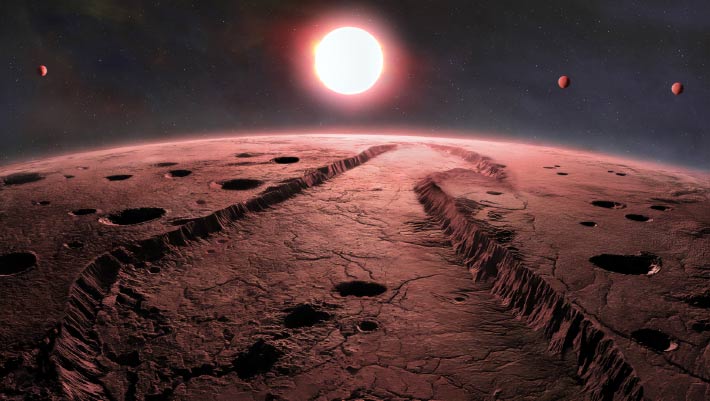
A recent study reveals that the four extraterrestrial planets orbiting Barnard’s Star, the closest single star to our Sun, are likely rich in the mineral periclase, which has stripped them of their atmospheres, rendering them inhospitable to life.
Artist’s illustration of an exoplanet orbiting Barnard’s Star. Image credit: International Gemini Observatory / NOIRLab / NSF / AURA / P. Marenfeld.
Barnard’s Star is a 10 billion-year-old red dwarf star located just 6 light-years from Earth in the constellation Ophiuchus.
Also known as Gliese 699 or GJ 699, it ranks as the second closest star to the Sun after the Alpha Centauri triple star system.
Discovered in 2025, the four rocky exoplanets that orbit Barnard’s Star are all smaller than Earth and Venus but larger than Mars.
In analyzing the chemical makeup of Barnard’s Star, astronomer Xander Byrne and his team at the University of Cambridge found high levels of a rare mineral called periclase, which is located just a few hundred kilometers beneath the Earth’s surface.
“Barnard’s Star contains higher amounts of magnesium compared to other stars, suggesting the planets may also be rich in magnesium,” Byrne noted.
“On Earth, this magnesium contributes to a mineral called olivine, crucial for storing water within the planet.”
The high magnesium levels lead to the formation of periclase, a mineral that does not hold much water.
Additionally, the planets around Barnard’s Star are unlikely to have retained any atmosphere.
“These planets are perpetually hostile due to their proximity to the star,” Dr. Byrne remarked.
“The outermost planets orbit 10 times closer than Mercury’s distance from the Sun.”
“Being this close to a star with low gravity causes the atmosphere to dissipate.”
The planets could have maintained an atmosphere for a maximum of 2 billion years, far shorter than the system’s age of 10 billion years.
Their closeness to the star results in tidal locking, meaning each planet consistently shows the same face to its star, similar to the Moon’s relationship with Earth.
This results in one hemisphere basking in perpetual daylight, while the other remains in eternal darkness.
Compact planetary systems like those around Barnard’s Star often face instability, leading to potential collisions or ejections from the system due to gravitational interactions.
However, scientists have found that orbital resonance may contribute to the stability of the Barnard system.
The orbital periods of the three inner planets follow a 9:12:16 ratio, akin to two consecutive perfect fourths in music.
This harmonic alignment may help stabilize the orbits of the planets, preventing gravitational disturbances.
Future missions, such as the European Space Agency’s Plato mission, may help uncover more small planets similar to those orbiting Barnard’s Star.
“Detecting large planets is easier than finding smaller ones, so our knowledge of planets like those in this system remains limited,” Dr. Byrne explained.
“The enhanced sensitivity of upcoming missions will allow us to identify numerous small, rocky planets akin to Earth.”
The study’s findings are detailed in a paper published in the June 24th issue of Royal Astronomical Society Monthly Notices.
_____
Xander Byrne and colleagues. 2026. Barnard’s Planetary System: Stability, Composition, and Evolution of Four Extraterrestrial Planets. MNRAS 550 (2): stag1207; doi: 10.1093/mnras/stag1207
Source: www.sci.news