


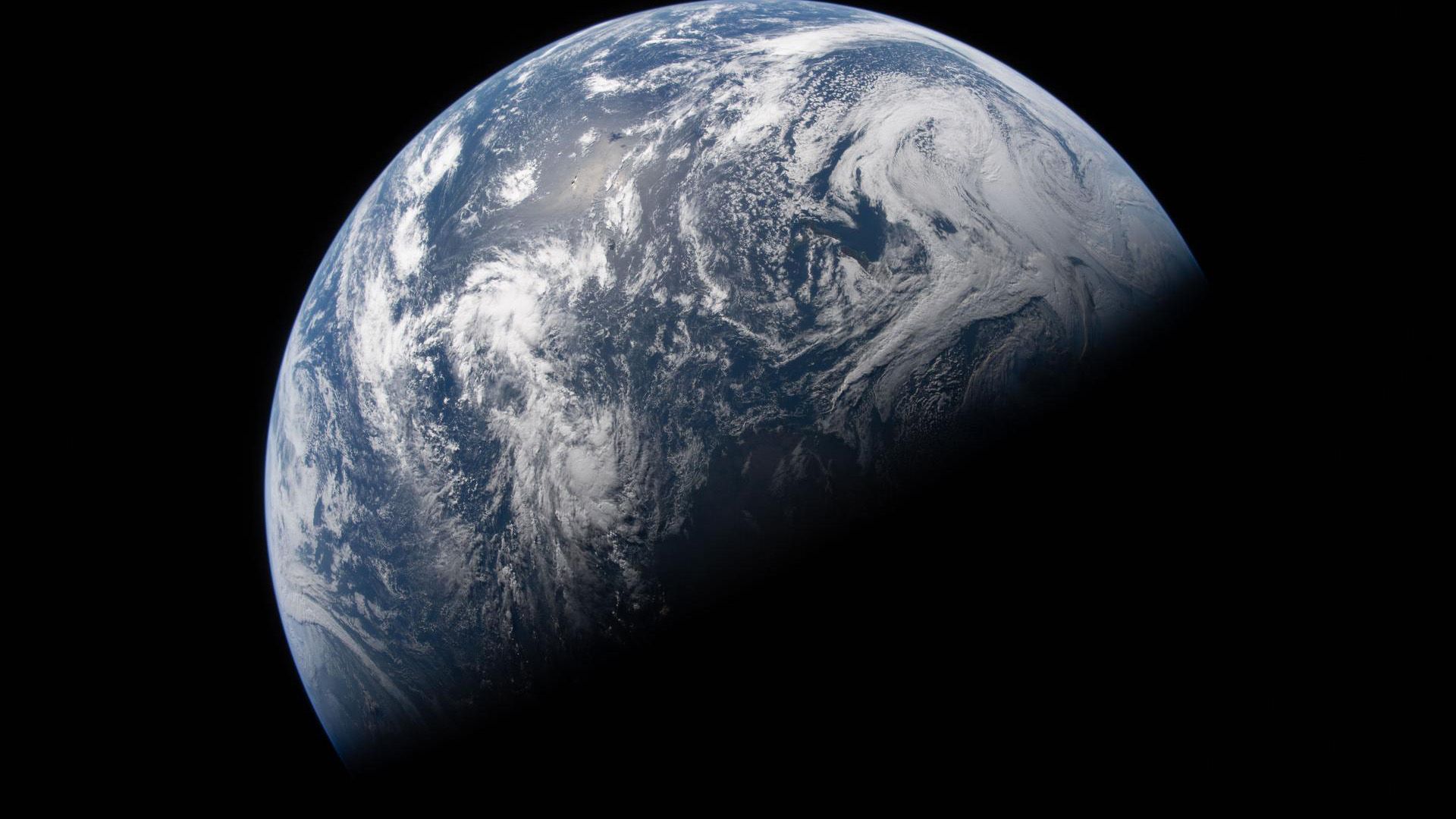
Earth Is Becoming Rounder as Polar Ice Melts, Study Finds
Earth is gradually becoming rounder because climate change is melting polar ice sheets, according to a new study. Tracking this subtle change could help researchers measure how strongly human activity is affecting Earth’s ice and water distribution.
Why Earth is not a perfect sphere
Earth is already slightly flattened at its poles and bulges around the equator. This shape is caused by the planet’s rotation, which pushes mass outward around the equator.
However, new research suggests that the solid Earth is becoming rounder at an accelerating rate. The change is primarily linked to melting polar ice sheets, which alter the pressure on Earth’s crust and redistribute mass across the planet.
This finding applies to the solid part of Earth. The oceans continue to bulge outward near the equator.
How melting ice changes Earth’s shape
When polar ice melts, it removes pressure from the crust beneath it. The crust can then slowly rise, similar to bread dough springing back after being pressed.
At the same time, the redistribution of water toward the equator places more mass in that region and reduces the equatorial bulge in the solid Earth. Together, these effects make the planet’s rocky surface slightly more spherical.
Christoforos Kotsakis, a professor of geodesy at Aristotle University of Thessaloniki in Greece, developed a method for analyzing measurements from the Global Navigation Satellite System (GNSS) to identify these changes.
GNSS measurements reveal an accelerating change
Using GNSS data, Kotsakis found that the poles rose and the equatorial bulge shrank by about 0.04 inch (1 millimeter) per year between 2011 and 2015.
That change was greater than the roughly 0.02 inches (0.5 millimeters) per year recorded between 1997 and 2000. The results indicate that Earth’s shape became rounder by approximately 0.016 inch (0.4 millimeter) per year for every 10-year period.
The change is extremely small compared with Earth’s size. The planet’s diameter at the equator is approximately 7,926 miles (12,756 kilometers). Even so, the shift provides valuable evidence of how melting ice is changing Earth’s surface.
The whole Earth is still becoming flatter
There is an important distinction between the solid Earth and the planet considered as a whole. When the oceans are included, Earth flattens by about 0.03 inches (0.8 millimeter) per year as seawater moves away from the poles and bulges around the equator.
This “weight of water” outweighs the rounding effect taking place in the underlying rock. In other words, Earth’s solid surface is becoming rounder, while the combined shape of the planet’s crust and oceans is becoming flatter.
The redistribution of water may also slow Earth’s rotation, a shift that has been reported in other studies.
Combining shape and gravity measurements
Researchers are also studying Earth’s changing shape through measurements of its gravitational field. Gravity varies depending on how much mass is present in a particular region.
Kotsakis found that GNSS measurements and gravitational-field measurements do not match perfectly. This indicates that Earth’s physical shape and gravitational field are not completely aligned. Used together, however, the methods can help researchers monitor the effects of climate change, including ice loss in Greenland and Antarctica and changes in seawater distribution.
Limitations of the study
GNSS provides direct measurements of changes in Earth’s surface, but the network has limitations. There are relatively few GNSS stations near the North and South Poles, and even fewer in remote ocean regions because stations must be placed on buoys.
The study was published in JGR Solid Earth.
Reference: Kotsakis, C. (2026b). “Map global GNSS vertical velocities to solid Earth map changes.” Geophysical Research Journal Solid Earth, 131(9). Read the study.
Source: www.livescience.com