


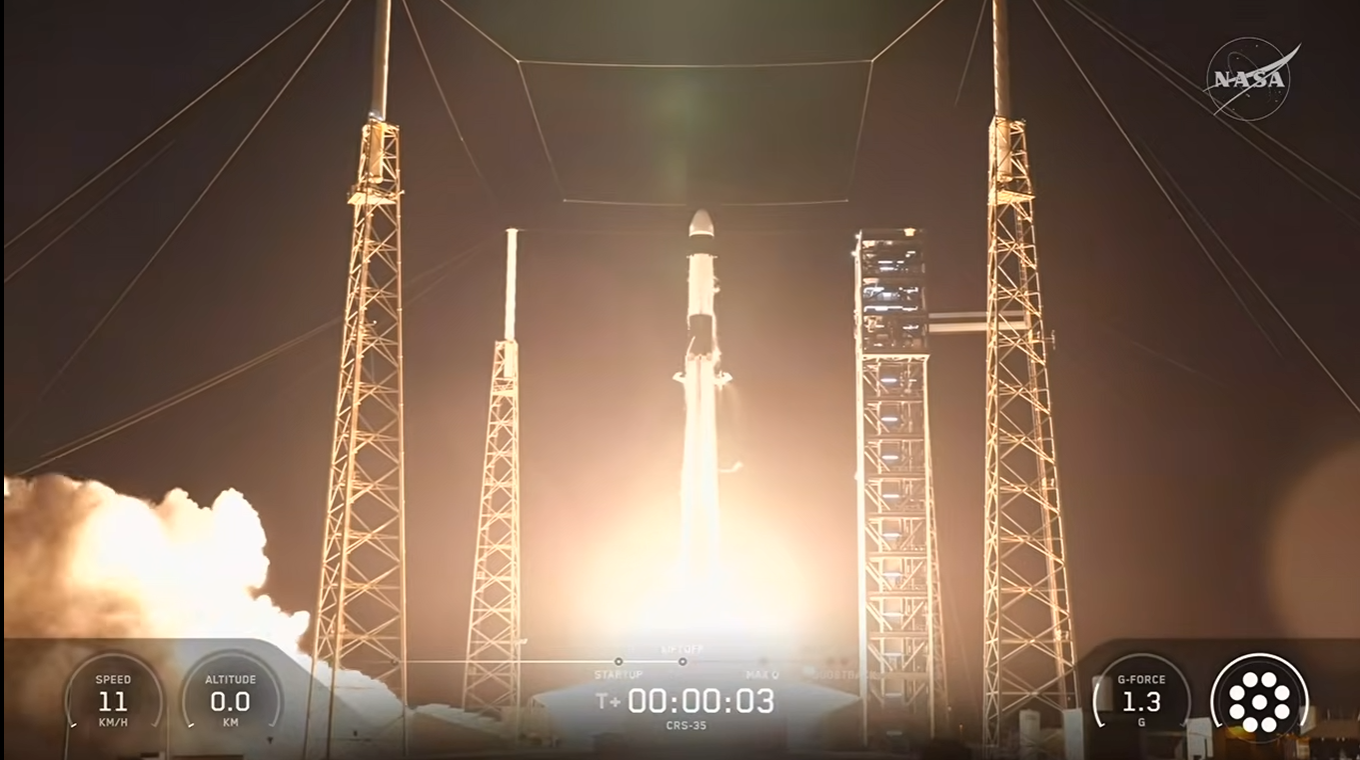
NASA’s SpaceX CRS-35 Mission Delivers Science, Supplies and New Solar Arrays to the Space Station
NASA’s SpaceX 35th commercial resupply mission lifted off at 6:33 a.m. EDT Tuesday aboard a Falcon 9 rocket from Space Launch Complex 40 at Cape Canaveral Space Force Station in Florida. The mission is carrying more than 6,300 pounds of supplies and hardware to the International Space Station.
Following its successful launch, the SpaceX Dragon spacecraft will deliver new science experiments, cargo and the final pair of International Space Station Roll-Out Solar Arrays to the orbiting laboratory.
When and Where to Watch the Dragon Docking
Dragon is scheduled to autonomously dock with the space-facing port of the International Space Station’s Harmony module at 11 a.m. Thursday, October 15. NASA will begin streaming the rendezvous and docking at 9:15 a.m. across a variety of online platforms.
New Solar Arrays Will Increase Space Station Power
The final pair of solar arrays will complete an enhancement to the space station’s power system. The upgraded system will increase the power available for research and operations while supporting the station’s safe, controlled deorbit. Astronauts plan to install the arrays during a series of spacewalks scheduled for later this fall.
SpaceX Dragon to Carry Cutting-Edge Microgravity Experiments
Dragon is also carrying several new experiments, including hardware designed to manufacture artificial retinas in microgravity. The technology could eventually help restore vision for patients on Earth.
The spacecraft will also deliver a 3D heart tissue model to support large-scale drug testing during future space missions. Additional investigations will examine how new types of glass form in microgravity and study brain organoids that could reveal potential therapeutic targets for neurodegenerative diseases such as Alzheimer’s disease, Parkinson’s disease and multiple sclerosis.
Space Station Research Supports Future Moon and Mars Missions
These experiments are among hundreds of studies conducted in orbiting laboratories across the fields of biology and biotechnology, physical sciences, and Earth and space sciences.
Research and technology investigations performed on the International Space Station benefit people on Earth and help lay the foundation for future deep-space missions. Through NASA’s Artemis program, astronauts will travel to the Moon in preparation for future human exploration of Mars, while discoveries from the station continue to inspire innovation and exploration.
When Will the Dragon Spacecraft Return to Earth?
The SpaceX Dragon spacecraft is scheduled to remain at the International Space Station until mid-November. It will then depart and return to Earth with research and cargo, landing off the coast of California.
Learn more about the International Space Station, its research and its crew below.
-end-
Joshua Finch / Jimi Russell
Headquarters, Washington
202-358-1100
[email protected] / [email protected]
Stephen Cisselov
Kennedy Space Center, Florida
321-876-2468
[email protected]
Sandra Jones / Joseph Zakruszewski
Johnson Space Center, Houston
281-483-5111
[email protected] / [email protected]
Source: www.nasa.gov