


NASA’s Webb Telescope Finds Clues to the Collision That Formed the Moon
Extreme debris disks around young stars reveal how violent impacts may have shaped Earth, the Moon and other rocky planets.
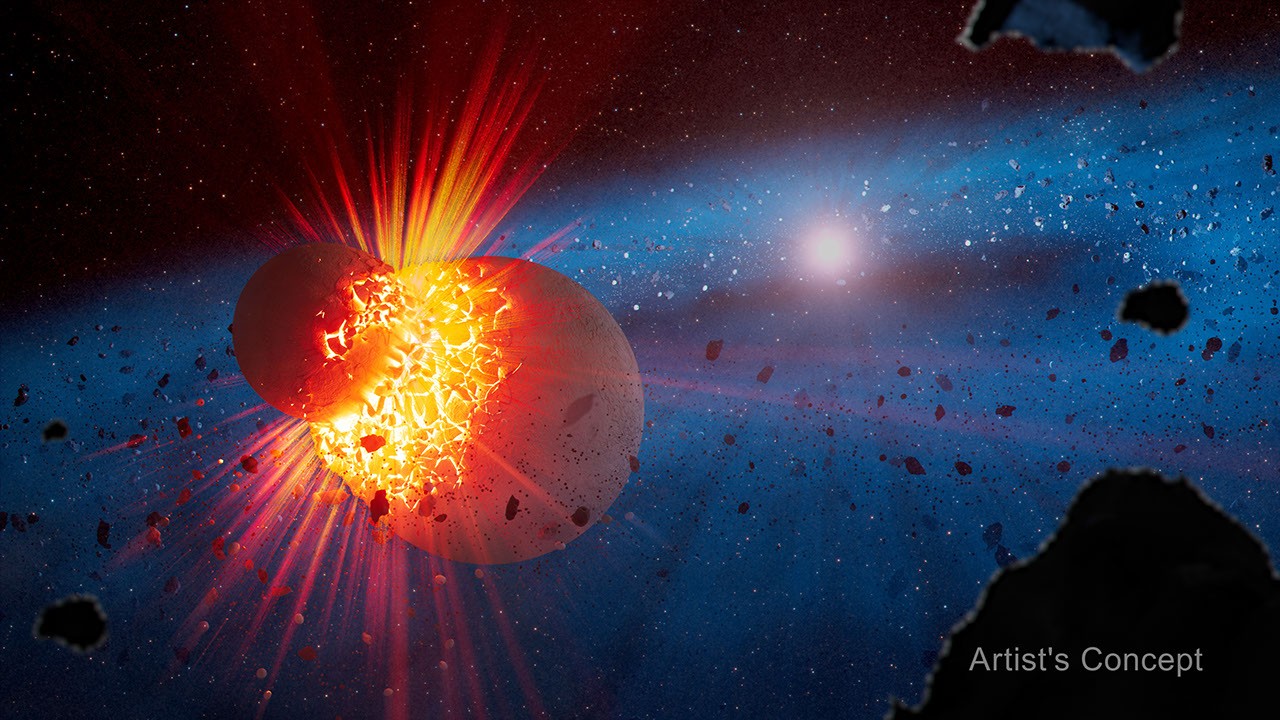
Early in the solar system’s history, scientists theorize that a Mars-sized object called Theia collided with the infant Earth. The impact vaporized enormous amounts of rock and blasted debris into space. Some of that material eventually coalesced into the Moon.
Now, NASA’s James Webb Space Telescope has studied young star systems showing signs of similarly violent collisions. The findings offer new clues about the energy involved in these events, the composition of their debris and the evolution of rocky planets—including the early Earth.
The research was published in The Astrophysical Journal.
Extreme debris disks may be produced by collisions similar to those that formed the Moon and shaped the early Earth.
Artwork: NASA, ESA, CSA, Joseph Olmstead (STScI)
What are extreme debris disks?
A star’s surroundings change as it ages. Young stars begin with gas-rich protoplanetary disks, where planets can form. Over time, those disks evolve into gas-poor debris disks made up largely of dust and fragments left over from planet formation.
NASA’s retired Spitzer Space Telescope observed a rare subclass called extreme debris disks. These systems contain unusually large amounts of warm dust close to their stars—at distances comparable to the regions occupied by the rocky planets in our solar system.
A team of astronomers led by Kate Hsu of the Space Science Institute in Boulder, Colorado, used Webb to investigate these unusual systems and determine what their dust can reveal about planetary impacts.
Webb examines 21 rare planetary systems
The number of extreme debris disks observed is far lower than theoretical predictions suggested. Based on available observations, scientists estimate that only about 1% of young stars show observable signs of this stage. Our own formative solar system may have passed through a similar phase.
Despite the rarity of these systems, the research team assembled a sample of 21 extreme debris disks. The sample included five systems identified in Spitzer’s archival data and 16 observed by Webb. The team conducted follow-up observations of 12 newly observed disks and four systems originally identified by Spitzer.
“This is the first time we have assembled enough systems to truly understand this subclass, called extreme debris disks,” said Hsu, lead author of the study.
“Before the Webbs were discovered, we had limited information. We knew they were strange and very different from the typical cold debris disks we know, such as Vega and Fomalhaut. Now that we have more data, we can find out what these disks represent about planet formation and evolution.”
Three features set extreme debris disks apart
Using mid-infrared spectra from Webb and Spitzer, the researchers confirmed that extreme debris disks share three key characteristics:
- Dust particles smaller than those found in protoplanetary systems or classical debris disks
- High concentrations of warm dust close to their stars
- Irregular changes in infrared brightness
To understand what causes these properties, the team examined the mineral composition of the disks. The systems fell into two broad groups: silica-rich disks and silica-poor disks.
On Earth, obsidian is an example of a silica-rich volcanic glass. Forsterite, a silica-poor mineral, occurs as green sand grains on some Hawaiian beaches. The mineral differences in extreme debris disks provide information about the types of collisions that created their debris and may help explain their changing infrared brightness.
“What was most exciting for me was that we were able to determine its composition just by observing its mid-infrared emission and beautiful spectral features in the Webb,” said Agnes Kospal of the Konkoli Observatory in Budapest, Hungary, and a co-author of the study.
“The embryos on these planets are so small that we have no choice but to study them indirectly.”
Silica reveals the energy of planetary collisions
About one-third of the sample was rich in silica. The researchers say these disks were likely created by high-energy collisions between Mars-sized bodies that vaporized a significant portion of the impact material.
The remaining two-thirds contained very little silica. These disks may have formed through lower-energy impacts involving moon-sized objects, such as grazing collisions between smaller planetary bodies.
The two groups also differ in age. Silica-rich disks appear only around stars less than 300 million years old. Silica-poor disks persist across a wider range of ages and often show larger changes in brightness.
The researchers propose that the brightness fluctuations may result from the rapid evolution of fresh debris. Orbital changes or additional collisions could alter the amount and distribution of dust around the star.
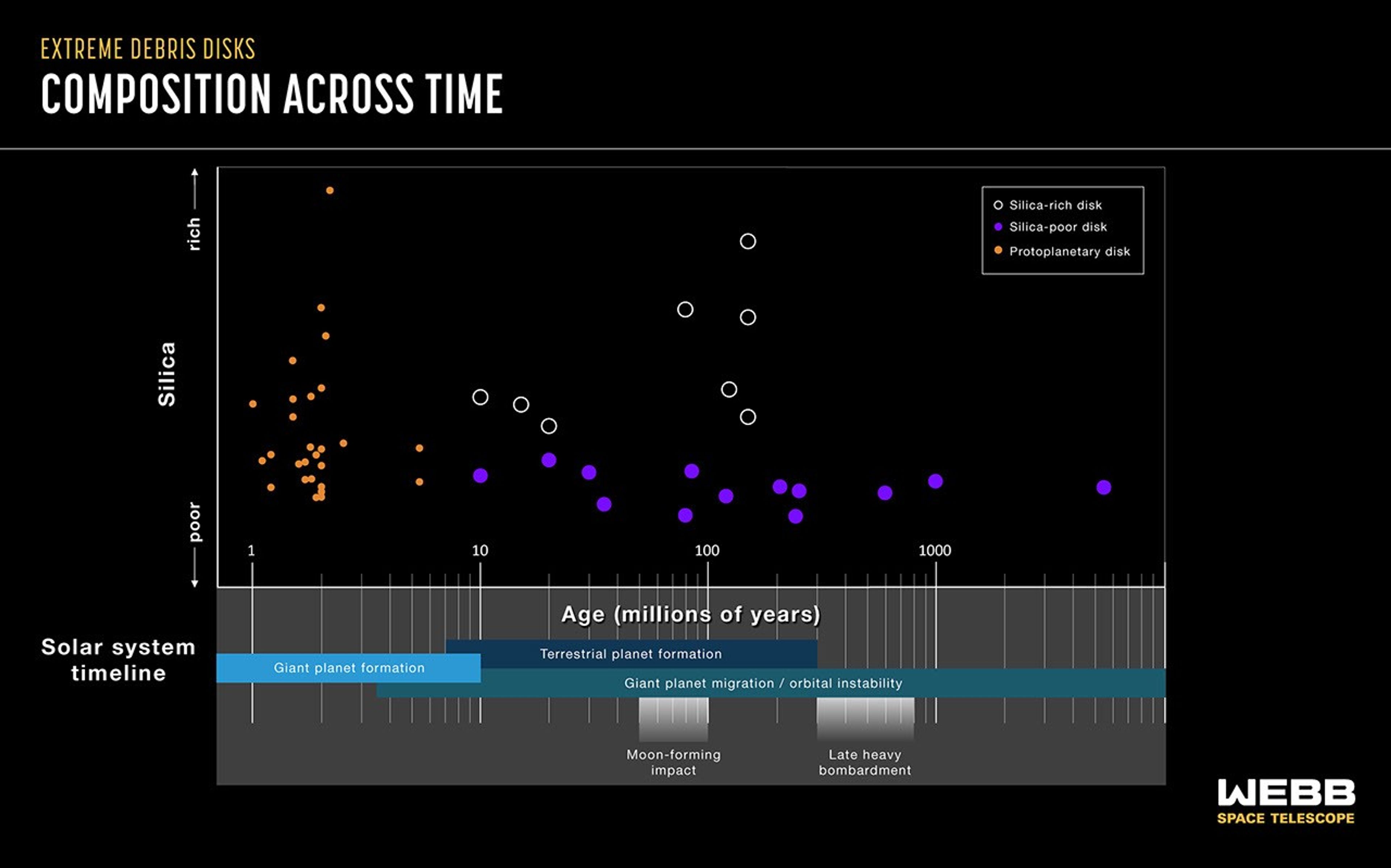
Scientists deduced that silica-rich disks are produced by high-energy impacts involving Mars-sized objects, while silica-poor disks are produced by lower-energy collisions involving moon-sized objects.
Illustration: NASA, ESA, CSA, Joseph Olmstead (STScI)
What Webb’s discovery may reveal about Earth and the Moon
The findings may apply directly to the history of our solar system, which could have experienced multiple extreme debris disk phases.
Simulations indicate that terrestrial planets such as Earth should form within the first few hundred million years after a solar system begins to develop. That timeline is consistent with the ages of previously observed silica-rich extreme debris disks.
It also matches estimates that Earth and the Moon formed roughly 100 million years after the Sun formed. The leading theory holds that the Moon was created when Earth collided with a Mars-sized object—an impact capable of producing the high-energy debris associated with silica-rich disks.
Scientists are also considering whether the young Sun experienced a silica-poor debris disk phase. If the long-lived silica-poor disks and their irregular infrared brightness changes are linked to orbital instability, they could be broadly consistent with the late heavy bombardment hypothesis.
In that scenario, a giant planet would have migrated significantly, disturbing the orbits of smaller objects. The resulting gravitational instability could have triggered catastrophic collisions and produced the short-lived, dusty phases seen in extreme debris disks.
More observations are needed
The researchers emphasize that important questions remain. They expect silica-rich systems to be absent from older extreme debris disks, but only three systems in their sample meet the necessary age requirement. Observing more examples will be important for testing that hypothesis.
“Of course, there is still much we don’t know about these disks,” said study co-author Attila Moore of the Concoli Observatory. “We expect that silica-rich systems are not present in older extreme debris disks. There are only three disks in our sample that meet that age criterion, so it would be good to observe more of these systems to confirm our hypothesis.”
Together, the observations connect the formation of rocky planets, the evolution of giant planets and the violent impacts that shaped planetary systems.
“How rocky planets form and how giant planets evolve are part of the broader story of the formation of the solar system. It’s all one story,” Su said. “Our research on extreme debris disks helps put together a picture of what we currently understand.”
About the James Webb Space Telescope
The James Webb Space Telescope is the world’s premier space science observatory. Webb investigates the mysteries of our solar system, studies distant worlds around other stars and explores the structure and origins of the universe—and humanity’s place within it.
Webb is an international program led by NASA and its partners, the European Space Agency and the Canadian Space Agency.
For more information about Webb, please visit NASA’s official Webb resources.
Source: science.nasa.gov