


Hubble Captures a Gravitational Lens Revealing Hidden Galaxies and Dark Matter
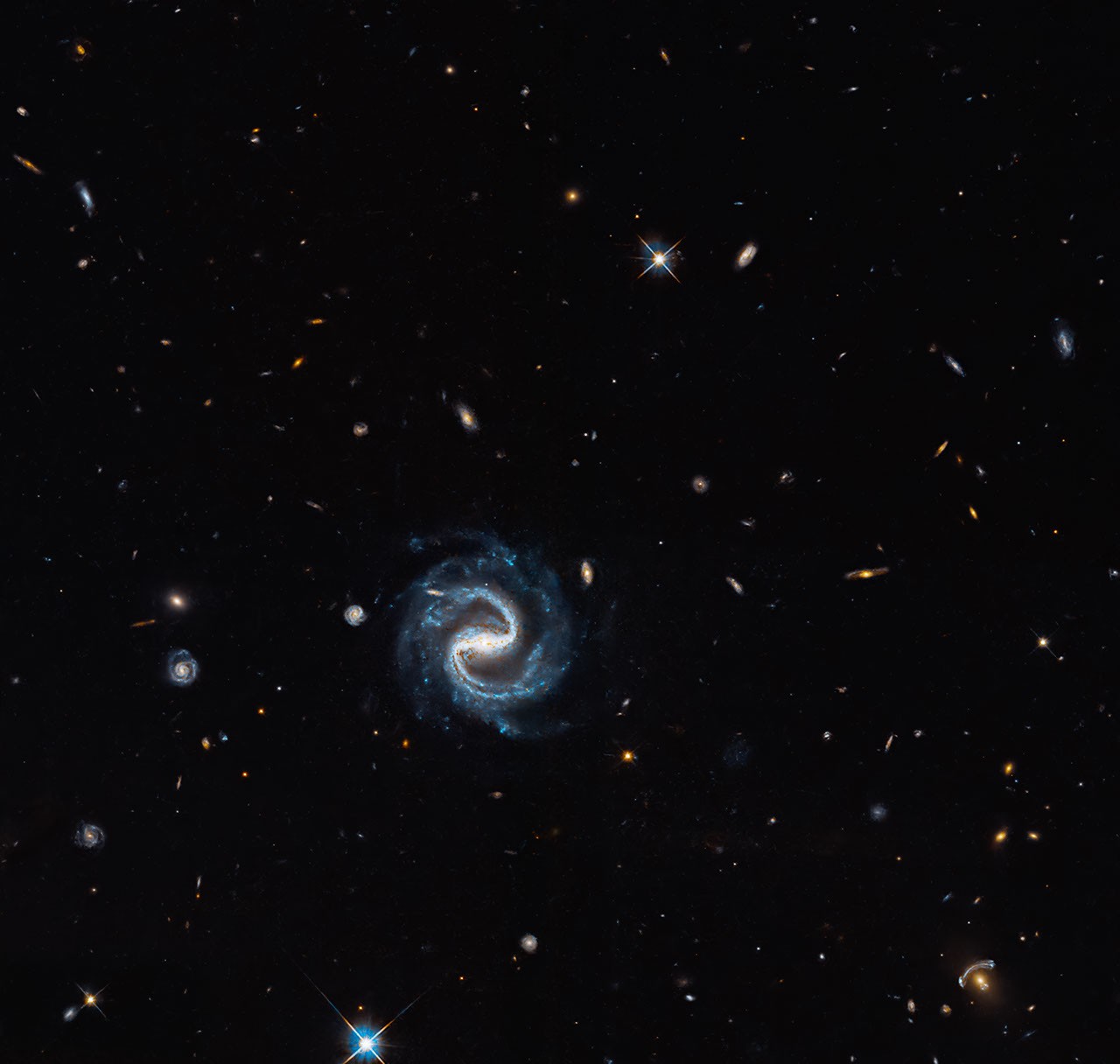
A wide-spread barred spiral galaxy dominates this image, but the real cosmic treasure is the gravitational lens in the lower-right corner. The lens magnifies and distorts distant background galaxies through the powerful gravity of nearby galaxies.
The observation is one of many gravitational lensing images captured by NASA’s Hubble Space Telescope in preparation for science with the Nancy Grace Roman Space Telescope.
How gravitational lensing bends light
Gravitational lensing occurs when the mass of a foreground object, such as a galaxy, distorts space-time. As light passes around the object, gravity bends, distorts, and magnifies the light—creating a natural lens in the universe.
These cosmic lenses form when a foreground galaxy and a more distant background galaxy are precisely aligned. The background galaxy’s light then bends around the foreground galaxy before reaching Earth.
A distant galaxy appears as two arcs
In this image, gravitational lensing reveals a foreground elliptical galaxy about 4.5 billion light-years away. The light we see from this galaxy began traveling toward us when our solar system was still forming.
The lensed background galaxy is about 8 billion light-years away, almost twice as distant. It appears as a pair of arcs: one large and prominent arc lies to the upper left of the foreground galaxy, while a much smaller inverted image appears to the lower right. Astronomers call this arrangement an arc-counterarc pair.
Gravitational lenses help map dark matter
The more massive the foreground galaxy, the stronger its gravitational lensing effect and the more dramatically it bends light. By studying the distortion of the background galaxy, researchers can estimate the mass of the foreground galaxy.
This technique plays an important role in the study of dark matter, a mysterious invisible substance that makes up most of the mass in the universe. Because visible matter alone cannot explain the level of distortion seen in background galaxies, researchers can use gravitational lensing to calculate the mass of foreground galaxies and the amount of dark matter they contain.
A barred spiral galaxy similar to the Milky Way
Almost every object in this image is a galaxy, except for a few scattered foreground stars. The large barred spiral galaxy is about the same size as the Milky Way, and astronomers believe it is also a barred spiral galaxy. Its name comes from the bar of stars extending through its center and connecting to its spiral arms.
The smaller spiral galaxies to the left may be satellite galaxies, similar to the Large and Small Magellanic Clouds that orbit the Milky Way.
How Hubble and Roman will work together
Hubble primarily observes the universe in visible and ultraviolet light, along with some infrared light. Roman will primarily observe infrared wavelengths, as well as some visible light.
Hubble provides high-resolution views of individual objects, while Roman’s much wider field of view will allow it to create broad panoramas of the sky. Together, the two space telescopes will offer a more comprehensive view of the universe.
Images like this provide a glimpse of how Hubble and Roman will work together. Astronomers will use Hubble’s gravitational lensing observations to analyze distortions, study dark matter in foreground galaxies, and prepare for future Roman observations.
Hubble can observe only one gravitational lens at a time, while Roman’s wide field of view will provide a much larger sample of these lenses. Researchers are using Hubble’s sharp images to build computer models that can better analyze distortions caused by dark matter. These tools will help astronomers study Roman’s large images, while Hubble will also follow up on interesting gravitational lenses discovered by Roman.
See more details
Media contact:
Claire Andreoli
NASA’s Goddard Space Flight Center, Greenbelt, Maryland
[email protected]
Source: science.nasa.gov