


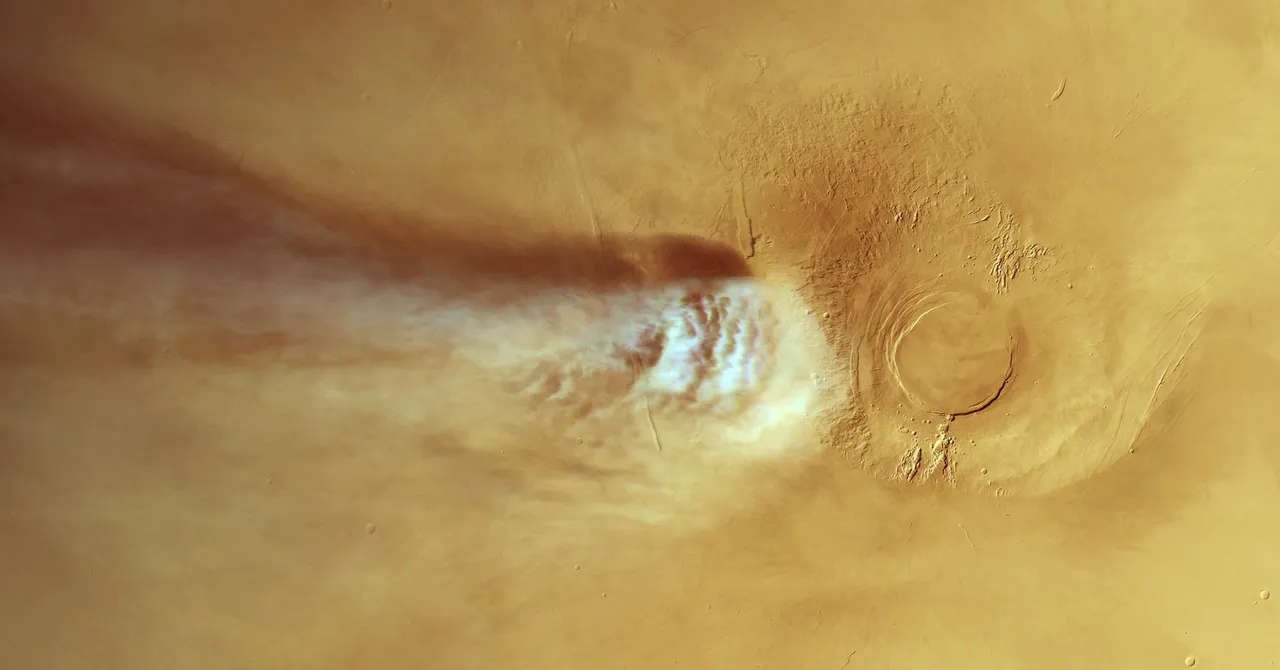
Every morning during spring and summer on Mars, a thin, elongated cloud forms near the Althea Mons volcano, stretches more than 1,000 miles (about the distance from New York to Kansas City), and then disappears. This cycle repeats for several months. First recorded by a spacecraft in 2018, the feature—known as the Arsia Mountains Elongated Cloud (AMEC)—has long lacked a plausible explanation. Now, researchers have modeled its formation and suggest it may result from a physical process never directly observed in any planetary atmosphere.
An unexpected way to form ice
“We found that we needed to include some exotic physics, physics that is in textbooks but treated as theoretical and usually thought to not occur in nature. Indeed, we have never seen it actually done in the wild before,” said Jorge Hernández Bernal, a planetary scientist at Sorbonne University in Paris and lead author of the study, in an ESA press release. “Once we incorporated this physics into the simulation, AMEC emerged exactly as we had hoped.”
On Earth, clouds typically form when water vapor condenses into droplets or ice crystals around tiny particles such as dust or salt. However, research published in Nature Geoscience suggests that AMEC may form through a process called homogeneous nucleation. In this process, vapor transforms directly into ice crystals without the assistance of solid particles.
“This is similar to condensation droplets appearing in the center of the room instead of on the window,” Hernández Bernal explained. “It’s totally unexpected.”
Volcanic waves drive the process
Homogeneous nucleation requires extreme conditions, including a temperature drop of 30 degrees Celsius within 10 minutes and very high relative humidity. The Mount Arsia volcano also plays an important role. When winds encounter the 65,000-foot-tall volcano, they generate powerful waves that propel humid air into the atmosphere within minutes.
Scientists had assumed that similar processes could occur in the upper atmospheres of other planets, including Venus and Earth, but they had never observed one directly. That may be because the phenomenon requires air humidity more than 100,000 times higher than levels measured on Earth.
Before this modeling work, scientists did not know that such humidity levels existed on Mars. “We don’t know as much about Mars’ atmosphere as we do about Earth’s atmosphere, so it’s a huge success to be able to recreate AMEC so well,” Hernández Bernal said. “The results are amazing.”
This story was originally published by WIRED Czech Republic and Slovakia. Translated from Czech.
Source: www.wired.com