


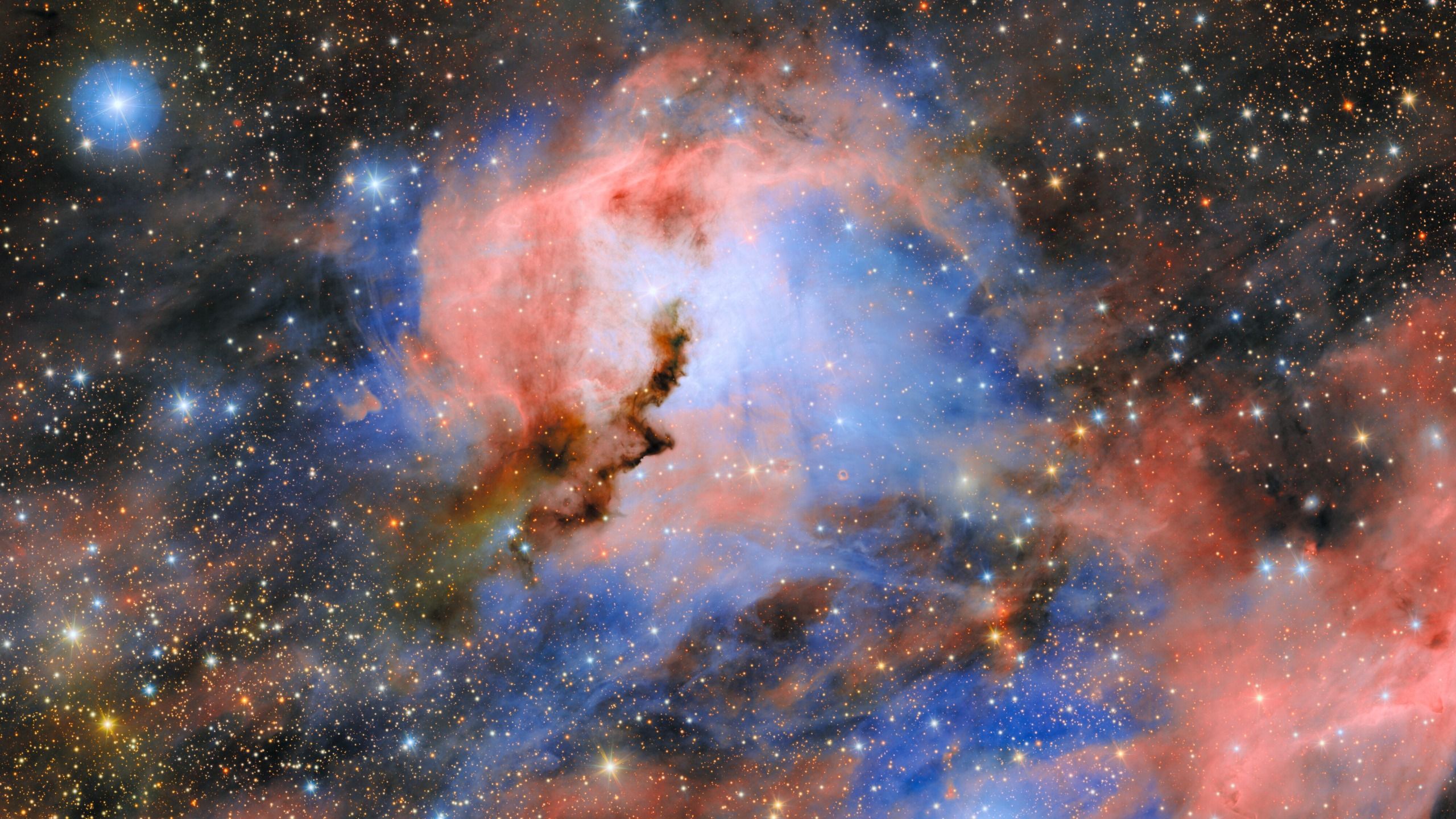
The Vera C. Rubin Observatory has released a striking test image of the Sassy Seagull Nebula Head, also known as IC 2177, revealing a birdlike cloud of glowing gas and reflective dust about 3,700 light-years from Earth. Captured during the observatory’s early commissioning work, the image demonstrates the capabilities of its cameras while offering a preview of the vast sky survey Rubin is expected to conduct over the next decade.
The Sassy Seagull Nebula Head
What it is: Sassy Seagull Nebula Head (IC 2177)
Where it is: Approximately 3,700 light-years away, between the constellations Monoceros and Canis Major
When it was shared: October 22, 2026
The Gull Nebula is a collection of three enormous clouds of irradiated gas. In the Rubin image, the bird’s “head” is a cloud called Sharpless 2-292. Its pink wings are made of hydrogen gas that glows when ionizing radiation from a young star at the center of the cloud excites it. The bird’s blue “feathers” are dust clouds reflecting light from young blue stars elsewhere in the region.
The feature that resembles a blinking eye is actually HD 53367, a flickering triple-star system containing three very young, energetic stars. These stars are actively shaping the surrounding cloud, although it is unclear whether the birdlike nebula or the observatory has won this spectacular visual encounter.
A test for Rubin Observatory
The image was produced from observations made with the Vera C. Rubin Observatory’s experimental 144-megapixel Commissioning Camera, or ComCam. According to the National Science Foundation, Rubin captured approximately 16,000 images of the night sky between October 24, 2024, and December 11, 2024.
The National Science Foundation co-manages Rubin Observatory with the U.S. Department of Energy. The deep-space images collected by ComCam were used to test the observatory’s hardware, software and image-processing systems.
Image credit: NSF–DOE Vera C. Rubin Observatory/NOIRLab/SLAC/AURA
ComCam’s test images were notably sharp, but the observatory has since upgraded to a camera with a field of view at least 20 times larger. The Legacy Space-Time Survey Camera, currently aboard Rubin’s Shimoni Survey Telescope, captures 3,200-megapixel images of the night sky every 30 seconds. The camera is designed to survey the entire southern sky every few nights, according to Tony Tyson, Rubin’s chief scientist, who previously spoke with Live Science.
A decade of observations ahead
Now that the Spatiotemporal Heritage Survey has officially begun, Rubin is expected to photograph the sky night after night for the next decade. The resulting cosmic time-lapse videos could reveal millions of changing or previously unknown objects and events, including exploding supernovae, newly discovered comets and exoplanets.
Future observations may even uncover another birdlike structure hidden among the stars.
For more information about IC 2177, see the European Southern Observatory’s material on the nebula.
Source: www.livescience.com