


Dark matter may seem like a ghostly presence in the universe, but its gravitational effects provide the leading explanation for several major astronomical observations. It helps explain why galaxies rotate so rapidly, why galaxies orbit within clusters at high speeds, how gravitational lenses strongly deflect light, and how visible matter is distributed throughout the cosmos.
A cosmic web of dark matter
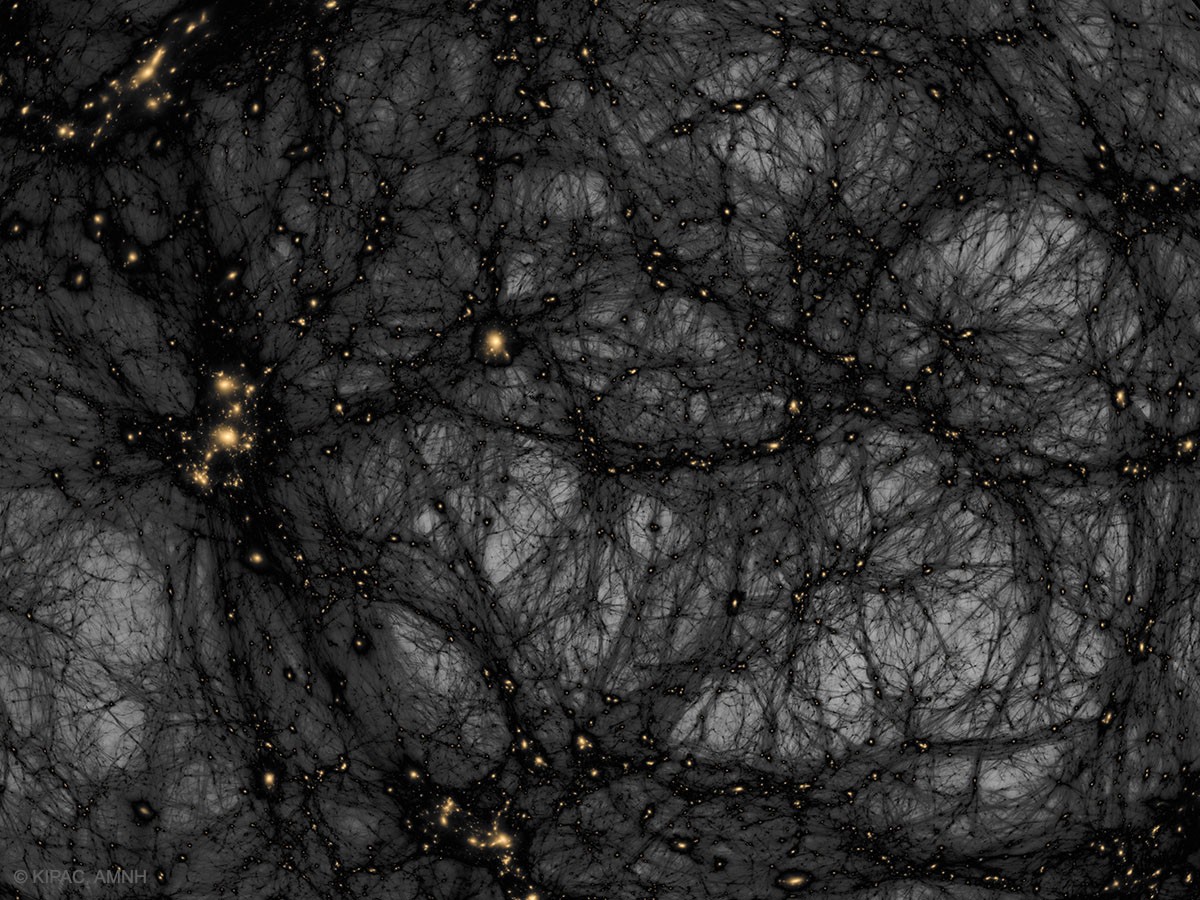
The featured visualizations come from the American Museum of Natural History’s Hayden Planetarium space show Dark Universe. They focus on one example of how diffuse dark matter appears to permeate the universe.
In this frame from a detailed computer simulation, complex filaments of dark matter are shown in black, spread throughout the universe in a pattern resembling a spider web. Ordinary matter is comparatively rare and is shown in orange. These simulations agree statistically with astronomical observations.
Dark energy takes the cosmic spotlight
Dark matter remains mysterious, including its unknown form, but it is no longer considered the strangest source of the universe’s gravity. That distinction now belongs to dark energy, a more uniform energy source that appears to exert repulsive gravity and control the expansion of the universe as a whole.
Tomorrow’s photo: Orion the Great.
Source: science.nasa.gov