


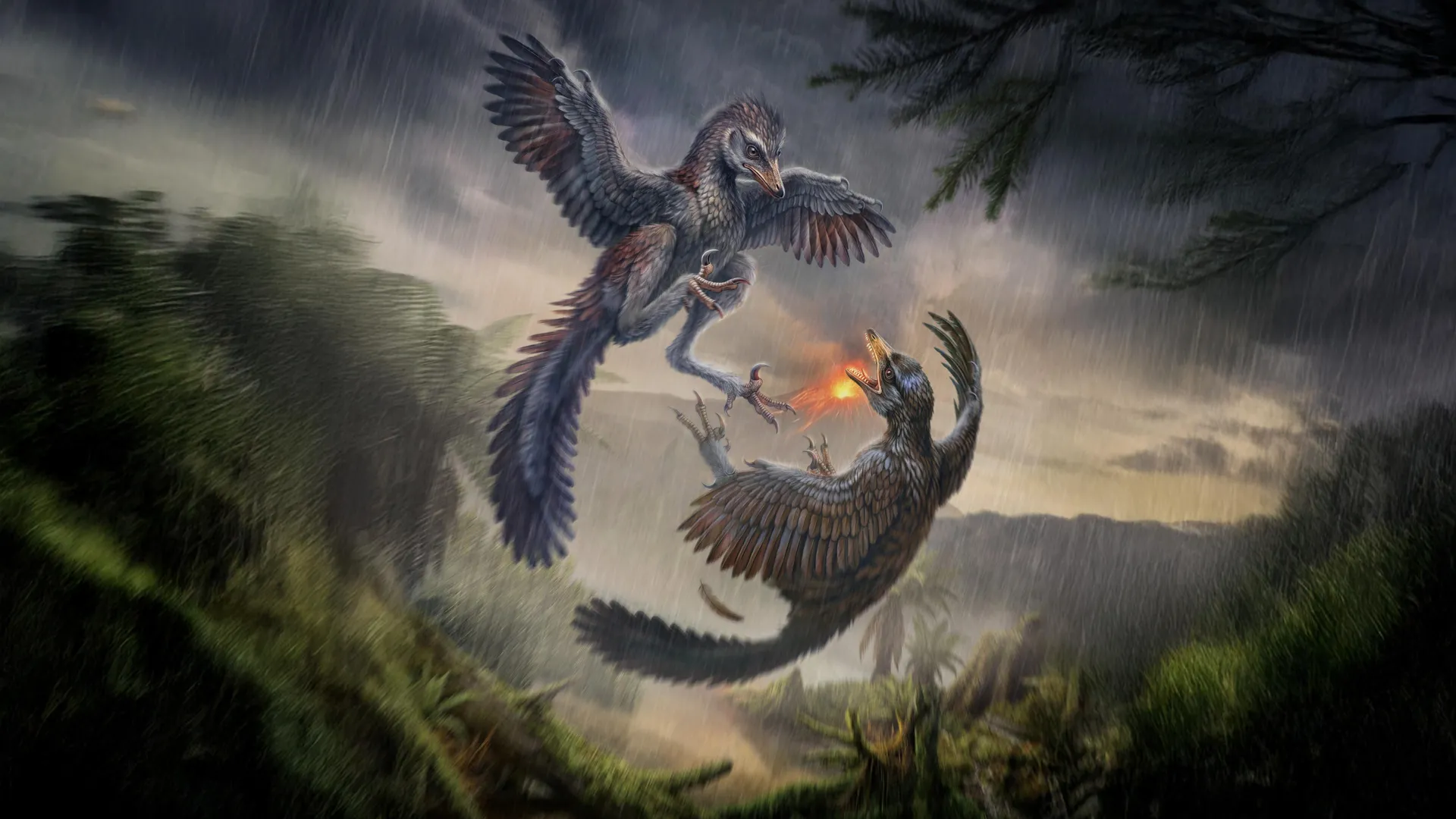
A remarkably well-preserved bird fossil from China, dating to about 150 million years ago, is challenging long-standing ideas about avian evolution. The crow-sized species, Yujuornis yangyuanensis, appears to have belonged to an early bird lineage that abandoned flight altogether, suggesting that some of the first birds evolved toward ground-dwelling lifestyles rather than increasingly specialized flight.
A Jurassic bird with dinosaur-like teeth and claws
Yujuornis yangyuanensis lived during the Late Jurassic Period, approximately 150 to 148 million years ago. Described in a research paper published in Nature, the species provides evidence that early bird evolution was more complex than scientists once believed. Ancient birds adapted to a range of environments and lifestyles, including life on the ground, rather than evolving solely toward improved flight.
Researchers from the Institute of Vertebrate Paleontology and Paleoanthropology (IVPP) of the Chinese Academy of Sciences (CAS) and the Fujian Provincial Institute of Geosciences discovered the fossils in the recently recognized Zhenghe fauna in southeastern China’s Fujian province. Their findings identify Yujuornis as the earliest known example of a bird lineage that lost the ability to fly.
The species had an unusual combination of bird and dinosaur characteristics. Its skeleton included features associated with birds, while also retaining anatomical traits familiar from small predatory dinosaurs.
Its jaws contained densely serrated teeth similar to those of deinonychosaur dinosaurs, a group of carnivorous dinosaurs that included agile predators closely related to birds. Such teeth are not usually associated with early birds.
Its second toe was another striking feature. The toe curved backward and ended in a curved, sickle-shaped claw, a characteristic strongly associated with deinonychosaurids, including the dromaeosaurids and troodontids.
“When I investigated Yujuhornis, we were struck by its extraordinary combination of features,” said Dr. Ming Wang, the study’s corresponding author. “It has a bird-like pelvis and hindlimb structure, while retaining the specialized predatory feet and teeth of a small carnivorous dinosaur. This shows that early bird evolution was much more complex than we previously realized.”
Where does Yujuornis fit in bird evolution?
To determine how Yujuhornis was related to other prehistoric birds and dinosaurs, the researchers conducted a detailed analysis of its evolutionary relationships. They used maximum parsimony and Bayesian tip-dating methods to compare anatomical features and reconstruct the species’ position on the evolutionary tree.
Maximum parsimony identifies the relationships that require the fewest evolutionary changes in traits. Bayesian tip dating also incorporates statistical estimates of evolutionary history and information about when the fossil organisms lived.
Both methods produced consistent results, placing Yujuhornis within Avialae, the evolutionary group that includes living birds and their extinct relatives.
“The results consistently showed Yujuhornis is firmly positioned within the avian family, a group that includes extant birds and extinct relatives, just above Archaeopteryx, and as a sister taxon to sinusoids,” said study co-author Dr. Zhonghe Zhou.
This placement is significant because Archaeopteryx, which also lived about 150 million years ago, is one of the best-known early bird relatives. The findings indicate that Yujuhornis was not simply a small predatory dinosaur with bird-like features; it belonged to an early branch of bird evolution.
Evidence that some early birds lost flight
The researchers also examined how Yujuhornis moved and lived. They measured its skeletal proportions and compared them statistically with those of other animals to determine whether its anatomy was adapted for flight or ground locomotion.
The proportions of its limbs were very similar to those of modern ground-dwelling birds and other prehistoric dinosaurs closely related to birds. This similarity suggests that Yujuhornis lived entirely on the ground and probably never had the ability to fly.
The discovery points to an unexpected direction in the history of birds. Instead of all early bird lineages evolving toward stronger wings and more efficient flight, some appear to have adapted to lifestyles in which flight was unnecessary.
This challenges the traditional assumption that the early stages of bird evolution were driven primarily by the demands of flight. It suggests that birds were already occupying a variety of ecological roles and developing a broad range of body forms.
A new perspective on Jurassic bird evolution
The discovery of Yujuhornis indicates that bird evolution was not a simple, one-directional process. Even during the Late Jurassic, when the earliest bird lineages were emerging, some species developed adaptations favoring life on land rather than in the air.
Its combination of bird-like anatomy, dinosaur-like predatory features and apparent flightlessness offers a glimpse of an unusual evolutionary experiment. The fossil shows that early birds were more anatomically and ecologically diverse than previously recognized.
The find also underscores the scientific importance of the Zhenghe fauna, which is helping researchers investigate a poorly understood period in bird evolution. Further discoveries in this region of China could provide additional insight into the surprising evolutionary paths taken by the earliest birds.
Source: www.sciencedaily.com