


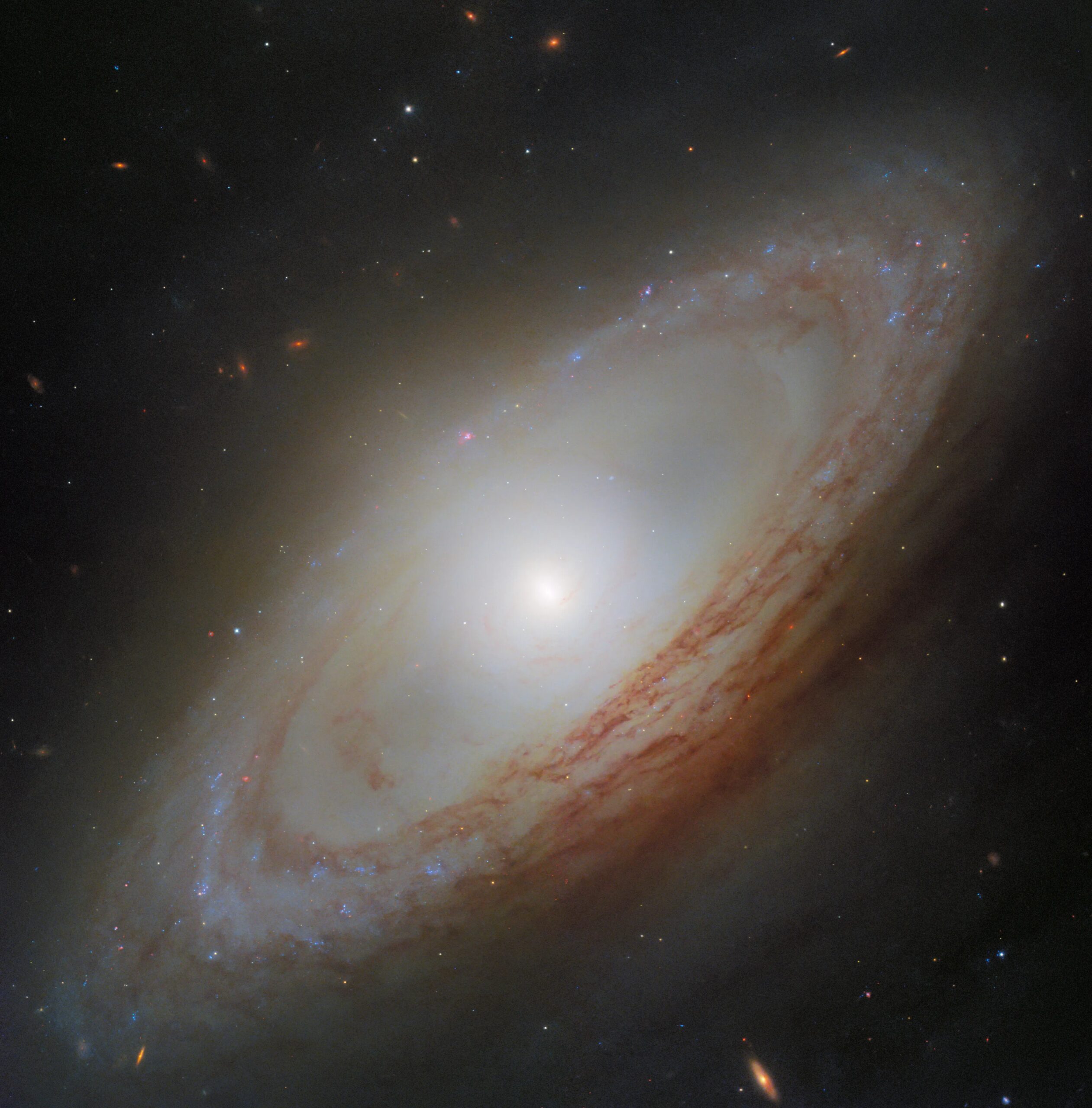
Hubble Reveals NGC 4698, a Spiral Galaxy with a Twisted Center
A new image from NASA and ESA’s Hubble Space Telescope reveals the unusual structure of NGC 4698, a spiral galaxy located approximately 55 million light-years away in the constellation Virgo. Although the galaxy appears calm, it contains a chaotic secret: its central bulge and inner disk are oriented at right angles to the rest of the galaxy.
NGC 4698 is one of more than 1,000 galaxies in the Virgo Cluster, the closest large cluster of galaxies held together by gravity. Like the Milky Way, it has a thin disk of stars, gas, and dust surrounded by spiral arms. The arms contain clumps of opaque brown dust and small clusters of bright blue stars.
A spiral galaxy with unusual arms
Unlike many spiral galaxies, NGC 4698’s delicate arms are most visible in the outer regions of its disk. Rather than winding toward the bright center, the arms appear to move away from it and form a ring-like structure around the galaxy.
At the heart of NGC 4698 is an elongated galactic bulge. Its diffuse, off-white glow comes from smaller, older, and cooler stars than the giant blue stars scattered across the galaxy’s outer disk. These densely packed stars orbit a supermassive black hole containing millions of times the mass of our Sun. Scientists have found signs that the black hole is actively growing as its gravity draws gas inward.
A galactic bulge turned on its side
With its flat, star-filled disk and glowing center, NGC 4698 resembles a typical spiral galaxy. However, it is one of the few known spiral galaxies with a bulge extending at right angles to its disk.
The unusual structure is faintly visible in this Hubble image as the ghostly glow of a stellar bulge extending above and below the dusty disk. Stars and gas near the galaxy’s center also rotate perpendicularly to the rest of the disk, leaving the two regions seemingly out of sync.
Did a galactic merger create the strange structure?
Astronomers believe the cause may lie outside NGC 4698 itself. If the galaxy pulled in gas from an external source, that newly acquired material could have formed a disk of gas and stars at an angle to the original disk.
Some observations suggest that NGC 4698 may once have experienced a small galactic merger. Short “tails” of hydrogen flowing from one side of the galaxy provide evidence that such an interaction may have occurred.
Studying galaxies in the Virgo Cluster
The data used to create this image came from an observation program focused on galaxies in the Virgo Cluster. The program examines details in relatively nearby galaxies, including individual star clusters and nebulae.
Researchers will also use these observations to develop a broader understanding of how a galaxy’s journey through a galaxy cluster affects its evolution and its ability to form new stars.
Text credit: ESA/Hubble
Media contact:
Claire Andreoli
NASA’s Goddard Space Flight Center, Greenbelt, Maryland
[email protected]
Source: science.nasa.gov