


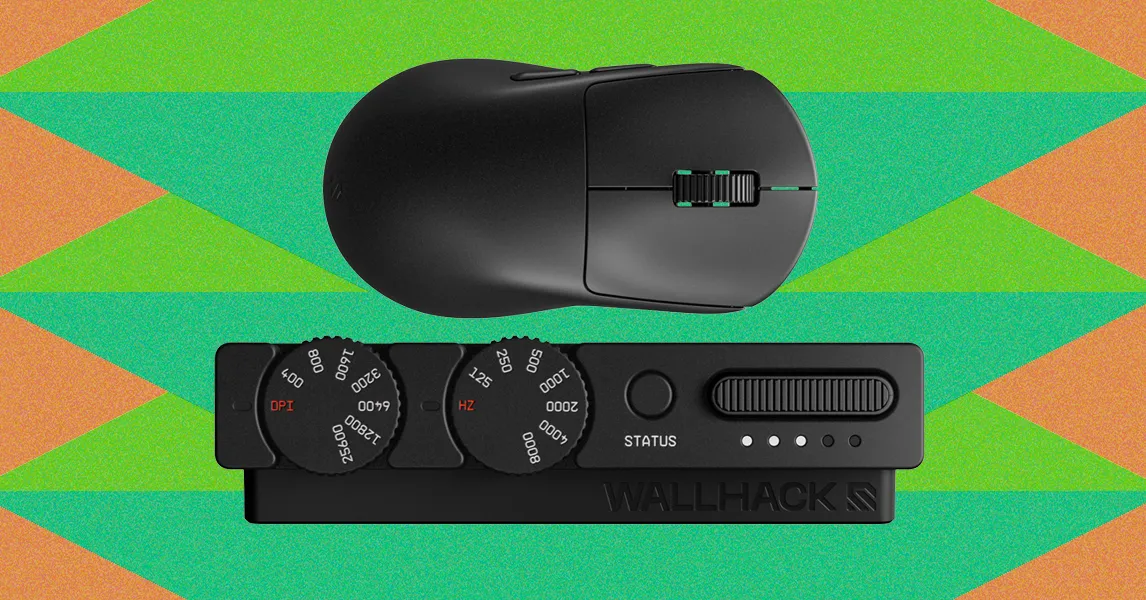
Wallhack’s M-001 mouse takes an unusual approach to both structure and power: its printed circuit board forms part of the chassis, while a spring-loaded, hot-swappable battery replaces the usual USB-C charging port. The design exposes the electronics beneath the mouse, and its substantial wireless dongle includes dedicated controls for DPI and polling rate.
An exposed structural design
Turn the mouse over and one of its most atypical design decisions becomes clear: it has no conventional bottom shell. Instead, a thin frame surrounds the mouse and holds its six feet in place, leaving a gap that exposes the entire PCB and battery.
Notably, the PCB functions as the mouse’s main structural component rather than simply sitting inside a separate shell. Similar approaches are used in the design of supercars and sportsbikes. The Ferrari F50, for example, uses its engine block as a stressed member to add stiffness throughout the car, a technology Ferrari borrowed from its Formula 1 team.
Using the PCB this way can improve stiffness while reducing weight. It also makes the electronics visible when the mouse is turned over, allowing the entire circuit board to be seen.
A satisfying hot-swappable battery
Behind the PCB is the M-001’s hot-swappable battery. Several mice use removable batteries, but the M-001’s replacement mechanism is particularly distinctive. Rather than relying on magnets or a rotating lock, the battery uses a custom spring-loaded ejector similar to the mechanisms found in SD cards and Nintendo Switch cartridges.
To install the battery, push it into place until it clicks. The same action removes it: push the battery in until it clicks, and it pops out slightly so it can be pulled free. Among the mice tested with removable batteries, this mechanism is especially intuitive, enjoyable to use, and sturdy.
The system also involves trade-offs. Hot-swappable batteries can provide effectively unlimited battery life, provided the depleted battery is connected to the dongle for recharging when it is replaced. Because of this, Wallhack removed the mouse’s USB-C port entirely. The M-001 works only as a 2.4-GHz wireless mouse; it cannot be connected directly by cable or charged through the mouse.
That limitation was not a major issue with a fully charged spare battery available for replacement. In theory, removing additional components between the antenna and receiver could also improve connection quality. However, if the battery runs out and the dongle is lost or breaks, there is no alternative way to use the mouse.
A more substantial dongle
The dongle has been a recurring weakness of high-polling-rate mice. High polling rates require the receiver to remain nearby, which generally means placing a small receiver on the desk. These devices often include only one or two connection points and perhaps a few LED indicators—typically one to three—to show battery life, connection quality, or other settings.
They are usually small and light enough to slide around the desk. The tension from their cable can also pull them out of position, sometimes sending them behind the desk.
The M-001 addresses most of these problems with a dongle that has a more deliberate purpose and physical presence. Instead of the small, utilitarian receiver many manufacturers provide, Wallhack has created a substantial industrial design: a medium-sized metal wedge with the same gunmetal-gray finish as the mouse.
Its front includes two camera-like dials, buttons, and a slot for a rechargeable battery. The DPI dial is numbered from 400 to 25,600, while the polling-rate dial covers 125 Hz to 8,000 Hz.
Source: www.wired.com