


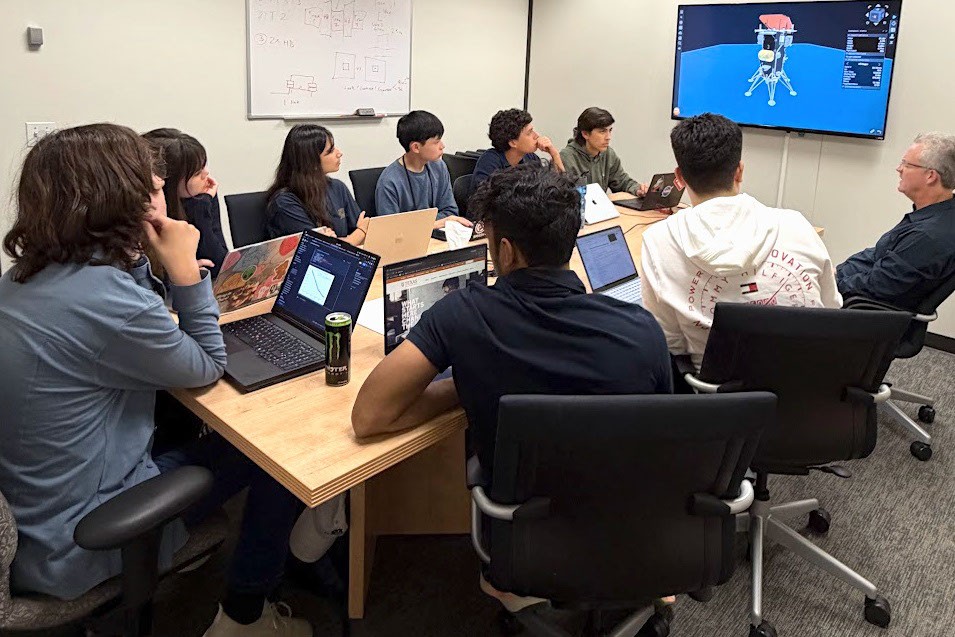
The University of Texas Space Research Center’s NASA STEM Earth Science Enhancement (SEES) Internship Program gave high school students the opportunity to study how spacecraft can measure propellant in microgravity. In summer 2026, the SEES Mission Architecture Tools for Research, Integration, and Exploration (MATRIX) team developed a model to predict when Modal Propellant Gauging (MPG) could produce reliable fuel-mass measurements during Intuitive Machines’ planned IM-3 lunar mission.
In microgravity, liquid propellant clings to the walls of a tank rather than settling at the bottom, making its mass difficult to determine. This is a central challenge for NASA’s Artemis program and future lunar operations.
Using sound to measure propellant
The MATRIX team was mentored by Dr. Kevin Crosby. Crosby and colleagues at NASA developed the Modal Propellant Gauging approach at Carthage College in Kenosha, Wisconsin. MPG estimates the amount of fuel in a tank by analyzing the tank’s acoustic response.
The method has been used successfully in several spaceflight experiments and is scheduled for a demonstration on Intuitive Machines’ IM-3 mission. The IM-3 lander, Trinity, is scheduled to land on the Moon in the Liner Gamma region in 2027. The student team developed a model to predict when MPG could obtain reliable measurements during the mission, giving the interns practical experience with techniques used in spaceflight and lunar operations.
Reconstructing lunar missions from public data
The MATRIX team relied entirely on publicly available information, including mission data released by Intuitive Machines. NASA’s Jet Propulsion Laboratory Navigation and Ancillary Information Facility (NAIF) provided detailed orbital records for the IM-1 and IM-2 missions.
By comparing the reconstructed flight path of the IM-2 spacecraft with a kinematic model that did not include engine thrust, the researchers identified engine burns and estimated the change in velocity produced by each burn.
Because IM-3’s complete trajectory is not publicly available, the team used flight data from IM-1 and IM-2 to create a reconstruction algorithm. The students also ran computational fluid dynamics (CFD) simulations to estimate propellant slosh inside the tank and used Monte Carlo simulations to model the possible range of propellant states.
Identifying measurement opportunities
The team’s analysis indicated that MPG could take reliable measurements during two major burns: lunar orbit insertion (LOI) and powered descent. In some cases, measurements could also be possible during descent orbit insertion.
The spacecraft’s starting mass had the greatest effect on the length of each measurement window. The MATRIX team also identified potential IM-3 launch opportunities in 2027 and conducted a landing-site analysis for Liner Gamma, showing the distribution of possible landing sites near the target area.
Presenting the research
The team briefed Intuitive Machines’ advocacy group, explained its methods and findings to engineers, and demonstrated that a rigorous analysis of an active lunar mission can be built using publicly available data.
The students presented their research, “A Computational Model for Estimating the Modal Propellant Gauge (MPG) Window on the Intuitive Machines IM-3 Mission,” at the SEES Annual Symposium and the Wisconsin Space Grant Consortium Annual Conference. The team plans to present the work again at the American Geophysical Union (AGU) annual meeting in San Francisco in December 2026.
“In less than a month, this team of high school students developed a deep understanding and competency in advanced techniques comparable to that of advanced graduate students in the field,” Crosby said. “Their work product was exceptional, and their presentation to Intuitive Machines engineers impressed everyone with the sophistication and creativity of their work. The SEES program has consistently provided a unique environment for students to demonstrate that they can achieve more than what is asked of them, even in cutting-edge classes.”
The SEES program gives 11th- and 12th-grade students hands-on experience with the data, tools, and analytical techniques used throughout the aerospace industry. By applying NASA and commercial mission data to an active lunar mission, the MATRIX team contributed analyses related to propellant management, in-space refueling, fuel depots, and the capabilities needed for sustained exploration of the Moon and beyond.
SEES Mission Architecture (MATRIX) team
Lyimbek Abdikalikov, The Woodlands, Texas
Emmanuel Bravo, Boca Raton, Florida
Winston Huang, San Francisco, California
Adriana Krajinovic, Dallas, Texas
Marco Lo Cicero, Tomball, Texas
Henry Martin, Milwaukee, Wisconsin
Reba Paul, Bethlehem, Pennsylvania
Swayam Sahoo, North Chelmsford, Massachusetts
Project mentor: Dr. Kevin M. Crosby, University of Carthage and Wisconsin Space Grant Consortium
Project assistant: Mauro Esquivel, mathematics teacher, McAllen, Texas
The SEES project is supported by NASA Cooperative Agreement Award Number NNH15ZDA004C and is part of the NASA Science Activation Program portfolio, which connects learners with authentic NASA science experiences through partnerships with educators and community organizations.
Source: science.nasa.gov