


New research led by scientists at the University of Lethbridge has revealed the most detailed picture yet of the dodo’s sensory abilities. The study suggests that the extinct flightless bird (Raphus cucullatus) had a complex sensory world and may have been active at dawn, dusk or even at night—challenging its long-standing reputation as a “stupid bird.”
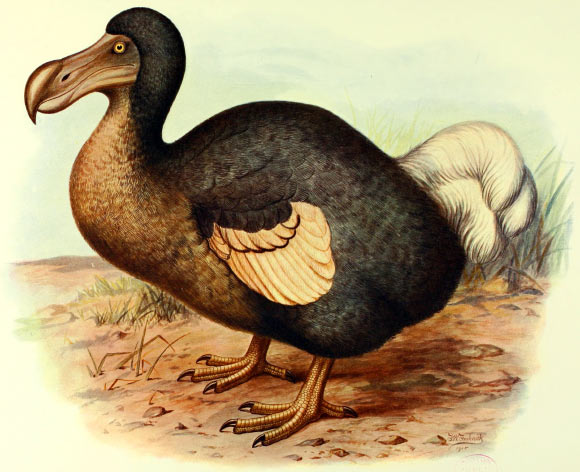
The dodo (Raphus cucullatus) by Frederick William Frohawk, 1905.
The dodo and its close relative, the Rodrigues Solitaire (Pezophaps solitaria), are among the best-known examples of human-caused extinction. Both flightless island birds disappeared after human activity and introduced animals severely affected their native ecosystems.
Despite their importance in science and popular culture, relatively little is known about how these extinct birds lived, behaved and interacted with their surroundings.
“Few animals symbolize human impact on nature as intensely as the dodo,” said University of Lethbridge Ph.D. student Sara Citron and her colleagues.
“Endemic to Mauritius, the flightless dodo generated interest in humanity’s role in extinction and helped pave the way for the emergence of conservation biology.”
“Extensive research on the dodo has produced insights into—and ongoing debate about—many aspects of its biology.”
“However, much of this knowledge was established after the species disappeared in the late 17th century. Although the dodo survived the arrival of humans on Mauritius for several decades, only limited and often inaccurate observations of its behavior and ecology were recorded while it was alive, and no skins were preserved.”
“Based on historical accounts, the dodo probably nested on the ground and showed little fear of humans. This behavior is common among island species that evolved without mammalian predators and contributed to the unfair portrayal of the dodo as ‘stupid.’”
“Notably, this description was never applied to the dodo’s closest relative, the Rodrigues Solitaire, which became extinct around 1761,” they added.
“Because of accounts written by François Leguat in 1691–93 and Julien Tafforet in 1725–26, both of whom were marooned on Rodrigues, the behavior of the Solitaire is much better documented than that of the dodo.”
“Their descriptions of the Solitaire’s intense aggression toward members of its own species—and potentially other species—may have spared it from being given the same inaccurate reputation as the dodo.”
For the new study, the researchers compared CT scans of dodo and Rodrigues Solitaire skulls with scans from 36 living pigeon and dove species. They examined the birds’ eye sockets, nerve openings and three-dimensional brain reconstructions known as endocasts.
The results reveal important differences between these closely related extinct island birds and provide new clues about dodo behavior, vision, hearing and smell.
The Rodrigues Solitaire, once considered a giant version of a pigeon, was found to have sensory systems broadly similar to those of its living relatives, apart from its unusual skull shape.
The dodo, by contrast, displayed a distinctive combination of sensory features. Its optic lobes—the brain regions responsible for processing visual information—were more than three times smaller relative to brain size than those of the Nicobar pigeon, the dodo’s closest living relative.
This reduced visual-processing region is more commonly associated with some nocturnal birds than with daytime-active pigeons. The finding suggests that the dodo may have been most active during the early morning, evening or nighttime rather than exclusively during daylight hours.
“We suspected that dodos were better adapted to seeing in darker conditions,” said Flinders University Professor Vera Weisbecker.
“They had slightly larger eyes but unusually small optic lobes, a region of the brain involved in processing visual information.”
“This could mean that their visual abilities were more limited because smaller optic lobes may indicate that light signals reached the brain through fewer nerves.”
“We see similarly small optic lobes in several nocturnal birds, including the elusive Australian night parrot and New Zealand kakapo. These species rely less on vision and are active mainly at night.”

Restoration of the Rodrigues Solitaire, a flightless member of the pigeon order endemic to Rodrigues, Mauritius (Frederick William Frohawk, 1907)
The dodo also appeared to have enlarged olfactory bulbs compared with other pigeons, suggesting that its sense of smell may have been particularly well developed.
The researchers also identified signs of an enlarged trigeminal nerve near the beak. This nerve carries touch sensations from the face and may have been linked to the dodo’s unusually large upper bill.
Importantly, the scientists found no evidence that the dodo had a reduced brain region associated with cognition. This finding challenges the idea that the bird’s calm behavior around humans reflected low intelligence.
Measurements of the birds’ inner-ear structures also suggest that both the dodo and Rodrigues Solitaire may have communicated using unusually low-frequency sounds.
“There is no evidence that the dodo was any less intelligent than its relatives—and we know that pigeons are quite intelligent,” said University of Lethbridge researcher Dr. Andrew Iwaniuk.
“The dodo has an exceptionally unusual skull with a strangely domed head, but the part of its brain associated with cognition was exactly the size expected for a bird of its body size.”
“These gentle birds may have been highly social. Like many island species, they evolved in an environment without mammalian predators and may simply have had no reason to develop fearful behavior,” Citron added.
“Calling them ‘stupid’ because they were naive makes it sound as though they deserved to become extinct, which is profoundly unfair.”
“We are quite confident that dodos were active at dawn, dusk or during the night, which would make them the only known nocturnal pigeon in the world.”
“This behavior may have given the dodo an advantage over the many strictly daytime-active turtles that lived on Mauritius.”
“At night, the bird may have avoided competition for food with other species, including the island’s numerous turtles.”
“The dodo’s skull differs from that of every living bird, making it both fascinating and difficult to interpret.”
“By comparing digital reconstructions of the world’s only two complete dodo skulls, we now have a much stronger basis for determining which features are characteristic of the species and what they reveal about how the dodo lived,” said Dr. Christy Anna Hipsley, a researcher at the Natural History Museum Denmark.
“This study provides an important new framework for understanding the dodo’s behavior, sensory biology and ecology,” said Dr. Peter Andrew Hosner, also from the Natural History Museum Denmark.
“The dodo has become a symbol of extinction, but in many ways it remains surprisingly mysterious.”
“Every new piece of evidence helps us move beyond myths and develop a more accurate picture of how this extraordinary bird lived before it disappeared.”
The team’s results were published on August 5, 2026, in the Zoological Journal of the Linnean Society.
_____
Sara Citron et al. 2026. The sensory world of the Dodo and Solitaire revealed by endocast and skull anatomy. Zoological Journal of the Linnean Society 207 (4): zlag123; doi: 10.1093/zoolinnean/zlag123
Source: www.sci.news