


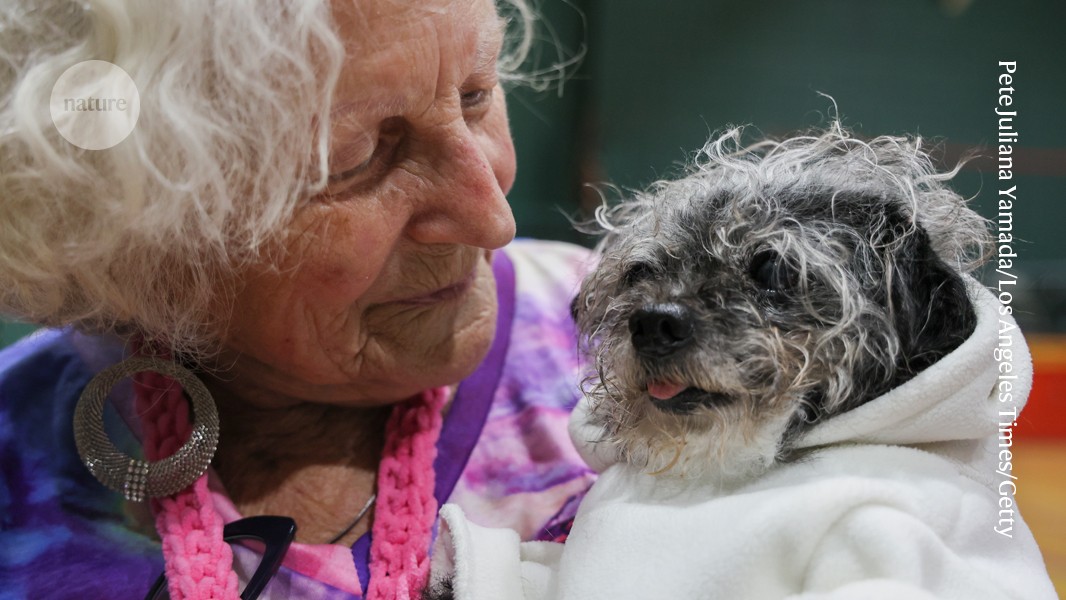
In addition to humans, gene therapy to extend lifespan is also being studied in dogs. Credit: Juliana Yamada/Los Angeles Times/Getty
Scientists and companies are increasingly exploring ways to extend the healthy lives of pets, from probiotic treatments and repurposed human drugs to gene therapies for dogs. The growing field was highlighted earlier this month at the first Animal Longevity Summit in Toronto, Canada, where aging researchers met with developers working on canine cancer treatments, cat medicines, pet cryopreservation and other technologies.
Vera Gorbunova, an aging researcher at the University of Rochester in New York, has attended many longevity conferences during her decades of research. But the Toronto meeting was unlike any she had seen before, in part because several dogs joined the scientists from academia and industry.
“It may have been a slightly different group of people than you would see at a typical seniors’ conference,” Gorbunova said.
The small, inaugural summit brought together researchers studying aging in different animal species and teams working on canine cancer, axolotl regeneration and the genetics of mammals that thrive in extreme environments. Participants also included companies developing gene therapies for dogs, probiotic pellets for cats and methods for cryopreserving pets.
This interest reflects the size and potential growth of the market. Cameron Hurlbert, a senior analyst at AniVC, a venture capital firm in Miami, Florida, said that the large investments directed towards extending healthy human lives could encourage similar work in pets. The US pet and animal health market is estimated to be worth US$150 billion and is likely to grow as more people in the United States buy pet health insurance, he said.
New treatments for aging pets
Most current efforts to extend pets’ healthy lifespans focus on diet, including probiotic preparations, Hurlbert said. For medicines, many companies are looking to repurpose drugs that have already been approved for humans rather than developing entirely new treatments.

Large dogs age faster than small dogs – a rogue ‘jump gene’ may be to blame
Not every company is following that route. The Cat Health Company, based in Bucharest, has announced plans to identify new drugs for age-related diseases in cats, including sarcopenia, a muscle-wasting condition, and kidney disease. Alex Batisha, the company’s co-founder and chief operating officer, said it currently has two compounds in clinical trials, with others also in clinical trials.
Gene therapy for dogs
Several companies are pursuing gene therapy. Rejuvenate Bio, a biotechnology company in San Diego, California, is developing a treatment for mitral valve disease, the most common heart disease in dogs. Noah Davidson, the company’s co-founder and chief scientific officer, said this is only the therapy’s first potential use. He hopes it could eventually be used to treat metabolic syndrome and extend lifespan. Rejuvenate is also working to reduce the manufacturing costs of gene therapy, a complex treatment, to levels compatible with the pet market.
Genflow Biosciences is developing a gene therapy intended to extend dogs’ longevity and reduce sarcopenia. If the drug is successful, the company hopes to sell it to a larger animal-drug company and use the proceeds to fund research into the same approach in humans, said Eric Leire, the Brussels-based company’s founder and chief executive.

How aging changes our genes — vast epigenetic atlas gives clearest picture yet
Academic researchers could also benefit from working with startups, said Noah Snyder Mackler, a comparative aging scientist at Arizona State University in Tempe. Government funding for dog research often prioritizes findings that can be applied to human health rather than treatments for dogs, leaving academic researchers dependent on industry partnerships to pursue canine-focused interventions.
“We don’t have the resources to follow up on dog-centered interventions,” said Snyder Mackler, a researcher with the Dog Aging Project, a large collaboration studying aging in dogs.
Gorbunova said she welcomed the meeting. “It was a revelation to me to see how much people care about extending the lifespan of their pets,” she said.
Source: www.nature.com