


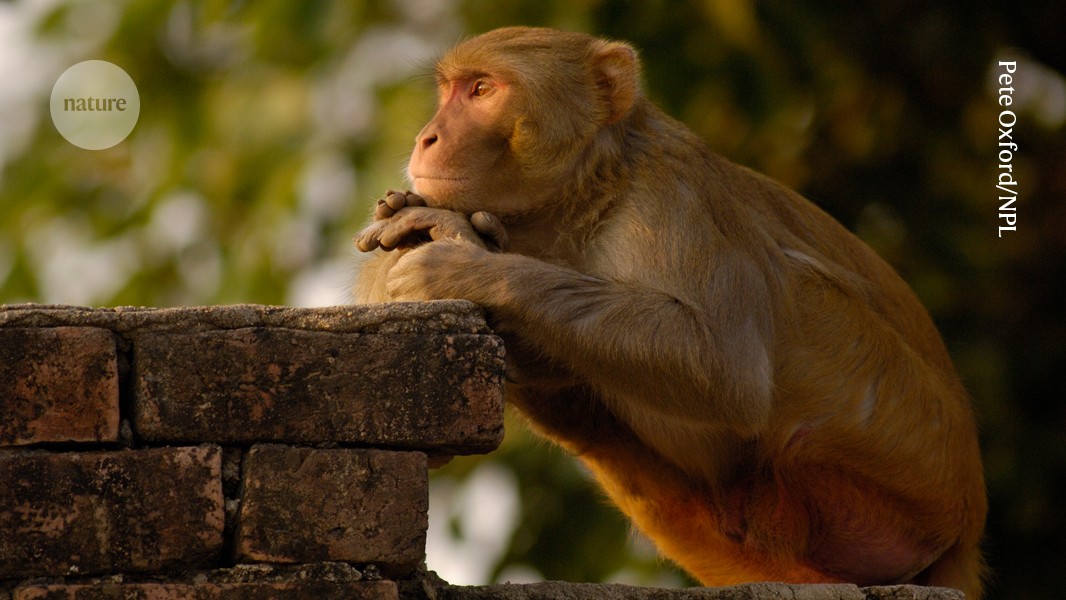
A study by neuroscientist Doris Tsao and her colleagues has found that a macaque monkey’s brain strongly represents images that the animal is not consciously aware of. By decoding neural activity, the researchers reconstructed both the image the monkey was consciously seeing and another image that was visible to its eyes but outside its awareness. The findings, which have not yet been peer-reviewed, could help scientists investigate how the brain generates consciousness.
“The reaction to the preprint was surreal,” says Tsao, who is based at the University of California, Berkeley. She explained the study on social media on 17 October. After 10 days, her summary had received more than 2 million views and 11,000 likes.
The research, posted on bioRxiv1, examined the brain of a macaque during a visual-perception experiment. Using only the monkey’s neural activity, Tsao’s team was able to reconstruct with high fidelity not only the images the monkey was consciously seeing, but also images that were directly in front of its eyes yet had escaped conscious awareness.
Previous studies in monkeys had detected only weak neural responses to content of which the animals were unaware. “It’s very surprising to discover this strong signal that is not consciously perceived,” Tsao says. She was also surprised that the study found brain activity switching between patterns associated with conscious and unconscious processing several times per second.
Scientists who study consciousness were intrigued by the research and praised its rigorous methods. Others, however, suggested that the attention it received on social media was excessive. “This is an interesting little flurry of papers,” says John Sekhon, a cognitive neuroscientist at the University of California, Los Angeles. “But some of the findings were not completely unexpected.”
Unseen and unnoticed
Imagine looking through binoculars that show a different image to each eye. Rather than perceiving a combination of the two images, people typically perceive only one image at a time. This phenomenon, known as binocular rivalry, is important in consciousness research because it allows scientists to study what happens in the brain when an image enters conscious awareness.
Tsao and her team investigated this phenomenon in monkeys by showing them an image of a face in one eye and, seconds later, an image of another face in the other eye. In the equivalent experiment involving humans, participants shown both images would be expected to report seeing only the second image. Researchers believe that monkeys experience the same effect.
The researchers recorded activity in two brain regions known to be involved in face recognition: the inferotemporal cortex and the prefrontal cortex.
They first showed the monkeys both faces simultaneously, allowing the team to identify the distinct patterns of neural activity produced by each image. The researchers then began the experiment by presenting the first image to one eye. When the second image was introduced to the other eye, the monkey’s brain activity rapidly switched between the two neural patterns, at a rate of 15 times per second.
Source: www.nature.com